


r25C PT
r25C PT
Catalog excerpts
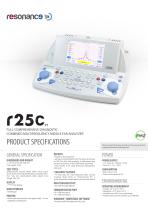
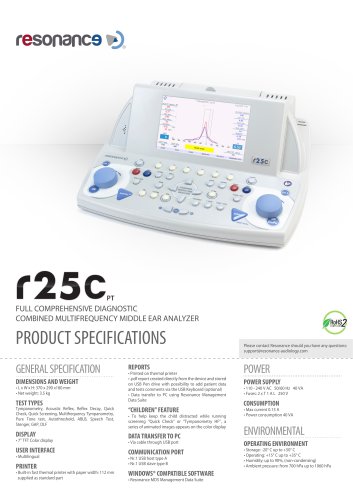
Please contact Resonance should you have any questions: [email protected] FULL COMPREHENSIVE DIAGNOSTIC COMBINED MULTIFREQUENCY MIDDLE EAR ANALYZER Tympanometry, Acoustic Reflex, Reflex Decay, Quick Check, Quick Screening, Multifrequency Tympanometry, Pure Tone test, Autothreshold, ABLB, Speech Test, Stenger, GAP, DLF • Built-in fast thermal printer with paper width: 112 mm supplied as standard part • Printed on thermal printer • .pdf report created directly from the device and stored on USB Pen drive with possibility to add patient data and tests comments via the USB Keyboard (optional) • Data transfer to PC using Resonance Management Data Suite • To help keep the child distracted while running screening “Quick Check" or “Tympanometry HF", a series of animated images appears on the color display • Via cable through USB port • Resonance MDS Management Data Suite
Open the catalog to page 1
TYMPANOMETRY OPERATING AUDIOMETRY OPERATING COMPLIANCE/REGULATORY SPECIFICATIONS SPECIFICATIONS STANDARDS • 1000 Hz for Admittance (Y) curve tympanometry with added Susceptance (B) and Conductance (G) curves. • Harmonic distortion: Less than 1% ADMITTANCE MEASUREMENTS • Sensitivity scale: Auto Scales to appropriate range, available scale at 226 Hz 1.5, 2, 5 and 7 ml • HF Sensitivity scale: Auto Scales to appropriate range, available scales for 678, 800 and 1000 Hz: 5, 10, 15, 20, 25 mmho • Control: Automatic • Range: from +200 up to -400 daPa adjustable in 50 daPa steps • Pressure accuracy: +/-...
Open the catalog to page 2All Resonance catalogs and technical brochures


Archived catalogs
 RESONANCE LITE line
1 Page


- Medical video endoscope
- SEBA hearing assessment system
- Screening audiometer
- Video otoscope
- Diagnostic audiometer
- Medical video endoscope with speculum
- Video otoscope with speculum
- Acoustic reflex tester
- OAE screening system
- Clinical diagnostic audiometer
- Diagnostic tympanometer
- Screening tympanometer
- Clinical diagnostic tympanometer