


TIGA

TIGA
Catalog excerpts

User Manual
Open the catalog to page 1
T1GA User Manual | Thank you We hope the product and service you have received has met your expectations. Please take time to read the instructions contained within, to familiarise yourself with your new RGK chair and to ensure you get maximum performance and Russel Simms, Greg Eden, Commercial Director Do not operate this equipment without first reading and understanding this manual. If you are unable to understand the warnings and instructions, contact a healthcare professional (doctor /therapist) before attempting to use this equipment - otherwise injury or damage may result. Need replacement...
Open the catalog to page 2
TIGA User Manual | Contents User Manual Contents Special Notes Safety Summary Product Description Production Identification Tilting Tilting Unattended Safety Inspection Checklist Troubleshooting / Maintenance Procedure 7 Replacing Front Fork Assembly & Castors Wheels Procedure 8 Wheel Locks Adjusting / Replacing Wheel Locks Procedure 9 Footrest Standard Footrest Adjustment / Replacement Installing / Adjusting Optional Angle Adjustable Footrest Procedure 10 Folding and Unfolding the backrest Procedure 11 Adjusting Height Adjustable Stroller Handles: Fold Down Pushing Handles and Screw In Pushing...
Open the catalog to page 3
TIGA User Manual | Special Notes Special Notes The manual must be read thoroughly to avoid damage when handling and using your RGK Wheelchair. Definitions of words used in this manual Wheelchair Selection Advice to the user of a Potential Risk of injury if the advice is not followed. Advice to user that Potential Damage to equipment may occur if the advice is General advice or best practice As a manufacturer of wheelchairs, RGK endeavours to supply a wide variety of wheelchairs to meet many needs of the end user. However, final selection of the type of wheelchair to be used by an individual rests...
Open the catalog to page 4
T1GA User Manual | Safety Summary Safety Summary Wheelchair tie-down restraints and seat restraints. RGK recommends that wheelchair users not be transported in vehicles of any kind while in wheelchairs. It is RGK's position that users of wheelchairs should be transferred into appropriate seating in vehicles for transportation and use be made of the restraints made available RGK cannot and does not recommend any wheelchair transportation systems. As regards restraints-seat belts, it is the obligation of the dealer, therapists and other health care professionals to determine if a seating restraint...
Open the catalog to page 5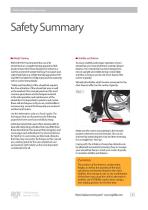
T1GA User Manual | Safety Summary Safety Summary ►Weight Training RGK DOES NOT recom mend the use of its wheelchairs as a weight training apparatus. RGK products have NOT been designed or tested as a seat for any kind of weight training. If occupant uses said wheelchair as a weight training apparatus, RGK shall NOT be liable for bodily injury and the warranty will be voided immediately. "Safety and Handling"ofthe wheelchair requires the close attention of the wheelchair user as well as the assistant. This manual points out the most common procedures and techniques involved in the safe operation...
Open the catalog to page 6
TIGA User Manual | Product Description RGK TIGA Manual Propelled Wheelchair Product Description TIGA manually propelled wheelchair combines the bespoke, personal values and perfection. Chair is suitable for a wide range of users whose mobility has been reduced or removed by a disability or chronic illness. The TIGA is hand built from aerospace grade aluminium. Two frame design options are available either open frame or closed frame design, delivering a lightweight and versatile chair. It is the ultimate lightweight wheelchair with its smooth clean curves and a simplistic design make it the perfect...
Open the catalog to page 7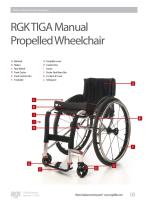
T1GA User Manual | Product Description RGKTIGA Manual Propelled Wheelchair E Front Castor Forks J Under Seat Brace Bar Need replacement parts? www.rgklife.com
Open the catalog to page 8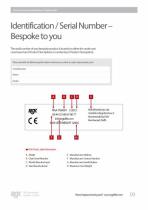
Identification / Serial Number- The serial number of your bespoke product 5 kxated c*i erthei the under seal cross brace bar (I Product CtetnpOon) or cumber bar (J Produa Description), m ti&K Oulr Ubri information F Manulact urp r Contact Numbcf Need replacement parts' wvifwjgkbfecom
Open the catalog to page 9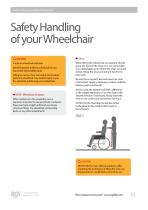
T1GA User Manual | Handling of Wheelchairs Safety Handling A note to wheelchair assistants DO NOT attempt to lift the wheelchair by any removable (detachable) parts. Lifting by means of any removable (detachable) parts of a wheelchair may result in injury to you the assistants and damage your wheelchair. ^NOTE - Wheelchair Assistants When assistance to the wheelchair user is required, remember to use good body mechanics. Keep your back straight and bend your knees whenever tilting the wheelchair or traversing kerbs, or any other impediments When tilting the wheelchair, an assistant should grasp...
Open the catalog to page 10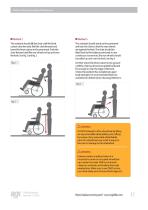
T1GA User Manual | Handling of Wheelchairs The assistant should tilt the chair until the front castors clear the kerb. Roll the chair forward and lower the front castors to the pavement. Push the chair forward until the rear wheels roll up and over The assistant should stand on the pavement and turn the chair so that the rear wheels areagainstthe kerb.The chair should be tilted back to the balance point and, in one continuous movement, the rear wheels should be pulled up and over the kerb. See fig 4. DO NOT return the front castors to the ground until the chair back has been pulled backward far...
Open the catalog to page 11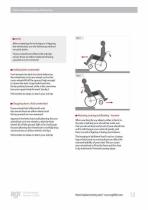
After mattering the techniques of tipping the wheelchair, use the following method I If your wheelchair H fitted with *r*>ups ensure these *m cither rotated and being upwaidsoreven removed •Tackling Kerbs unattended Push towards the kerb, lean iMckbalancmg th* wheelchair onittrear whetfs solluf the castor wheebfch ort the ground high enough to clearer tin* kerb Oraspboth kind firm firmry pushing forward, while at the KMC IKW m Dropping down 4 Kerb unblended If yowrwheekKsu is fined with iinh tips unsure t liew aie either rotated and lacing upwards or even removed. Approach the kerb lean back...
Open the catalog to page 12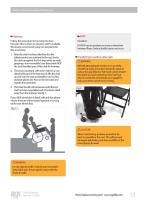
Follow this procedure for moving the chair between floors when an elevator is NOT available. We always recommend using two assistants for this procedure. 1. After the chair has been tilted backto the balance point, one assistant (in the rear) backs the chair up against the first step, while securely grasping a non-removable (non-detachable NOT the push handles) part of the chair for leverage. 2. The second assistant with a firm hold on a non- detachable part of the framework, lifts the chair up and over the stair and steadies it as the first assistant places one foot on the next stair and 3....
Open the catalog to page 13


