


920i and 1280 Comparative Matrix
1 / 1 PageView full catalog
920i and 1280 Comparative Matrix
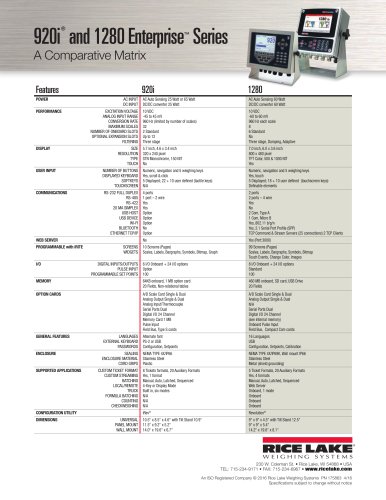
Product catalog summary
Overview: This document provides a comparative analysis of the 920i and 1280 Enterprise Series weighing systems by Rice Lake Weighing Systems. It outlines specifications, features, and capabilities of both models.
Power Input: Both models offer AC auto-sensing and DC/DC converter options, with the 920i supporting 25 or 65 Watt and the 1280 supporting 60 Watt.
Performance: Both models provide a 10 VDC excitation voltage. The 920i supports an analog input range of -45 to 45 mV and a conversion rate of 960 Hz, accommodating up to 32 scales. The 1280 supports a range of -60 to 60 mV, with a conversion rate of 960 Hz per scale, and supports up to 8 scales.
Display: The 920i features a 5.7-inch monochrome display, while the 1280 offers a 7.0-inch color TFT display with touchscreen capabilities.
User Input: Both models include numeric, navigation, and weighing keys. The 920i uses tactile keys, while the 1280 features a touchscreen interface.
Communications: The 920i supports multiple RS ports and optional USB and Ethernet connections. The 1280 includes USB host/device, Wi-Fi, Bluetooth, and Ethernet TCP/IP with web server capabilities.
Programmability: The 920i supports 10 programmable screens, while the 1280 supports 99 screens with advanced widget options.
I/O and Memory: The 920i offers 6 onboard I/O with options for 24 more, while the 1280 provides 8 onboard I/O. The 920i has 64KB onboard memory, expandable to 1 MB, whereas the 1280 includes 460 MB onboard memory.
Enclosure and Applications: Both models feature stainless steel enclosures with different sealing standards. The 920i supports various applications like custom ticket formats and batching, while the 1280 offers additional functionalities like onboard counting and checkweighing.
Dimensions: The document provides detailed dimensions for universal, panel, and wall mount configurations for both models.
See more
Catalog excerpts

920i and 1280 Enterprise™ SeriesA Comparative Matrix Features 920i WEIGHING SYSTEMS 230 W. Coleman St. • Rice Lake, WI 54868 • USA TEL: 715-234-9171 • FAX: 715-234-6967 • www.ricelake.com An ISO Registered Company © 2016 Rice Lake Weighing Systems PN 175863 4/16 Specifications subject to change without notice
Open the catalog to page 1All Rice Lake catalogs and technical brochures
 Equipoise Compact Balance
2 Pages
 CW-90
CW-902 Pages
 882IS Performance Series
4 Pages
 120 Digital Weight Indicator
2 Pages
 Load Cell and Weigh Module Handbook
114 Pages
 Overhead Weighing Catalog 2025
228 Pages
 Precision Solutions June 2025
292 Pages
 Load Cell Guide, June 2025
388 Pages
 Master Catalog June 2025
980 Pages
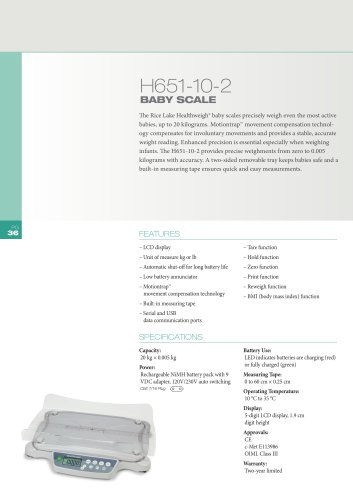 H651-10-2 BABY SCALE
2 Pages

*Prices are pre-tax. They exclude delivery charges and customs duties and do not include additional charges for installation or activation options. Prices are indicative only and may vary by country, with changes to the cost of raw materials and exchange rates.