
- Catalogs
- Rigaku Corporation
- XtaLAB Synergy-S


XtaLAB Synergy-S
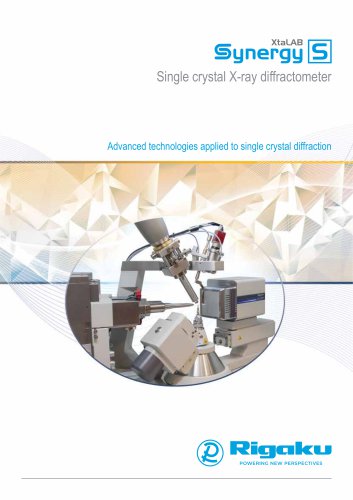
XtaLAB Synergy-S
- User-Inspired Software: The CrysAlisPro software integrates new goniometer features to enhance speed and throughput.
- Advanced X-ray Sources: PhotonJet-S microfocus X-ray sources offer extended tube life and increased flux.
- Detector Technology: The HyPix-6000HE detector provides low noise and a high dynamic range for accurate measurement of both weak and strong reflections.
- Goniometer Design: Enhanced motor speeds and a telescoping 2θ arm improve data collection efficiency.
- Safety and Accessibility: The enclosure adheres to stringent X-ray safety guidelines while providing ample workspace.
- Gap-Free Reciprocal Space: Efficient strategy algorithms and hardware capabilities address data collection gaps.
- Importance of Weak Data: Accurate measurement of weak reflections is crucial for refined structure analysis, supported by the detector's high Detective Quantum Efficiency (DQE).
- Detector Selection: HPC detectors are critical for low noise and high dynamic range.
- Beam Conditioning: A variable slit assembly optimizes divergence, enhancing resolution and data collection efficiency.
- Unique Benefits: Features include new microfocus sources, dual-source configurations, and a user-friendly cabinet design.
- CrysAlisPro Software: Provides a multi-threaded environment for efficient data collection and processing, with modes for small molecule and macromolecular experiments.
- "What Is This?" Feature: Enables rapid data set collection and structure determination, delivering results in minutes for well-diffracting crystals.
- Improved Data Quality and Speed: The XtaLAB Synergy-S offers brighter sources, faster goniometer speeds, and closer detector distances compared to its predecessor, the SuperNova.
- New Sources and Higher Flux: Source redesign improves intensity, leading to better I/s and lower Rint and R1 values.
- Data Collection: Detailed experimental parameters and results demonstrate the instrument's efficiency in collecting high-quality data.
- Fast SAD Phasing: The system accurately measures data for structure solution, particularly for weak anomalous signals in proteins.
Catalog excerpts
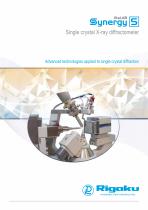
Single crystal X-ray diffractometer Advanced technologies applied to single crystal diffraction
Open the catalog to page 1
– Fast, Precise, Intelligent CONTINUITY AND INNOVATION The common goal of any single crystal experiment is to efficiently and accurately measure reciprocal space data. This is true whether you are determining the structure of a novel chemical compound, screening a crystal before a synchrotron trip or measuring highly redundant, high-resolution data for a charge density study or S-SAD phasing. In all cases, the quality of data generated by your diffractometer, as well as the speed and ease by which you can measure the data, is paramount to the success of your research. With your success utmost...
Open the catalog to page 2
Gap-free reciprocal space refers not only to measuring a data set to IUCr acceptable completeness, but also to the proper measurement of weak reflections so that they have sufficient information content for use in refinement. A diffractometer that does not allow for accurate measurement of weak reflections introduces a gap in your measurement of reciprocal space. Detectors with a high-noise threshold are the biggest sources of such a gap. We avoid this problem with proper detector selection and proper adjustment of data collection parameters. THE IMPORTANCE OF WEAK DATA Any diffractometer can...
Open the catalog to page 3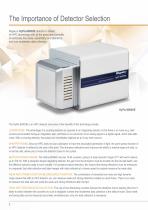
The Importance of Detector Selection Rigaku’s HyPix-6000HE detector is based on HPC technology with all the associated benefits of extremely low noise, essentially zero deadtime, and true shutterless data collection. The HyPix-6000HE is an HPC detector and some of the benefits of this technology include: LOWER NOISE: The advantage of a counting detector as opposed to an integrating detector is that there is no noise (e.g. dark current) accumulated during an integration step, and there is no conversion of an analog signal to a digital signal, which also adds noise. With a counting detector, the...
Open the catalog to page 4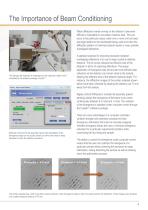
The Importance of Beam Conditioning When diffraction events overlap on the detector it becomes difficult or impossible to accurately measure data. This can occur in two particular cases: when one or more unit cell axes are large relative to the wavelength being used and when the diffraction pattern of a twinned sample results in many partially overlapped reflections. The Synergy slit assembly is integrated into the collimator holder and is controlled by the software package, CryAlisPro. A standard practice for improving resolution between overlapping reflections is to use a longer crystal-to-detector...
Open the catalog to page 5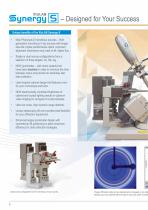
– Designed for Your Success Unique benefits of the XtaLAB Synergy-S • New PhotonJet-S microfocus sources – third generation microfocus X-ray sources with longer tube life, higher-performance optics, improved alignment mechanism and, best of all, higher flux. Single or dual source configurations from a selection of three targets: Cu, Mo, Ag. NEW goniometer – with motor speeds that have been doubled in order to minimize the time between scans and provide for extremely fast data collection. User-inspired cabinet design that features room for your microscope and tools. NEW electronically controlled...
Open the catalog to page 6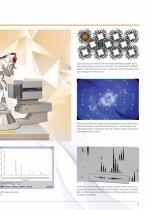
LAB Synergy-S system. sPro. Cage structures are renowned for their weakly diffracting properties due to high solvent content in the pores or channels. The sensitive HyPix-6000HE detector, having high dynamic range, is particularly useful for detecting weak spots alongside the intense ones. Reconstructed diffraction images can show evidence of super lattices within particular hkl planes. Visualising this phenomenon in two dimensions can make indexing easier. Particularly useful for inorganic samples where atoms have shifted within the lattice. Small pixels combined with a single pixel point spread...
Open the catalog to page 7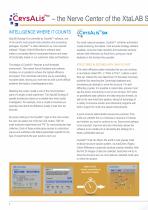
– the Nerve Center of the XtaLAB S INTELLIGENCE WHERE IT COUNTS XtaLAB Synergy-S is controlled by CrysAlisPro software, one of the world’s most popular data collection and processing packages. CrysAlisPro is often referred to as “user-inspired software”. Rigaku Oxford Diffraction’s software team makes a concerted effort to incorporate features and areas of functionality based on our customers’ ideas and feedback. The design of CrysAlisPro features a multi-threaded environment. This means that all hardware and software modules run in parallel to achieve the highest efficiency and speed. This maximizes...
Open the catalog to page 8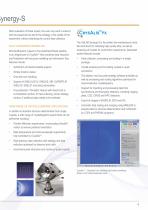
After evaluation of these results, the user may want to interact with the experiment to add to the strategy in the middle of the experiment, without disturbing the current data collection. FULLY INTEGRATED WORKFLOW StructureExplorer, based on the AutoChem/Olex2 pipeline, is an integral part of CrysAlisPr° that combines data reduction and finalization with structure modelling and refinement. Key features include: • AutoChem and AutoComplete support. • Simple intuitive viewer. • One-click twin handling. • Support of SHELXL2014, SHELXS, SIR, SUPERFLIP, SHELXD, SHELXT and olex2.solve/refine. • Pre-publication...
Open the catalog to page 9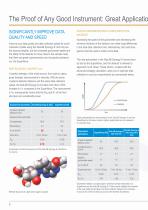
Chart representing the improvements of the XtaLAB Synergy-S over the SuperNova for the same crystal. Higher quality data can be measured in a shorter time. Experiment details on a light organic chemical sample measured on a SuperNova and the XtaLAB Synergy-S. These results highlight the benefits of the new, faster goniometer, the closer detector distance and increase in source flux of the microfocus source with the Atlas S2 detector.
Open the catalog to page 10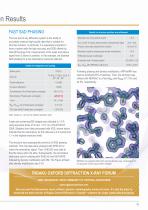
The true test of any diffraction system is the ability to accurately measure high-quality data that is suitable for structure solution. In particular, it is especially important to have a system with the high accuracy and DQE offered by XtaLAB Synergy-S for measurement of the weak anomalous signal from S atoms in proteins. In this example, we illustrate SAD phasing for a low redundancy lysozyme data set. Following phasing and density modification, ARP/wARP was used to autobuild 93% of residues. Then, the structure was refined with REFMAC to a final Rfac and Rfree of 17.5% and 22.5%, respectively....
Open the catalog to page 11All Rigaku Corporation catalogs and technical brochures
 ZSX Primus IV/IVi
16 Pages
 XtaLAB mini II
9 Pages
 Supermini 200
8 Pages
 CT Lab HX
4 Pages
- Analysis software
- Visualization software
- Control software
- Laboratory testing system
- Reporting software
- Windows software
- Laboratory software
- Spectroscope
- Control analyser
- Measurement software
- Benchtop spectrometer
- Real-time software
- Research software
- Compact spectrometer
- Optical spectrometer
- Preclinical imaging system
- High-resolution spectrometer
- Calorimeter
- Interoperability software