
- Catalogs
- RISystem AG
- MouseScrew

- Company
- Products
- Catalogs
- News & Trends
- Exhibitions
MouseScrew
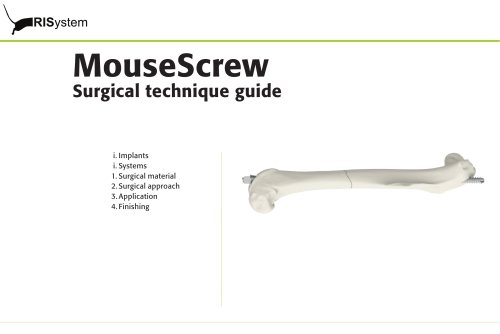
MouseScrew
The document is a surgical technique guide for the MouseScrew system, designed for intramedullary fixation and stabilization of closed femur fractures in mice. The MouseScrew is a medical-grade stainless steel lag screw used specifically for midshaft fractures.
Implants
The MouseScrew system includes a single standard-sized screw with an integral drive shaft that shears off at the correct torque. A guide tube is available for precise application.
Surgical Material
Specific instruments required include a guide tube, hand drills, an Accu Pen, a centering bit, various sutures, and a needle. These materials are essential for the proper application of the MouseScrew.
Surgical Approach
The procedure involves positioning the mouse dorsally, making a longitudinal incision along the medial side of the patella, and laterally dislocating the patella to expose the knee joint. The entry point is located intercondylarly on the femur.
Application
The surgical application involves drilling into the intercondylar notch, opening the proximal femur, and inserting the MouseScrew using a guide tube. The fracture is created using a guillotine.
Finishing
Wound closure is performed using Ethibond vicryl sutures or skin glue. Care is taken to avoid wound biting.
Hazards and Legal Restrictions
The document emphasizes that the procedures are hazardous and should only be performed by certified professionals. It disclaims responsibility for errors and advises independent verification of medical practices.
Conclusion
The MouseScrew system is a specialized tool for femur fracture stabilization in mice, requiring specific surgical materials and techniques. The guide provides detailed instructions for its application, emphasizing safety and professional responsibility.
Catalog excerpts

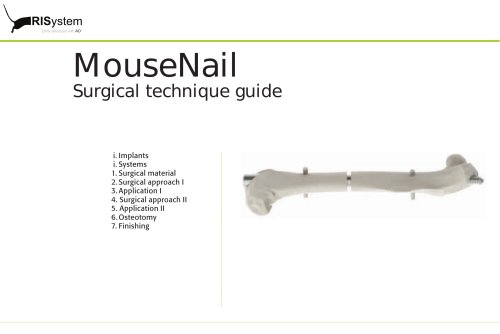
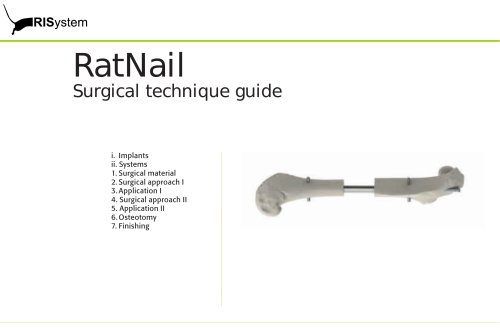
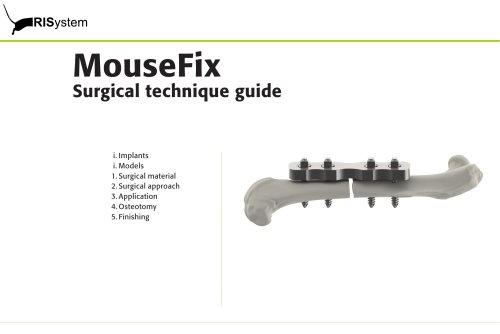
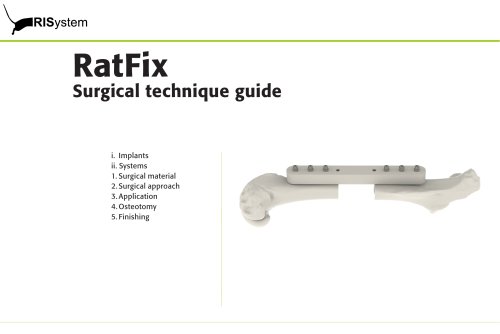
Surgical technique guide i. Implants i. Systems 1. Surgical material 2. Surgical approach 3. Application 4. Finishin
Open the catalog to page 1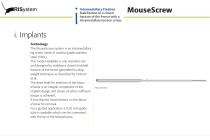
Intramedullary Fixation Stabilization of a closed fracture of the Femur with a intramedullary tension screw. i. Implants Technology The MouseScrew system is an intramedullary lag screw made of medical grade stainless steel (316L). This model available in one standard size and designed to stabilize a closed midshaft fracture of the femur generated by drop weight technique as described by Einhorn et al.. The drive shaft for insertion of the MouseScrew is an integral component of the implant design and shears of when sufficient torque is achieved. A four flanche head remains on the MouseScrew for...
Open the catalog to page 2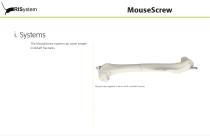
MouseScrew i. Systems The MouseScrew system can cover simple midshaft fractures. MouseScrew applied to femur with midshaft fracture
Open the catalog to page 3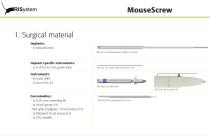
MouseScrew 1. Surgical material Implants: - 1x MouseScrew RIS.221.103 MouseScrew, length 17.20 mm Implant specific instruments: - 1x 0.20/0.35 mm guide tube Instruments: - 2x hand drills - 1x Accu Pen 3V RIS.390.130 Hand drill RIS.390.200 AccuPen 3V Consumables: - 1x 0.50 mm centering bit - 1x Vicryl suture 3-0 - Skin glue (Epiglue) / Vicryl suture 5-0 - 1x Ethibond Vicryl suture 6-0 - 1x 27G needle
Open the catalog to page 4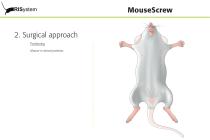
MouseScrew 2. Surgical approach Positioning Mouse in dorsal position.
Open the catalog to page 5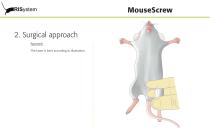
MouseScrew 2. Surgical approach Approach The knee is bent according to illustration.
Open the catalog to page 6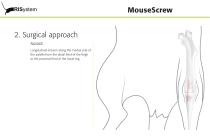
MouseScrew 2. Surgical approach Approach Longitudinal incision along the medial side of the patella from the distal third of the thigh to the proximal third of the lower leg.
Open the catalog to page 7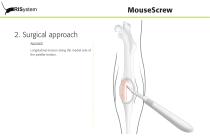
MouseScrew 2. Surgical approach Approach Longitudinal incision along the medial side of the patellar tendon.
Open the catalog to page 8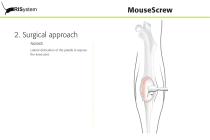
MouseScrew 2. Surgical approach Approach Lateral dislocation of the patella to expose the knee joint.
Open the catalog to page 9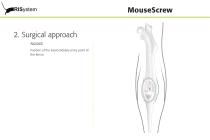
MouseScrew 2. Surgical approach Approach Position of the intercondylary entry point of the femur.
Open the catalog to page 10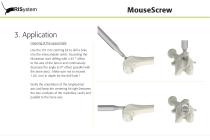
MouseScrew 3. Application Opening of the epycondyle Use the 0.5 mm centring bit to drill a hole into the intercondylar notch. According the illustration start drilling with a 45 ° offset to the axis of the femur and continuously decrease the angle to 0° offset (parallel with the bone axis). Make sure not to exceed 1.00 mm in depth for the drill hole ! Verify the orientation of the longitudinal axis and keep the centering bit right between the two condyles of the medullary cavity and parallel to the bone axis.
Open the catalog to page 11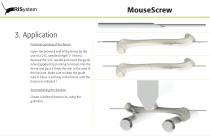
MouseScrew 3. Application Proximal opening of the femur Open the proximal end of the femur by the use of a 27G needle (length > 19mm). Remove the 27G needle and insert the guide tube (tappered tip pointing to femur) into the femur and pass it throu the skin in the area of the hip joint. Make sure to keep the guide wire in Place. It will stay in the femur until the fracture is initiated ! Accomplishing the fracture Create a defined fracture by using the guillotine.
Open the catalog to page 12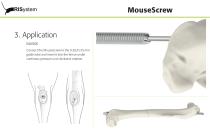
MouseScrew 3. Application Insertion Connect the MouseScrew to the 0.20/0.35 mm guide tube and insert it into the femur under continous pressure und clockwise rotation.
Open the catalog to page 13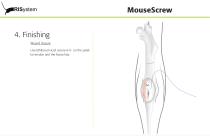
MouseScrew 4. Finishing Wound closure Use Ethibond vicryl suture 6-0 on the patellar tendon and the fascia lata.
Open the catalog to page 14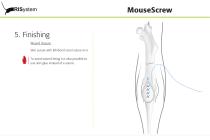
MouseScrew 5. Finishing Wound closure Skin suture with Ethibond vicryl suture 6-0. To avoid wound biting it is also possible to use skin glue instead of a suture.
Open the catalog to page 15
MouseScrew Hazards and legal restrictions Scientific editor: Illustrations: Design and layout: In collaboration with: Hazards Moritz Klein, Germany; Jörg Holstein, Germany Sandra Wissing, Switzerland Romano Matthys, Switzerland University of Saarland, Germany Trauma, Hand and reconstructive Surgery Director: Tim Pohlemann Great care has been taken to maintain the accuracy of the information contained in this publication. However, the publisher, and/or the distributor, and/or the editors, and/or the authors cannot be held responsible for errors or any consequences arising from the use of the information...
Open the catalog to page 16All RISystem AG catalogs and technical brochures
- Veterinary instrument kit
- Compression veterinary orthopedic screw
- Veterinary bone plate
- Orthopedic surgery veterinary instrument kit
- Tibia veterinary bone plate
- Mice veterinary bone plate
- Rat veterinary bone plate
- Small animal veterinary instrument kit
- Veterinary intramedullary nail
- Femur veterinary intramedullary nail
- Femur veterinary bone plate
- Humerus veterinary bone plate
- Veterinary external fixator
- Femur veterinary external fixator