
- Catalogs
- Röchling Sustaplast SE & Co. KG
- Röchling Sustainability Report 2025

Röchling Sustainability Report 2025
Röchling Sustainability Report 2025
The Röchling Group is committed to sustainability through its PRODUCTS, PEOPLE, and PLANET strategy, focusing on developing sustainable products, fostering a diverse workplace, and reducing environmental impact.
With a history spanning over 200 years, the Röchling Group operates in the Automotive, Industrial, and Medical sectors, emphasizing sustainable mobility, technical applications, and medical solutions. The group is headquartered in Mannheim, Germany, with 83 locations in 25 countries and 11,681 employees.
The report outlines commitments to sustainable products, quality, safety, diversity, and climate neutrality. Key initiatives include increasing recycled material use, enhancing product safety, promoting workplace diversity, and reducing greenhouse gas emissions.
The strategy focuses on sustainable products and innovations, circular economy, product quality, occupational health and safety, employee development, climate change, and responsible resource use. Goals and measures are developed through a systematic process involving employee and expert input.
Röchling focuses on sustainable product development, including bioplastics and recycled materials. Initiatives like Röchling-BioBoom® and Röchling-ReLoop® aim to strengthen the circular economy. The company invests in life cycle assessments to optimize product sustainability.
The company promotes diversity, inclusion, and equal opportunity, with initiatives like mentoring programs and leadership workshops. Safety is prioritized with global initiatives and ISO 45001 certifications.
Efforts to reduce environmental impact include commitments to climate neutrality, energy efficiency, and resource optimization. The company invests in renewable energy and energy-saving technologies.
The report highlights adherence to international standards and the role of the Röchling Foundation in supporting sustainable initiatives.
Röchling Automotive is committed to reducing the use of fossil raw materials by developing components made from post-consumer materials, promoting sustainability and the circular economy. Over 26% of materials used in their components are from post-industrial recycled material (PIR), with a goal to increase recycled materials to 30% by 2028.
Röchling Automotive supplies various components such as underbody panels, windshield washer reservoirs, and air ducts with a minimum of 30% recycled material. They collaborate with Aquafil to develop air filter box solutions using 30% fiberglass-reinforced ECONYL®, a sustainable alternative.
The company is developing new processes and projects to maximize the value of recycled components, ensuring sustainability throughout the production cycle. They are researching innovative solutions for D4R to improve recovery and recycling processes.
By 2028, Röchling Automotive aims to improve transparency on the environmental impacts of their products. They use the Global Warming Potential 100 (GWP100) method for calculating environmental impacts and are expanding automation processes across their plants.
Röchling Automotive uses Design for Sustainability (DfS) principles to optimize products for sustainability. They have developed a more sustainable trocar for medical use, reducing materials and weight, and improving recyclability.
Röchling Industrial products meet various quality and safety requirements, with many sites certified under international standards like ISO 9001. They aim for zero complaints and have initiatives like Quality North Star 2028 to promote excellence.
Röchling focuses on sustainability from product development to end-of-life, with measures like using recycled materials, promoting recycling, and reducing greenhouse gas footprints.
Röchling Automotive is dedicated to sustainable product development, emphasizing innovation, quality, and environmental responsibility across their operations.
Röchling Group is committed to reducing workplace accidents, aiming for a 50% reduction in the Lost Time Injury Rate (LTIR) by 2026. The LTIR measures workplace accidents per million working hours. Initiatives include the Safety Network at Röchling Industrial, which aligns with DIN ISO 45001 standards. Notable achievements include 1,000 accident-free days at the Nentershausen location and the "Schlauer Fuchs" award for a health campaign. Röchling Automotive and Medical divisions conduct regular safety surveys and training, with many locations certified under ISO 45001.
The company emphasizes diversity and equal opportunities, aiming for a 25% women's quota in management by 2030. Initiatives include mentoring programs, leadership workshops, and a network for women in leadership. Röchling Industrial and Medical collaborate with schools to promote engineering careers for girls. The company also conducts global employee surveys to enhance workplace conditions.
Röchling offers over 20 apprenticeships and dual study programs, focusing on leadership and internationality. The Leadership Academy supports managerial development. Röchling Medical uses virtual reality for ergonomic workstations, while Röchling Industrial promotes mental health through counseling services. The company values a collaborative culture for continuous learning and development.
Röchling is committed to reducing greenhouse gas emissions, aiming for climate neutrality. The divisions have signed up to the Science Based Targets Initiative (SBTi) for scientifically sound climate targets. Current goals include significant reductions in Scope 1 & 2 emissions by 2030 and 2040. The company sources green electricity and is expanding its own generation capabilities.
The document outlines Röchling Group's commitment to sustainability through renewable energy initiatives, efficient resource use, and compliance measures. It highlights the installation of photovoltaic systems across various locations and the development of a Scope 3 emissions balance.
Röchling has implemented photovoltaic systems at multiple industrial locations, including a one-megawatt peak system in Haren, Germany. These systems contribute significantly to the energy needs of the facilities, with some locations meeting up to 15% of their energy requirements through solar power. The company is exploring further installations in Germany.
The first Scope 3 emissions balance was prepared in line with the Greenhouse Gas Protocol. The process involved method development, data gathering, and linking activity data with emissions factors. Challenges included data availability, leading to the use of qualified assumptions and extrapolation methods. The majority of Scope 3 emissions stem from purchased goods and services.
Röchling emphasizes efficient resource use, with many locations certified under DIN EN ISO 14001 and 50001 standards. Energy management includes setting energy-saving targets and optimizing processes. Initiatives include using waste heat for building heating and reducing electricity consumption through various measures.
The Röchling Sustainability Center in Geeste-Dalum processes over 3,000 tons of offcuts into recycled materials. The company aims to increase the use of recycled materials in its products, with some products made entirely from recycled substances. Regulatory constraints limit the use of recycled materials in Röchling Medical.
The "Speak Up" whistleblower platform allows anonymous reporting of unethical conduct. Employees undergo annual compliance training to detect and report misconduct. The Röchling Code of Conduct outlines the company's commitment to legal and ethical standards.
The Röchling Foundation promotes initiatives to reduce plastic waste and foster a circular economy. The "Show what’s possible" program supports projects that inspire sustainable practices. The foundation also facilitates stakeholder dialogues to address plastic waste issues.
Catalog excerpts

Note: We have taken care to use gender-neutral language in our sustainability report. Where this was not possible for reasons of legibility, we have not differentiated between the genders. It is to be understood that all genders are addressed equally.
Open the catalog to page 2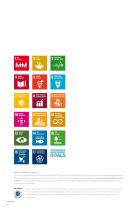
SDGs / UN Global Compact In its 2030 Agenda for Sustainable Development (2030 Agenda), the United Nations (UN) laid down the path for achieving worldwide economic progress in conjunction with social justice. The targets of this agenda are described in the Sustainable Development Goals (SDGs). In this sustainability report, we make various references to the SDGs that align with our sustainability strategy and that we aim to pursue accordingly. We are participants in the United Nations Global Compact. This is the world’s largest and most important initiative for responsible corporate governance....
Open the catalog to page 4
As a leading global plastics processing company, we are committed The Executive Board of the Röchling Group to developing and implementing sustainable strategies in our key (from left to right): Martin Schüler, Raphael areas of action: PRODUCTS, PEOPLE, and PLANET. Wolfram, Evelyn Thome, and Dr. Daniel Bühler. innovation and quality in order to develop green and resource- time. We have set ambitious efficient products. We focus on inclusion in which everyone that the entire life cycle of our environmental footprint. These products – from raw material their full potential. We nurture include measures...
Open the catalog to page 5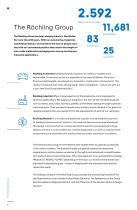
2.592 The Röchling Group The Röchling Group has been shaping industry. Worldwide. For more than 200 years. With our Automotive, Industrial, and Medical division, we transform the lives of people every day with our customized plastics: they reduce the weight of cars, make medication packaging more secure and improve industrial applications. billion euros in sales Röchling Automotive produces plastic solutions to make our mobility more sustainable. To this end, we use our expertise in the areas of Battery Solutions, Structural Lightweight, Aerodynamics, Propulsion, and Precision Components. This...
Open the catalog to page 6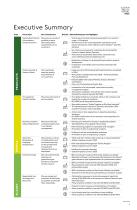
SUSTAIN ABILITY REPORT 2025 Executive Summary Area Focus Topic Sustainable Products & Innovations, Circular Economy We evolve our product portfolio to serve the sustainability requirements of our customers. Division Selected Measures and Highlights • Total share of recycled materials processed for our product 30 percent range • Performance of life cycle assessment calculations at all plants; introduction of the “Sphera LCA for Experts®” (LCA FE) software • Ten million euros invested in expanding the Sustainability Center in Geeste-Dalum/Germany • More than 20 sustainable alternatives, nearly...
Open the catalog to page 7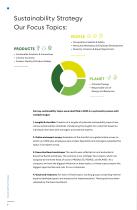
Sustainability Strategy Our Focus Topics: PEOPLE • Occupational Health & Safety • Attractive Workplace & Employee Development • Diversity, Inclusion & Equal Opportunity • Sustainable Products & Innovations • Circular economy • Product Quality & Product Safety PLANET • Climate Change • Responsible Use of Energy and Resources Our key sustainability topics were identified in 2023 in a systematic process with multiple stages: 1. Longlist & shortlist: Creation of a longlist of potential sustainability topics from various sustainability standards. Condensing the longlist into a shortlist based on individual...
Open the catalog to page 8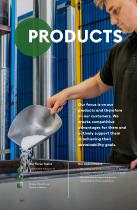
Our focus is on our products and therefore on our customers. We create competitive advantages for them and actively support them in achieving their sustainability goals. Sustainable Products & Innovations • We evolve our product portfolio to help our Circular Economy • We consistently meet the quality customers meet their sustainability goals. requirements of our customers. Product Quality & Product Safety
Open the catalog to page 9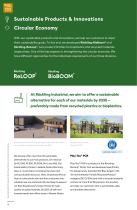
Sustainable Products & Innovations Circular Economy With our sustainable products and innovations, we help our customers to meet their sustainability goals. To this end, we developed Röchling-BioBoom® and Röchling-ReLoop®, two product families for bioplastics and recycled materials respectively. One of the key aspects is strengthening the circular economy. We have different approaches for the individual requirements of our three divisions. At Röchling Industrial, we aim to offer a sustainable alternative for each of our materials by 2035 – Sustainable Products & Innovations, Circular Economy...
Open the catalog to page 10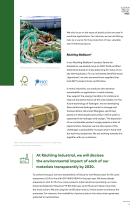
SUSTAIN ABILITY REPORT 2025 We also focus on the reuse of plastics that are used in maritime applications. For instance, we use old fishing nets as a source for the production of new, valuable semi-finished products. Röchling-BioBoom® In our Röchling-BioBoom® product family for Old fishing nets: a source for recycled products. bioplastics, we already have an ISCC PLUS certified alternative based on mass balancing for many of our key thermoplastics. For our laminated densified wood Lignostone®, we only use wood from suppliers that hold FSC® product chain certification. In many industries, our...
Open the catalog to page 11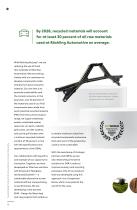
By 2028, recycled materials will account for at least 30 percent of all raw materials used at Röchling Automotive on average. With Röchling ReLoop®, we are reducing the use of fossil raw materials at Röchling Automotive. We are working closely with our customers to develop components made entirely from post-consumer material. Our aim here is to promote sustainability and Structural lightweight component for front-wheel suspension. Lighter, smarter, and more affordable. past year, over 26 percent of the materials used in our final components were made from post-industrial recycled material (PIR)....
Open the catalog to page 12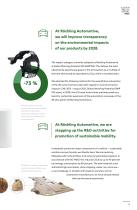
SUSTAIN ABILITY REPORT 2025 At Röchling Automotive, we will improve transparency on the environmental impacts of our products by 2028. The impact category currently adopted at Röchling Automotive is Global Warming Potential 100 (GWP100). This defines the heat absorbed by greenhouse gases in the atmosphere as a multiple of the heat that would be absorbed by CO2e within a hundred years. We adopted the following method for the quantitative calculation of the life cycle inventory data with regard to its environmental impacts: CML 2001 – August 2016, Global Warming Potential (GWP 100 years). In 2025,...
Open the catalog to page 13All Röchling Sustaplast SE & Co. KG catalogs and technical brochures
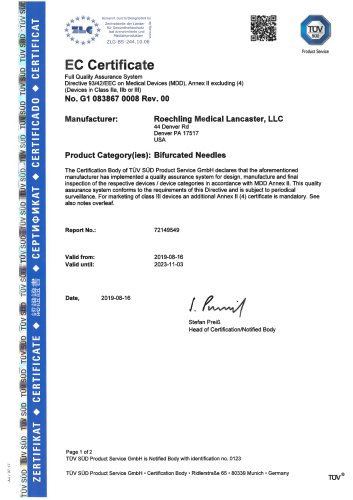 Certifications & Approvals
2 Pages
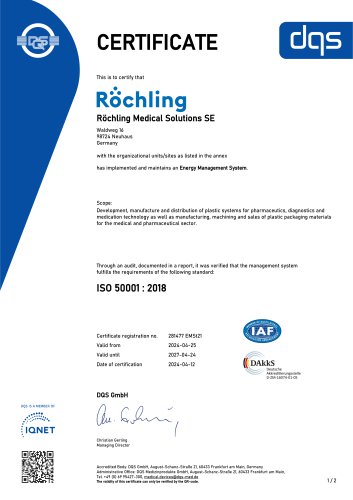 ISO 50001 Neuhaus
2 Pages
 Röchling Code of Conduct
26 Pages
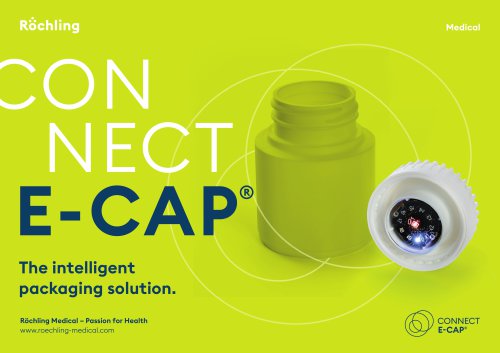 E-CAP®
4 Pages
- Syringe
- Cannula
- Medical sensor
- Sample container
- Monitoring sensor
- Surgical tubing
- Laboratory flask
- Intubation cannula
- Dental syringe
- Petri dish
- Feeding syringe
- Tracheotomy cannula
- Urine sample sample container
- Laboratory sample container
- Endoscopy tubing
- Oral syringe
- Tissue sample container
- Blood sample container
- Multilayer tubing
- Bone grafting syringe