
- Catalogs
- RWD Life Science
- RWD Detailed Explanation of 11 Key Problems of Cryostat


- Company
- Products
- Catalogs
- News & Trends
- Exhibitions
RWD Detailed Explanation of 11 Key Problems of Cryostat

RWD Detailed Explanation of 11 Key Problems of Cryostat
This document provides a detailed explanation of common issues encountered with cryostats, focusing on temperature control and slicing quality. It aims to assist users in troubleshooting and resolving these problems to ensure a reliable and efficient operation.
Temperature Control Issues
- Normal Temperature Ranges: The cryochamber should maintain a temperature between 0°C and -35°C, with a commonly used setting of -25°C. The specimen cooling temperature ranges from -10°C to -50°C, typically set at -20°C.
- Ambient Temperature Challenges: Issues such as a small laboratory space, blocked heat sinks, or nearby heat sources can prevent the cryostat from reaching the desired ambient temperature.
- Machine Heating Causes: Automatic heating of the glass window to prevent fogging and heat generation during operation can cause the machine to heat up. Blocked heat sinks should be checked if heating is abnormal.
- Automatic Heating: Temperature overshoot during setting and instability when the window is open for extended periods can cause automatic heating.
- Non-Operational Temperature Modes: In standby mode, the cryochamber and specimen maintain working temperatures. In sleeping mode, the cryochamber temperature is reduced to about -10°C, with a quick recovery time to -25°C.
Slicing Quality Issues
- Knife Holder Gap Issues: Excessive sample feeding or collisions can cause the knife holder to be out of alignment.
- Blade Replacement and Installation: Blades should be replaced using the knife holder or retractor, and installed by unlocking the blade locking knob and securing the blade in place.
- Thickness Adjustment: Slice thickness is adjusted during the feeding process, and accidental adjustments should be avoided.
- Blade Usage Duration: Conventional blades last for 20-30 sections, while RWD blades can handle 40-50 sections due to their rigidity and sharpness.
- Sample Feeding Issues: The cryostat may not feed samples if it has reached the end of the specimen or if the feeding part is frozen.
Conclusion
By understanding and addressing these 11 key problems, users can achieve smooth and efficient slicing with their cryostats.
Catalog excerpts
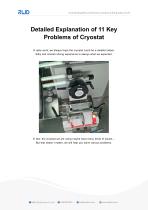
Detailed Explanation of 11 Key Problems of Cryostat In daily work, we always hope the cryostat could be a reliable helper. Silky and smooth slicing experience is always what we expected. In fact, the cryostat we are using maybe have many kinds of issues… But that doesn’t matter, we will help you solve various problems.
Open the catalog to page 1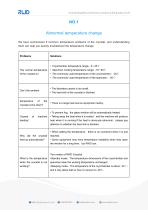
NO.1 Abnormal temperature change We have summarized 5 common temperature problems of the cryostat, and understanding them can help you quickly troubleshoot the temperature change. • Cryochamber temperature range:0~-35℃ The normal temperature • Specimen Cooling temperature range: -10~-50℃ • The commonly used temperature of the cryochamber:-25℃ • The commonly used temperature of the specimen:-20℃ • The laboratory space is too small. • The heat sink of the cryostat is blocked. the cryostat come down? • There is a large heat source equipment nearby. • To prevent fog,the glass window will be automatically...
Open the catalog to page 2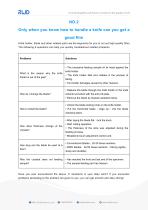
NO.2 Only when you know how to handle a knife can you get a good film Knife holder, blade and other related parts are the keypionts for you to cut out high-quality films. The following 6 questions can help you quickly troubleshoot related problems. Solutions • The excessive feeding sample hit its head against the What is the reason why the knife holder is out of the gap? knife holder. • The knife holder falls and collides in the process of taking. • Tool holder damages caused by other reasons. • Replace the blade through the knife holder or the knife retractor provided with the anti-roll plate....
Open the catalog to page 3Archived catalogs
 RWD Surgical Instruments
18 Pages
 RWD Infusion imager RFLSI Ⅲ
2 Pages
 RWD Rotating impactor 68099Ⅱ
2 Pages
 RWD Syringe Pump R462
1 Page
 Rotary Microtomes S710
2 Pages
 RWD Veterinary medical equipment
32 Pages
 RWD Microcentrifuge M1324R
2 Pages
 RWD Osmotic infusion Pump
2 Pages
 RWD Gradient Thermal Cycler
2 Pages
 2015 Product Catalogue
44 Pages
 PRODUCT CATALOGUE 2017
51 Pages



- Medical dolly
- Detection kit
- Logistics trolley
- RWD surgery forceps
- RWD grasping forceps
- Laboratory incubator
- Medical kit
- Microscopy
- Cannula
- Laboratory centrifuge
- Compound microscope
- Stainless steel forceps
- Benchtop centrifuge
- Patient monitor
- Laboratory microscope
- Dental treatment unit
- RWD straight forceps
- Cytology reagent
- Desktop microscope
- Blood centrifuge