
- Catalogs
- RWD Life Science
- RWD Precise Annealing Temperature Control with Gradient Thermal Cycler


- Company
- Products
- Catalogs
- News & Trends
- Exhibitions
RWD Precise Annealing Temperature Control with Gradient Thermal Cycler

RWD Precise Annealing Temperature Control with Gradient Thermal Cycler
- 12 linear gradients for optimizing annealing temperature
- Personalized account management for organized programs
- 7-inch touch screen for intuitive programming
- Suitable for PCR experiments and constant temperature incubation
Catalog excerpts
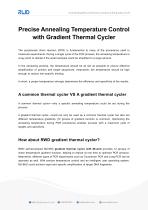
Precise Annealing Temperature Control with Gradient Thermal Cycler The polymerase chain reaction (PCR) is fundamental to many of the procedures used in molecular experiments. During a single cycle of the PCR process, the annealing temperature is a key point to decide if the small samples could be amplified to a large amount. In the annealing process, the temperature should be as low as possible to ensure effective amplification of primers and target sequences, meanwhile, the temperature should be high enough to reduce non-specific binding. In short, a proper temperature strongly determines the efficiency and specificity of the results. A common thermal cycler VS A gradient thermal cycler A common thermal cycler—only a specific annealing temperature could be set during the process. A gradient thermal cycler—could not only be used as a common thermal cycler but also set different temperature gradients (12 groups of gradient function is common). Optimizing the annealing temperature during PCR procedures enables success with a maximum yield of targets and specificity. How about RWD gradient thermal cycler? RWD self-developed M2-96G gradient thermal cycler with 96-well provides 12 groups of linear temperature gradient function, helping to realize at one time to optimize PCR protocol. Meanwhile, different types of PCR experiments such as Touchdown PCR and Long PCR can be operated as well. With precise temperature control and an intelligent user operating system, M2-96G could achieve rapid and specific amplification of target DNA fragments.
Open the catalog to page 1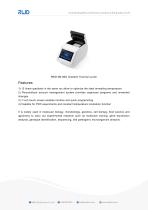
RWD M2-96G Gradient Thermal Cycler Features 1) 12 linear gradients in the same run allow to optimize the ideal annealing temperature 2) Personalized account management system provides organized programs and unwanted changes 3) 7 inch touch screen enables intuitive and quick programming 4) Capable for PCR experiments and constant temperature incubation function It is widely used in molecular biology, microbiology, genetics, cell biology, food science and agronomy to carry out experimental research such as molecular cloning, gene expression analysis, genotype identification, sequencing, and pathogenic...
Open the catalog to page 2Archived catalogs
 RWD Surgical Instruments
18 Pages
 RWD Infusion imager RFLSI Ⅲ
2 Pages
 RWD Rotating impactor 68099Ⅱ
2 Pages
 RWD Syringe Pump R462
1 Page
 Rotary Microtomes S710
2 Pages
 RWD Veterinary medical equipment
32 Pages
 RWD Microcentrifuge M1324R
2 Pages
 RWD Osmotic infusion Pump
2 Pages
 RWD Gradient Thermal Cycler
2 Pages
 2015 Product Catalogue
44 Pages
 PRODUCT CATALOGUE 2017
51 Pages



- Medical dolly
- Detection kit
- Logistics trolley
- RWD surgery forceps
- RWD grasping forceps
- Laboratory incubator
- Medical kit
- Microscopy
- Cannula
- Laboratory centrifuge
- Compound microscope
- Stainless steel forceps
- Benchtop centrifuge
- Patient monitor
- Laboratory microscope
- Dental treatment unit
- RWD straight forceps
- Cytology reagent
- Desktop microscope
- Blood centrifuge