
- Catalogs
- RWD Life Science
- RWD Why Do Histologists Need to Use SemiFully Automatic Rotary Microtome


- Company
- Products
- Catalogs
- News & Trends
- Exhibitions
RWD Why Do Histologists Need to Use SemiFully Automatic Rotary Microtome

RWD Why Do Histologists Need to Use SemiFully Automatic Rotary Microtome
Histologists face challenges with manual rotary microtomes, such as poor sectioning results, uncontrollable manual feeding, and maintenance issues. RWD offers semi-automatic and fully automated rotary microtomes to address these problems.
Outstanding and Steady Sectioning Performance
The automated rotary microtomes feature a highly precise injection system with cross roller bearings and a dense spindle, ensuring minimal sample thickness and precise sectioning. Manual microtomes rely on gear wheels that wear over time, affecting precision.
Preventing Sample Waste
Automated microtomes use a rock function and stepper motor for accurate trimming, preventing tissue loss. They also offer adjustable and reversible sample orientation with a patented visual pointer for precise angle adjustments, unlike manual microtomes that depend on operator intuition.
Highly Efficient Operation
The ergonomic design of automated microtomes integrates the feeding knob, allowing flexible speed control and reducing muscle fatigue. They offer a fully automated cutting mode for standardized sectioning, unlike manual microtomes that cause fatigue and slow down operations.
Cost Efficiency
Automated microtomes have an easy-to-clean waste tray with anti-static, paraffin-resistant qualities, reducing cleaning time. They also feature a touch screen for recording and tracing sectioning data, facilitating maintenance and troubleshooting, unlike manual microtomes that require time-consuming conventional maintenance.
Catalog excerpts
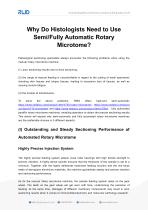
Why Do Histologists Need to Use Semi/Fully Automatic Rotary Microtome? Pathological sectioning specialists always encounter the following problems when using the manual rotary microtome machine: (1) poor sectioning results due to thick sectioning; (2) the range of manual feeding is uncontrollable in regard to the cutting of small specimens including skin tissues and biopsy tissues, leading to excessive loss of tissues, as well as causing muscle fatigue; (3) the trouble of maintenance. To fully automated paraffin rotary microtome machines, enabling operators to obtain the precise sectioning results. This article will explain why semi-automatic and fully automated rotary microtome machines are the preferable choices in 5 different aspects. (I) Outstanding and Steady Sectioning Performance of Automated Rotary Microtome Highly Precise Injection System The highly precise feeding system adopts cross roller bearings with high tensile strength to prevent vibration. A highly-dense spindle ensures that the thickness of the sample is set to a minimum. Together with the highly deliberate motorized feeding function and the link block made of aerospace aluminium materials, the machine guarantees steady and precise injection and sectioning performance. As for the manual rotary microtome machine, the sample feeding system relies on the gear wheel. The teeth on the gear wheel will get worn with time, undermining the precision of feeding. At the same time, damages of different machinery components may result in poor sectioning results when it comes to immunohistochemistry and molecular pathology research. -1-
Open the catalog to page 1
(II) Prevent the Waste of Samples Rock Function + Stepper Motor For Accurate Trimming Start the rock function. Expertised operators can rotate the handwheel in a half turn or quarter turn instead of a full turn, shortening the sectioning process and enhancing the cutting efficiency. Equipped with the stepper motor, the microtome sets the section thickness based on the advance/moving range so as to prevent the excessive loss of tissues. Manual rotary microtome is not able to control the advance/moving range when cutting small specimens like skin tissues or biopsy tissues. Adjustable and Reversible...
Open the catalog to page 2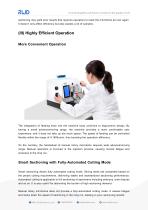
sectioning may yield poor results that requires operators to reset the microtome all over again. It doesn’t only affect efficiency but also wastes a lot of samples. (III) Highly Efficient Operation More Convenient Operation The integration of feeding knob into the machine body conforms to ergonomics design. By having a small advance/moving range, the machine provides a more comfortable user experience, and it does not take up too much space. The speed of feeding can be controlled flexibly within the range of 0-1800um/s, thus boosting the operation efficiency. On the contrary, the handwheel of...
Open the catalog to page 3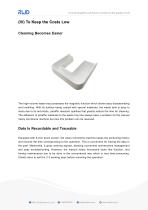
(IV) To Keep the Costs Low Cleaning Becomes Easier The high-volume waste tray possesses the magnetic function which allows easy disassembling and installing. With its surface being coated with special materials, the waste tank is easy to clean due to its anti-static, paraffin resistant qualities that greatly reduce the time for cleaning. The adhesion of paraffin materials to the waste tray has always been a problem for the manual rotary microtome machine but now this problem can be resolved. Data Is Recordable and Traceable Equipped with 5-inch touch screen, the rotary microtome machine keeps...
Open the catalog to page 4Archived catalogs
 RWD Surgical Instruments
18 Pages
 RWD Infusion imager RFLSI Ⅲ
2 Pages
 RWD Rotating impactor 68099Ⅱ
2 Pages
 RWD Syringe Pump R462
1 Page
 Rotary Microtomes S710
2 Pages
 RWD Veterinary medical equipment
32 Pages
 RWD Microcentrifuge M1324R
2 Pages
 RWD Osmotic infusion Pump
2 Pages
 RWD Gradient Thermal Cycler
2 Pages
 2015 Product Catalogue
44 Pages
 PRODUCT CATALOGUE 2017
51 Pages



- Medical dolly
- Detection kit
- Logistics trolley
- RWD surgery forceps
- RWD grasping forceps
- Laboratory incubator
- Medical kit
- Microscopy
- Cannula
- Laboratory centrifuge
- Compound microscope
- Benchtop centrifuge
- Stainless steel forceps
- Patient monitor
- Laboratory microscope
- Dental treatment unit
- RWD straight forceps
- Cytology reagent
- Desktop microscope
- Blood centrifuge