- Catalogs
- Safeguard Medical
- NIO™ HUMAN CADAVER

NIO™ HUMAN CADAVER
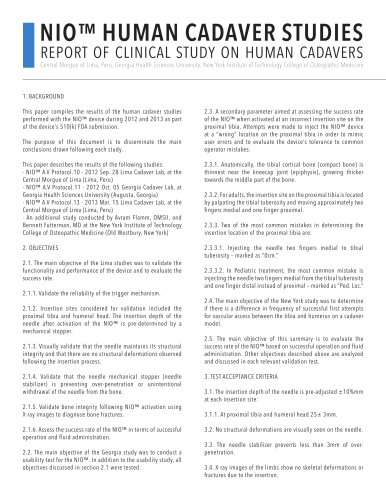
NIO™ HUMAN CADAVER
Catalog excerpts
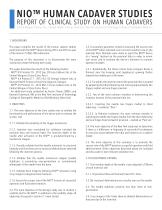
Central Morgue of Lima, Peru, Georgia Health Sciences University, New York Institute of Technology College of Osteopathic Medicine This paper compiles the results of the human cadaver studies performed with the NIO™ device during 2012 and 2013 as part of the device's 510(k) FDA submission. The purpose of this document is to disseminate the main conclusions drawn following each study. This paper describes the results of the following studies: ■ NIO™ A.V Protocol.10 - 2012 Sep. 28 Lima Cadaver Lab, at the Central Morgue of Lima (Lima, Peru) ■ NIO™ A.V Protocol.11 - 2012 Oct. 05 Georgia Cadaver Lab, at Georgia Health Sciences University (Augusta, Georgia) ■ NIO™ A.V Protocol.13 - 2013 Mar. 15 Lima Cadaver Lab, at the Central Morgue of Lima (Lima, Peru) ■ An additional study conducted by Avram Flamm, OMSII, and Bennett Futterman, MD at the New York Institute of Technology College of Osteopathic Medicine (Old Westbury, New York) 2.1. The main objective of the Lima studies was to validate the functionality and performance of the device and to evaluate the success rate. 2.1.1. Validate the reliability of the trigger mechanism. 2.1.2. Insertion sites considered for validation included the proximal tibia and humeral head. The insertion depth of the needle after activation of the NIO™ is pre-determined by a mechanical stopper. 2.1.3. Visually validate that the needle maintains its structural integrity and that there are no structural deformations observed following the insertion process. 2.1.4. Validate that the needle mechanical stopper (needle stabilizer) is preventing over-penetration or unintentional withdrawal of the needle from the bone. 2.1.5. Validate bone integrity following NIO™ activation using X-ray images to diagnose bone fractures. 2.1.6. Assess the success rate of the NIO™ in terms of successful operation and fluid administration. 2.2. The main objective of the Georgia study was to conduct a usability test for the NIO™. In addition to the usability study, all objectives discussed in section 2.1 were tested. 2.3. A secondary parameter aimed at assessing the success rate of the NIO™ when activated at an incorrect insertion site on the proximal tibia. Attempts were made to inject the NIO™ device at a "wrong" location on the proximal tibia in order to mimic user errors and to evaluate the device's tolerance to common operator mistakes. 2.3.1. Anatomically, the tibial cortical bone (compact bone) is thinnest near the kneecap joint (epiphysis), growing thicker towards the middle part of the bone. 2.3.2. For adults, the insertion site on the proximal tibia is located by palpating the tibial tuberosity and moving approximately two fingers medial and one finger proximal. 2.3.3. Two of the most common mistakes in determining the insertion location of the proximal tibia are: 2.3.3.1. Injecting the needle two fingers medial to tibial tuberosity - marked as "0cm." 2.3.3.2. In Pediatric treatment, the most common mistake is injecting the needle two fingers medial from the tibial tuberosity and one finger distal instead of proximal - marked as "Ped. Loc." 2.4. The main objective of the New York study was to determine if there is a difference in frequency of successful first attempts for vascular access between the tibia and humerus on a cadaver model. 2.5. The main objective of this summary is to evaluate the success rate of the NIO™ based on successful operation and fluid administration. Other objectives described above are analyzed and discussed in each relevant validation test. 3. TEST ACCEPTANCE CRITERIA 3.1. The insertion depth of the needle is pre-adjusted ±10%mm at each insertion site: 3.1.1. At proximal tibia and humeral head 25± 3mm. 3.2. No structural deformations are visually seen on the needle. 3.3. The needle stabilizer prevents less than 3mm of overpenetration. 3.4. X-ray images of the limbs show no skeletal deformations or fractures due to the ins
Open the catalog to page 1
3.5. Successful operation of the device entails: 3.5.1. The trigger mechanism operated properly and the needle stabilizer was easily released. 3.5.2. The device successfully inserted the needle into the bone. 3.5.3. It was possible to separate the trocar from cannula using manual vertical force while twisting. 3.5.4. Fluids were flushed into the intended area with no noticeable extravagation of fluids, thus, administration of fluids was successful. 3.6. For the secondary study on proximal tibia and for the study performed in NY, the success rate was assessed by successful operation of the device...
Open the catalog to page 2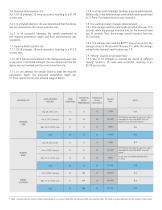
7.6. Proximal tibia insertion site: 7.6.1. Of 58 attempts, 53 were successful, resulting in a 91.4% success rate. 7.6.2. In all failed attempts, the user determined that the device was not inserted into the correct insertion site. 7.6.3. In all successful attempts, the needle penetrated to the required penetration depth and fluid administration was successful. 7.7. Humeral head insertion site: 7.7.1. Of 58 attempts, 54 were successful, resulting in a 93.1% success rate. 7.7.2. All 4 failures encountered in the Georgia study were due to user error. In all failed attempts, the user determined that...
Open the catalog to page 3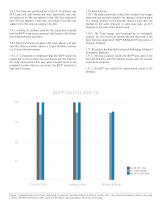
7.9.2. The study was performed on a total of 12 cadavers, age 20-93 years old, both female and male. Specifically, there was one subject in his 90s, two subjects in their 80s, four subjects in their 70s, two subjects in their 60s, one subject in his 40s, one subject in his 30s, and one subject in his 20s. 7.9.3. Initially, all cadavers used for this study were injected with the NIO™ at the correct proximal tibia location. All of these initial attempts were successful. 7.9.4. Out of six failures, two were in the same cadaver, a 35 year old male; three in another cadaver, a 73 year old male; and...
Open the catalog to page 4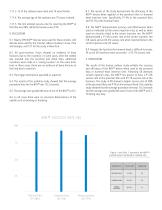
7.11.3. 12 of the cadavers were male and 14 were female. 7.11.4. The average age of the cadavers was 79 years at death. 7.11.5. The first attempt success rate for inserting the NIO™ at the tibia was 98%, while the humerus was 91%. 8.1. Nearly 390 NIO™ devices were used for these studies. 263 devices were used for the internal cadaver studies in Lima, Peru and Georgia, and 127 for the study in New York. 8.2. All post-insertion X-rays showed no evidence of bone fractures due to the insertion. In some cases, after the needle was injected into the proximal and distal tibia, additional insertions...
Open the catalog to page 5All Safeguard Medical catalogs and technical brochures
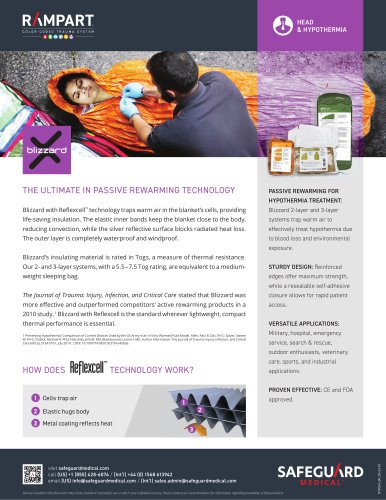 Blizzard
2 Pages
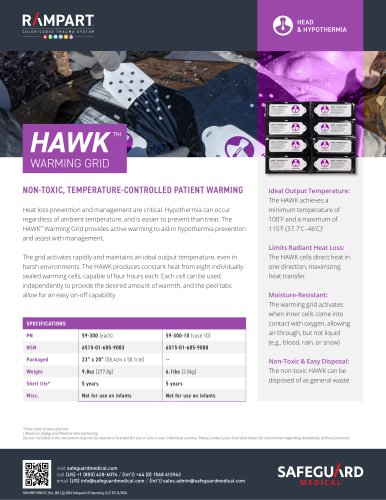 HAWK ™
1 Page
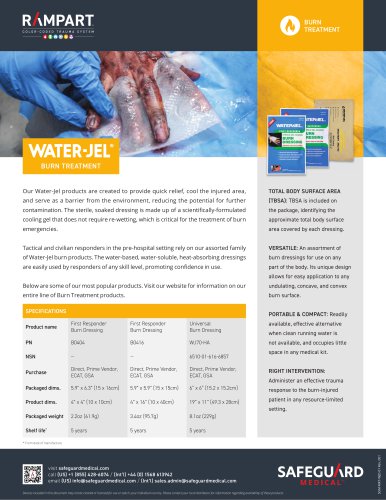 Water-Jel
1 Page
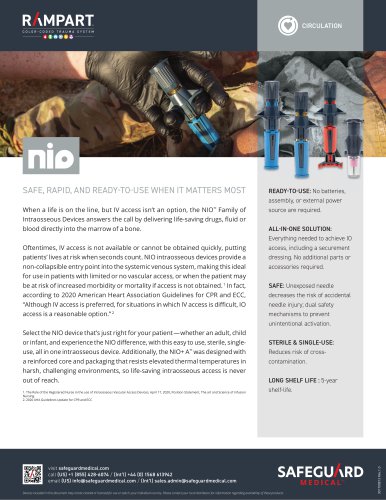 NIO_Family
2 Pages
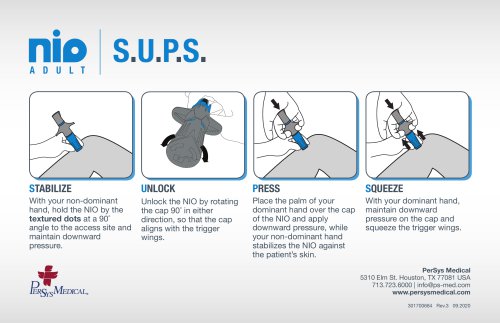 NIO+ Adult
1 Page
 RUSSELL CHEST SEAL
1 Page
 NASAL AIRWAY
1 Page
 CELOX™ RAPID
1 Page
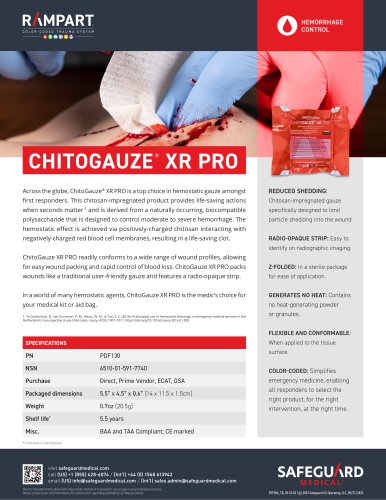 CHITOGAUZE ® XR PRO
1 Page
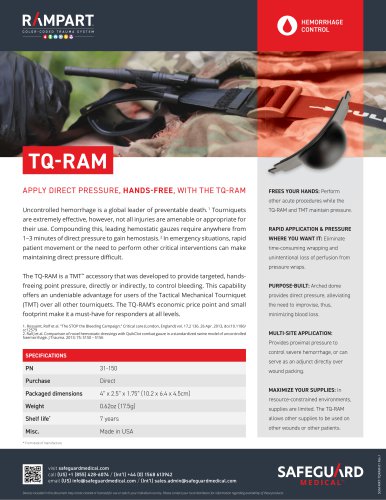 TQ-RAM
1 Page
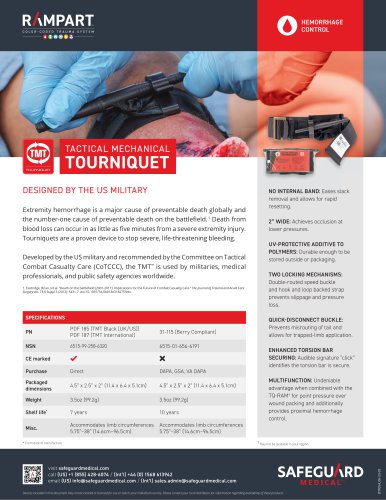 TMT™ Tourniquet
1 Page