
- Catalogs
- Sanzonate™
- TESTING

TESTING

TESTING
Aqueous Ozone from SanzonateTM Solutions was tested for its effectiveness in removing peanut protein residues from surfaces. The testing was conducted by Wilcox EVS Solutions using Hygiena PRO-Clean swabs to detect protein residues.
Testing Procedure
The test involved four types of peanut butter: Smooth PB, Jiffy Smooth Natural, Skippy Super Chunky Natural, and Wegmans Self-grind, Just Nuts. The substrates tested were Stainless Steel and Formica. The procedure included:
- Applying 1 gram of each peanut butter on three areas of each substrate.
- Allowing the peanut butter to sit for 5 minutes.
- Swabbing the surfaces, which turned purple indicating the presence of protein.
- Spraying Aqueous Ozone (~1.5 ppm) on the surfaces for 3 seconds and letting it sit for 10 seconds.
- Wiping the surfaces with a clean microfiber cloth and re-swabbing to check for protein residue.
Results
The swabs initially turned purple, indicating the presence of peanut proteins. After cleaning with Aqueous Ozone, the swabs showed no protein residue, confirming the solution's effectiveness.
Conclusion
Wilcox EVS Solutions concluded that Aqueous Ozone from SanzonateTM effectively removes peanut protein residues from hard surfaces. It is recommended for use in environments where removing peanut protein is crucial.
Additional Information
For more details, visit SANZONATE.COM.
Catalog excerpts
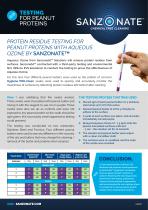
TESTING FOR PEANUT PROTEINS SANZONATE CHEMICAL FREE CLEANING PROTEIN RESIDUE TESTING FOR PEANUT PROTEINS WITH AQUEOUS OZONE BY SANZONATETM Aqueous Ozone from Sanzonate™ Solutions will remove protein residue from surfaces. Sanzonate"™ contracted with a third-party testing and environmental firm (Wilcox EVS Solutions) to conduct the testing to prove the effectiveness of Aqueous Ozone. For this test, four different peanut butters were used as the protein of concern. Hygiena PRO-Clean swabs were used to quickly and accurately monitor the cleanliness of surfaces by detecting protein residues left behind after cleaning. Step 1 was validating that the swabs worked. Three swabs were inoculated with peanut butter and mixing it with the reagent to see it turn purple. Three swabs were also set up as controls and were not exposed to any peanut protein so the swab should be light green, this was exactly what happened so testing could proceed. The testing was conducted on two substrates, Stainless Steel and Formica. Four different peanut butters were used to see any difference in the viscosity of the oils and butters that may change the cleaning / removal of the butter and proteins when cleaned. THE TESTING PROCESS THAT WAS USED: • Placed lgm of each peanut butter on 3 stainless steel areas and 3 Formica areas • Allowed peanut butter to sit for 5 minutes to adhere to the surface • A swab of each surface was taken, and all swabs immediately turned purple • Sprayed Aqueous Ozone of ~ 1.5 ppm onto the peanut inoculated surfaces until wet, ~ 3 sec - the solution sat for 10 seconds • The solution and peanut butter were wiped with a clean microfiber cloth • The surfaces were re-swabbed, and the color of the swabs was recorded. Stainless Steel Visit : SANZONATE.COM
Open the catalog to page 1All Sanzonate™ catalogs and technical brochures
 AQUEOUS OZONE
1 Page
 AQUAFLOW MIDI
2 Pages
 S-MOP
S-MOP2 Pages
 AQUAFLOW
2 Pages
 AQUAKART PRO
2 Pages