
- Catalogs
- S.B.M. France
- SYNTHETIC BONE SUBSTITUTES BONE VOID FILLERS

- Products
- Catalogs
- News & Trends
- Exhibitions
SYNTHETIC BONE SUBSTITUTES BONE VOID FILLERS
SYNTHETIC BONE SUBSTITUTES BONE VOID FILLERS
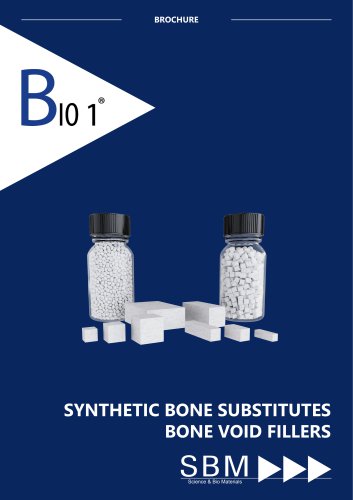
Since 1995, SBM has been a leader in developing synthetic bone substitutes, specifically BIOSORB, made from pure Beta-Tricalcium Phosphate (ß-TCP). The BIO 1® line is designed to fill bone voids resulting from injuries or surgeries, with CE marking in Europe and FDA clearance in the US. Over 145,000 implants have been used globally.
Advantages of BIO 1®
Unlike autografts, BIO 1® eliminates the need for a second surgical site, reducing operative time and patient discomfort. It offers an unlimited supply without donor dependency and carries no risk of disease transmission. The synthetic nature ensures regulatory acceptance worldwide and predictable performance.
BIO 1® Characteristics
BIO 1® features controlled porosity and mechanical resistance similar to human bone, ensuring biocompatibility and osteoconduction. It supports rapid bone ingrowth and integration without immune rejection.
Types of BIO 1®
Available in various forms such as sticks, blocks, cubes, and granules, BIO 1® offers different porosity levels to suit specific medical needs.
Applications
- Traumatology: Used in fracture surgeries to fill bone defects, often combined with autologous bone for larger defects.
- Benign Bone Tumors and Cysts: Fills voids post-curettage, suitable for pediatric patients.
- Spondylodesis: Used in spinal fusion surgeries, combined with autologous bone and blood.
- Chin Osteotomy: Used in genioplasty, combined with autologous PRF for stabilization.
- Crest Iliac Defects: Fills voids post-bone graft harvesting, mixed with patient blood for integration.
Conclusion
BIO 1® provides a reliable, safe, and effective solution for various orthopedic and surgical applications, backed by extensive clinical data and manufacturing expertise.
Catalog excerpts
SYNTHETIC BONE SUBSTITUTES BONE VOID FILLERS
Open the catalog to page 1
Benign bone tumors and cysts _ 10 Crest iliac defects after bone graft harvesting _ 16
Open the catalog to page 3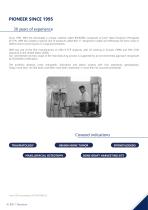
PIONEER SINCE 1995 30 years of experience Since 1995, SBM has developed a unique material called BIOSORB, composed of pure* Beta-Tricalcium Phosphate (ß-TCP). SBM has created a specific line of products called BIO 1®, designed to safely and effectively fill bone voids or defects due to bone injuries or surgical procedures. SBM was one of the first manufacturers to offer ß-TCP implants, with CE marking in Europe (1998) and FDA 510K clearance in the United States (2003). Our commitment at every stage of the manufacturing process is supported by an environmental approach recognized by ECOVADIS certification....
Open the catalog to page 4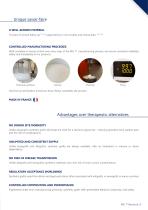
Unique savoir-faire A WELL-KNOWN MATERIAL 10 years of clinical follow up [1 to 5] supported by in vivo studies and clinical data. [7 to 10] CONTROLLED MANUFACTURING PROCESSES With complete in-house control over every step of the BIO 1® manufacturing process, we ensure consistent reliability, safety and traceability of our products. Chemical synthesis Gamma ray sterilization (minimum dose 25kGy) completes the process. Advantages over therapeutic alternatives NO DONOR SITE MORBIDITY Unlike autografts, synthetic grafts eliminate the need for a second surgical site - reducing operative time, patient...
Open the catalog to page 5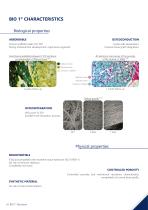
BIO 1® CHARACTERISTICS Biological properties ABSORBABLE Porous scaffold made of ß-TCP. Strong chemical link development: rapid bone ingrowth. Guide cells penetration. Improve bone graft integration. Good biocompatibility between ß-TCP and bone: no interposition of fibrous tissue [10] 3D electronic microscopy of the porosity of the ceramic (x 1000) [10] Mature bone Woven bone Ceramic implant Mature bone Woven bone Ceramic implant OSTEOINTEGRATION 95% pure* ß-TCP. Excellent cell resorption process. Physical properties BIOCOMPATIBLE Fully biocompatible with excellent tissue tolerance (ISO 10993-1)....
Open the catalog to page 6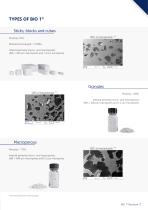
TYPES OF BIO 1® Sticks, blocks and cubes SEM* of macroporosity [11] Porosity: 45%. Mechanical strength: >15MPa. Internal porosity (micro- and macropores): d90 ≈ 300 μm macropores and 1.2 μm micropores. Porosity: >60%. Internal porosity (micro- and macropores): d90 ≈ 300 μm macropores and 1.2 μm micropores. Internal porosity (micro- and macropores): d90 ≈ 640 μm macropores and 0.5 μm micropores. *Scanning Electron Microscopy
Open the catalog to page 7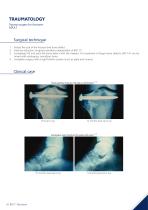
TRAUMATOLOGY Trauma surgery for fractures ADULT Assess the size of the fracture and bone defect. Fracture reduction (surgical procedure independant of BIO 1®). Completely fill and pack the bone defect with the implant. For treatment of larger bone defects, BIO 1® can be mixed with autologous cancellous bone. Complete surgery with a rigid fixation system (such as plate and screws). Clinical case Tibial plateau fracture (28 years old female) [11] Post-op X-ray 12 months post-op X-ray Astragalus neck fracture (53 years old man) [11] 2.5 months post-op X-ray 9 months post-op X-ray
Open the catalog to page 8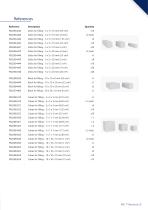
Description Sticks for filling Sticks for filling Sticks for filling Sticks for filling Sticks for filling Sticks for filling Sticks for filling Sticks for filling Sticks for filling Sticks for filling Sticks for filling Block for filling -Block for filling Block for filling Block for filling Cubes for filling Cubes for filling Cubes for filling Cubes for filling Cubes for filling Cubes for filling Cubes for filling Cubes for filling Cubes for filling Cubes for filling Cubes for filling Cubes for filling Cubes for filling Cubes for filling Cubes for filling Cubes for filling
Open the catalog to page 9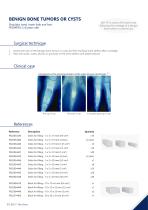
BIO 1® is used to fill a bone void following the curettage of a benign bone tumor or a bone cyst. Shoulder, hand, lower limb and foot PEDIATRIC (>8 years old) References Reference Description Quantity
Open the catalog to page 10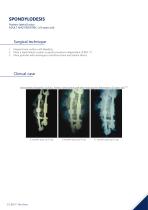
SPONDYLODESIS Postero-lateral fusion ADULT AND PEDIATRIC (≥8 years old) Prepare bone surface until bleeding. Place a rigid fixation system (surgical procedure independent of BIO 1®). Place granules with autologous cancellous bone and patient blood. Clinical case Instrumented Idiopathic Scoliosis. Postero-lateral bone graft after reducing the deformation (20 years old) [11] 3 months post-op X-ray 6 months post-op X-ray
Open the catalog to page 12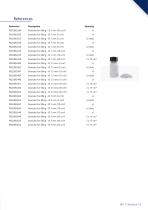
References Reference
Open the catalog to page 13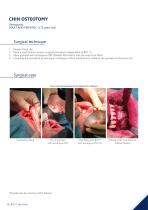
CHIN OSTEOTOMY Genioplasty ADULT AND PEDIATRIC (≥15 years old) Prepare bone site. Place a rigid fixation system (surgical procedure independent of BIO 1®). Place granules with autologous PRF (Platelet-Rich Fibrin) into the void to be filled. Complete the procedure by placing an autologous fibrin membrane to stabilize the granules at the bone site. Surgical case Chin wing genioplasty by Dr Saboye Dr. Saboye* Void before filling Mix of granules with autologous PRF *Clinical case by courtesy of Dr. Saboye Void filling with BIO 1® and autologous PRF mix Placing a PRF membrane to stabilize fixati
Open the catalog to page 14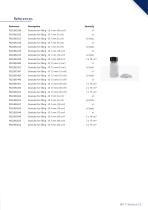
Granules for filling Granules for filling Granules for filling Granules for filling Granules for filling Granules for filling Granules for filling Granules for filling Granules for filling Granules for filling Granules for filling Granules for filling Granules for filling Granules for filling Granules for filling Granules for filling Granules for filling Granules for filling Granules for filling Granules for filling Granules for filling Granules for filling Granules for filling Granules for filling
Open the catalog to page 15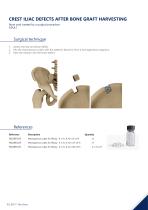
Bone void created by a surgical procedure ADULT 1. Assess the size and bone defect. 2. Mix the macroporous cubes with the patient's blood to form a homogeneous coagulum. 3. Pack the mixture into the bone defect. References Reference Macroporous cubes for filling - 4 x 4 x 4 mm (5 cm3) Macroporous cubes for filling - 4 x 4 x 4 mm (15 cm3) Macroporous cubes for filling - 4 x 4 x 4 mm (30 cm3)
Open the catalog to page 16
1. Blondel B, et al. Influence of screw type on initial coronal and sagittal radiological correction with hybrid constructs in adolescent idiopathic scoliosis. Correction Priorities. 2012 2. Blondel B, et al. Reciprocal sagittal alignment changes after posterior fusion in the setting of adolescent idiopathic scoliosis. 2012. 3. Bonnevialle P, et al. Kapandji pinning and tuberosities fixation of three- and four-part fractures of the proximal humerus. 2013. 4. Huitema GC, et al. Pulmonary function after less invasive anterior instrumentation and fusion for idiopathic thoracic scoliosis. 2013. 5....
Open the catalog to page 18All S.B.M. France catalogs and technical brochures
 Products Catalogue S.B.M.
24 Pages
- Bone plate
- Suture thread
- General surgery suture thread
- Orthopedic surgery bone substitute
- Non-absorbable suture thread
- Osteotomy plate
- Suture anchor
- Metallic osteotomy plate
- Locking osteotomy plate
- Granules bone substitute
- Non-absorbable suture anchor
- 2 suture thread
- Orthopedic surgery suture thread
- Rigid bone substitute
- Rotator cuff suture anchor
- Suture button
- Cruciate ligament interference screw
- Interference screw