
- Catalogs
- ScanModul®
- Full catalogue - Hi Res

- Company
- Products
- Catalogs
- News & Trends
- Exhibitions
Full catalogue - Hi Res

Full catalogue - Hi Res
Catalog excerpts

ScanCell® Trolley roller door down. Type B-M060. Item no. 40651100D
Open the catalog to page 1
ScanModul® / Table of Contents Table of Contents About us Our modular system Company´s history Experienced partner NoCount® Solution
Open the catalog to page 2
Trays, Baskets, Shelves Baskets – dividable Trays – dividable Trays – non-dividable Instrument trays Wire Baskets High-temperature resistant trays Preconfigured modular inserts Modular inserts Preconfigured trays for medicine Accessories for baskets and trays Labeling System Wall panels and telescopic rails Storage of sterile goods ScanCell® Pre-configured ScanCell® ScanCell® overview ScanCell® sidepanel customization Cleanline cabinets Fire-retardant/lead protected cabinets Medicine cabinets Product overview Mounted items Stainless steel table tops Transport solutions Lightweight distribution...
Open the catalog to page 3
Its name reflects its programme Our modular system The base of ScanModul's success is a modular system that we introduced in the year 1970 which has meanwhile become the industry standard. Based on a 60 cm x 40 cm grid, we developed baskets and trays in various materials for the use in the healthcare sector, which perfectly matched our trolleys and cabinets. Full size modul Half size modul In the course of time, ½ modules were added. This sophisticated system enables us – working together with our customers – to develop integrated logistics solutions for conceivable tasks. Here in the catalogue...
Open the catalog to page 4
Cabinets, Trolleys, Carts Modules Trays, Baskets, Shelves Furniture Types
Open the catalog to page 5
We started with hospital furniture and equipment in Denmark Founded in 1912 by the silversmith Georg Larsson the company soon specialized in supplying beds and other equipment to Danish hospitals. Ole Larsson continued in his father´s footsteps in 1940. The company moved on in specializing production with a very extensive product range for use in the hospital and nursing home sector. Milestone in the company´s history In the early 1970s a revolutionary modular storage concept was developed and introduced to the Scandinavian market. The ISO standard for 400 x 600 mm modules is based on this system,...
Open the catalog to page 6
ScanModul® today Continuing our successful journey As the inventor and largest vendor in the field of modular System, ScanModul® is proud of its leadership position. With the headquarter and it`s modern production facility in Houten, The Netherlands ScanModul® today continues to fulfill the needs of more than 8 000 customers in healthcare worldwide, with an eye on operational excellence and the people it is supposed to support in their daily work. ScanModul® prides itself on having excellent quality and the broadest product portfolio in the industry. Innovations and the continuing extension of...
Open the catalog to page 7
Experienced partner in efficient logistic solutions Over 110 years of presence in the healthcare market, more than 50 years of experience with logistics systems, and over 2000 completed projects worldwide speak for themselves regarding ScanModul®´s experience. For us, professional project management, from analysis and evaluation through conception to the realization, goes without saying. You, the customer, are always in our focus – because your satisfaction is our primary target. In all we do we focus on fulfilling our customers’ requirements in the logistical operations process up to the nursing...
Open the catalog to page 8
Brilliantly Simple – Simply Brilliant The idea behind our system is as simple as it is brilliant. Based on a standardized bin size of 400 x 600 mm, which is devidable, made for Kan-Ban use (“2-Bin”), we can design a highly flexible flow (solution) for a variety of logistics tasks within the hospital ecosystem. We are the “one partner” our clients need Optimising your facility through open communication As our client you get one partner to assist you with developing or maintaining the best possible logistical process in your healthcare facilty. We work closely with you during every stage of the...
Open the catalog to page 9
Let’s introduce to you our NoCount® Solution Simple and highly efficient The base of our work and also the base of every optimization in the whole logistics supply chain is our NoCount®-Solution. This solution is a highly flexible tool that allows us to improve any possible initial situation according to our customers' wishes. NoCount® is our fully scalable concept of organizing any logistical flow in your healthcare facility. Weather it is to facilitate the daily workflow in a department, or a fully connected and ERP integrated solution; our NoCount® solution fits to any requirement. Together...
Open the catalog to page 10
A powerfull tool, based on 3 systems ISO-Modular-System The 400 x 600 mm ISO Modular baskets and trays are the core of any logistical concept we develop for our customers. We invented and introduced it to healthcare in the early ’70-ies. This idea is essential everywhere high amounts of products are handled. With our solutions you can easily implement this system into your processes due to flexible storage units that e.g. allow a wide variation of possible separations to help employees in their daily business. Our Kan-Ban or 2-Bin System uses the simplest visual signal to initiate stock replenishment:...
Open the catalog to page 11
ScanModul® / Trays, Baskets, Shelves Trays, Baskets, Shelves Efficient storage: be organised and flexible We have developed an ISO certified modular system for trays and baskets, which optimises the flow of supplies from central storage to the point-of-use. This allows modules – our common name for trays and baskets – to be moved from one place to another instead of picking each item from shelf to shelf. The modules are pivotal in our NoCount® logistic concept. Our dimensions have become today’s ISO standard in healthcare industry Pre-perforated for mounting safety stops Beaded edge for label...
Open the catalog to page 12
Trays, Baskets, Shelves ScanModul® / Trays, Baskets, Shelves
Open the catalog to page 13
ScanModul® / Trays, Baskets, Shelves Trays, Baskets and Shelves Quick overview Trays Trays are ideal for those purposes where you need a solid product that can be completely sealed with a lid or when you want to make sure that small items or liquids are contained within the module. Baskets Our lightweight baskets have small holes in the sides as well as in the bottom. This enables you to partly see the content without pulling out the module. Shelves We provide shelves in a variety of sizes and materials. Please contact your local sales representative to find the best solution for your need.
Open the catalog to page 14All ScanModul® catalogs and technical brochures
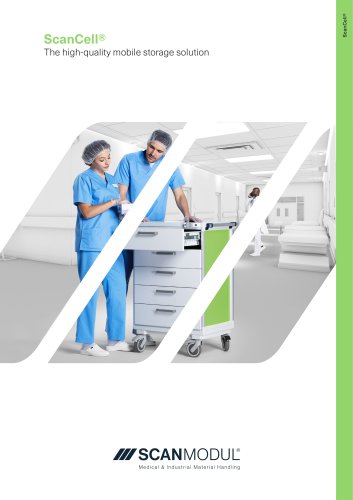 Scancell®
48 Pages
 Cabinets
47 Pages
 EN06-Transport Solutions
45 Pages
 Components for Modular Storage
48 Pages
 EN02-CatalogueIntro
12 Pages
 Full catalogue - low res
208 Pages
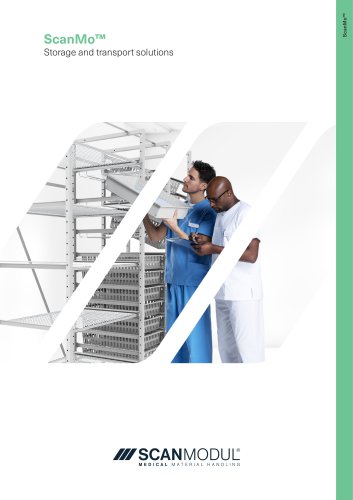
- ScanModul medical trolley
- Logistics trolley
- ScanModul hospital trolley
- Treatment cart
- Hospital wardrobe
- Medical device trolley
- ScanModul trolley with tray
- Medication cart
- Infusion stand
- Cart with bin
- Trolley with waste bin
- Emergency trolley
- Wardrobe with drawer
- IV pole on castors
- Control software
- 5-drawer trolley
- Stainless steel infusion stand
- Trolley with door
- Planning software
- Hospital software