


4500 Series of Instruments
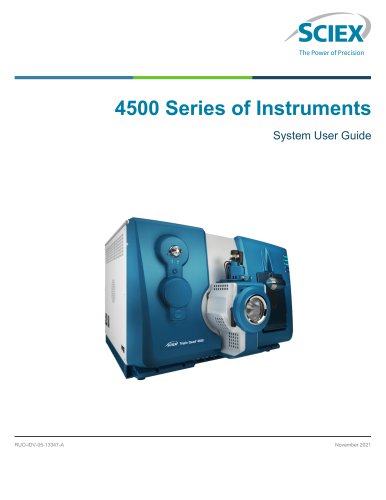
4500 Series of Instruments
- General Safety Information: Users must follow all safety precautions and comply with relevant EHS regulations to prevent injury or system damage.
- Documentation Symbols and Conventions: Symbols like DANGER, WARNING, and CAUTION indicate hazard severity.
- Regulatory Compliance: The system adheres to international standards, including EMC and safety regulations for various regions.
- System Overview: Describes the system's hardware and operational theory.
- Start Up and Shut Down: Provides detailed procedures for system startup and shutdown, including specific components like the syringe pump and diverter valve.
- Maintenance Schedule: Recommends regular maintenance tasks for optimal performance, including cleaning and component inspection.
- Calibration Ions and Solutions: Details calibration procedures.
- Glossary of Symbols and Warnings: Defines symbols and warnings used in the document.
- Information on contacting SCIEX for support and training.
- Safety Standards: Compliance with IEC 61010-1 and IEC 61010-2-061 is required.
- Electrical Precautions: Only qualified personnel should handle electrical installations.
- Mains Supply: Ensure emergency disconnection is possible and use only supplied mains cables.
- Protective Earth Conductor: Must be installed by a qualified electrician.
- Chemical Precautions: Decontaminate the system if hazardous materials were used.
- System Safe Fluids: Use only specified LC-MS-grade solvents and buffers.
- Ventilation Precautions: Ensure proper venting of fumes.
- Physical Precautions: Allow cooling time for hot surfaces and use mechanical lifting devices for heavy components.
- Environmental Precautions: Avoid explosive environments and maintain stable ambient temperatures.
- Electromagnetic Compatibility: Operate in a basic electromagnetic environment.
- Electromagnetic Interference: Classified as Class A equipment, suitable for non-residential environments.
- Decommissioning and Disposal: Follow local regulations for disposal of hazardous and electronic waste.
- Qualified Personnel: Only SCIEX personnel should install and service the equipment.
- Laboratory Conditions: Operate indoors with specified temperature and humidity ranges.
Emphasizes using SCIEX-recommended parts and professional moving services. Protective footwear is advised for handling heavy objects.
Describes the 4500 series instruments for chemical analysis, including key components like the mass spectrometer and ion source.
Explains the mass spectrometer's function, including ion transmission and filtering processes.
Details the mass spectrometer's hardware, including connections and LED functions.
Provides startup instructions, including gas connections and component configurations.
Highlights potential hazards and the importance of following procedures.
Outlines steps for safely shutting down and venting the system.
Provides instructions for resetting the mass spectrometer.
Describes tasks and references for different user roles.
Emphasizes regular maintenance and safety warnings.
Details cleaning methods to avoid damage and maintain system integrity.
- Curtain Plate Removal and Cleaning: Instructions for cleaning and reinstallation.
- Orifice Plate Cleaning: Cleaning instructions without removing the interface heater.
- Source Exhaust Drain Bottle Maintenance: Regular inspection and maintenance instructions.
- Roughing Pump Oil Level: Instructions for checking and maintaining oil levels.
- Storage conditions and contact information for long-term storage assistance.
- System Issues: Solutions for common issues like low gas flow and high vacuum pressure.
- Sensitivity Issues: Recommendations for cleaning and optimization.
- Background Noise: Cleaning and conditioning advice for high noise levels.
- Regular calibration and tuning recommendations.
- Explanation of symbols indicating compliance, hazards, and operational instructions.
Catalog excerpts
4500 Series of Instruments System User Guide
Open the catalog to page 1
This document is provided to customers who have purchased SCIEX equipment to use in the operation of such SCIEX equipment. This document is copyright protected and any reproduction of this document or any part of this document is strictly prohibited, except as SCIEX may authorize in writing. Software that may be described in this document is furnished under a license agreement. It is against the law to copy, modify, or distribute the software on any medium, except as specifically allowed in the license agreement. Furthermore, the license agreement may prohibit the software from being disassembled,...
Open the catalog to page 2
System User Guide RUO-IDV-05-13347-A
Open the catalog to page 3
System User Guide RUO-IDV-05-13347-A
Open the catalog to page 4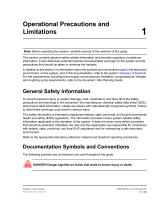
Operational Precautions and Limitations Note: Before operating the system, carefully read all of the sections of this guide. This section contains general safety-related information and provides regulatory compliance information. It also describes potential hazards and associated warnings for the system and the precautions that should be taken to minimize the hazards. In addition to this section, for information about the symbols and conventions used in the laboratory environment, on the system, and in this documentation, refer to the section: Glossary of Symbols. For site requirements, including...
Open the catalog to page 5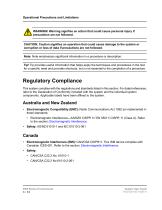
Operational Precautions and Limitations WARNING! Warning signifies an action that could cause personal injury if f * \ precautions are not followed. CAUTION: Caution signifies an operation that could cause damage to the system or corruption or loss of data if precautions are not followed. Note: Note emphasizes significant information in a procedure or description. Tip! Tip provides useful information that helps apply the techniques and procedures in the text for a specific need and provides shortcuts, but is not essential to the completion of a procedure. This system complies with the regulations...
Open the catalog to page 6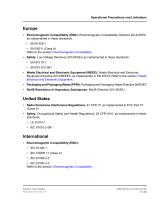
Operational Precautions and Limitations • Electromagnetic Compatibility (EMC): Electromagnetic Compatibility Directive 2014/30/EU as implemented in these standards: Refer to the section: Electromagnetic Compatibility. • Safety: Low Voltage Directives 2014/35/EU as implemented in these standards: • Waste Electrical and Electronic Equipment (WEEE): Waste Electrical and Electronic Equipment Directive 2012/96/EEC, as implemented in EN 40519. Refer to the section: Waste Electrical and Electronic Equipment. • Packaging and Packaging Waste (PPW): Packaging and Packaging Waste Directive 94/62/EC • RoHS...
Open the catalog to page 7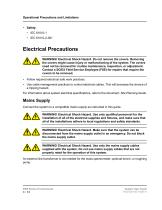
Operational Precautions and Limitations Electrical Precautions WARNING! Electrical Shock Hazard. Do not remove the covers. Removing the covers might cause injury or malfunctioning of the system. The covers need not be removed for routine maintenance, inspection, or adjustment. Contact a SCIEX Field Service Employee (FSE) for repairs that require the covers to be removed. • Follow required electrical safe work practices. • Use cable management practices to control electrical cables. This will decrease the chance of a tripping hazard. For information about system electrical specifications, refer...
Open the catalog to page 8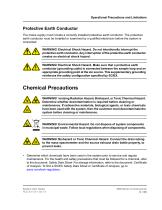
Operational Precautions and Limitations Protective Earth Conductor The mains supply must include a correctly installed protective earth conductor. The protective earth conductor must be installed or examined by a qualified electrician before the system is connected. WARNING! Electrical Shock Hazard. Do not intentionally interrupt the protective earth conductor. Any interruption of the protective earth conductor creates an electrical shock hazard. WARNING! Electrical Shock Hazard. Make sure that a protective earth conductor (grounding cable) is connected between the sample loop and an appropriate...
Open the catalog to page 9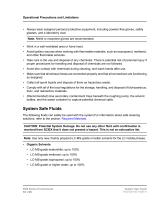
Operational Precautions and Limitations • Always wear assigned personal protective equipment, including powder-free gloves, safety glasses, and a laboratory coat. Note: Nitrile or neoprene gloves are recommended. • Work in a well-ventilated area or fume hood. • Avoid ignition sources when working with flammable materials, such as isopropanol, methanol, and other flammable solvents. • Take care in the use and disposal of any chemicals. There is potential risk of personal injury if proper procedures for handling and disposal of chemicals are not followed. • Avoid skin contact with chemicals during...
Open the catalog to page 10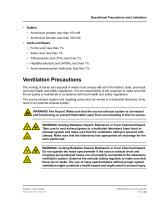
Operational Precautions and Limitations • Ammonium acetate; less than 100 mM • Ammonium formate; less than 100 mM • Formic acid; less than 1% • Acetic acid; less than 1% • Trifluoroacetic acid (TFA); less than 1% • Heptafluorobutyric acid (HFBA); less than 1% • Ammonia/ammonium hydroxide; less than 1% The venting of fumes and disposal of waste must comply with all of the federal, state, provincial, and local health and safety regulations. It is the responsibility of the customer to make sure that the air quality is maintained in compliance with local health and safety regulations. The source...
Open the catalog to page 11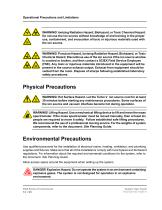
Operational Precautions and Limitations WARNING! Ionizing Radiation Hazard, Biohazard, or Toxic Chemical Hazard. Do not use the ion source without knowledge of and training in the proper use, containment, and evacuation of toxic or injurious materials used with the ion source. WARNING! Puncture Hazard, Ionizing Radiation Hazard, Biohazard, or Toxic Chemical Hazard. Discontinue use of the ion source if the ion source window is cracked or broken, and then contact a SCIEX Field Service Employee (FSE). Any toxic or injurious materials introduced in the equipment will be present in the source exhaust...
Open the catalog to page 12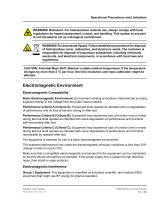
Operational Precautions and Limitations WARNING! Biohazard. For biohazardous material use, always comply with local regulations for hazard assessment, control, and handling. This system or any part is not intended to act as a biological containment. WARNING! Environmental Hazard. Follow established procedures for disposal of biohazardous, toxic, radioactive, and electronic waste. The customer is responsible for disposal of hazardous substances, including chemicals, waste oils, and electrical components, in accordance with local laws and regulations. CAUTION: Potential Mass Shift. Maintain a stable...
Open the catalog to page 13All SCIEX catalogs and technical brochures
Archived catalogs
 Brochure: AB SCIEX TOF/TOF? 5800
12 Pages
 Brochure: Discovery Proteomics
12 Pages
 Brochure: Targeted Protein Quant
12 Pages
 AB SCIEX TripleTOF® 5600+ System
12 Pages
 MetabolitePilot Software
6 Pages
 MultiQuant Software
6 Pages
 ProteinPilot Software
6 Pages
 Micro LC and cHiPLC Columns
6 Pages
 Ekspert NanoLC 400
7 Pages
 Eksigent Ultra LC Systems
6 Pages
 PA 800 plus Catalog
16 Pages
 ExionLC 100 Extended Specs
2 Pages
 SCIEX TRIPLE QUAD™ 5500 SYSTEM
12 Pages
 x500R
x500R8 Pages
 SelexION™
26 Pages
 MicroLC 200 Plus
6 Pages
 3200MD
8 Pages
 API 3200™ LC-MS/MS SYSTEM
8 Pages
 NanoLC™ 400
8 Pages
 MPX™
MPX™13 Pages
 SCIEX VISION
32 Pages
 SelexION
8 Pages


- Solvent reagent
- Molecular biology reagent
- SCIEX analysis software
- Visualization software
- Control software
- Quality control reagent
- Reporting software
- Windows software
- SCIEX laboratory software
- Monitoring software
- Automated software
- Acquisition software
- Traceability software
- Software module
- Benchtop spectrometer
- SCIEX chromatography system
- DNA cleanup reagent
- Research software
- Calibration reagent