

Treatment of Onychomycosis* with the JOULE® ClearSense?

Treatment of Onychomycosis* with the JOULE® ClearSense?
Onychomycosis is a nail infection primarily caused by dermatophytes such as Trichophyton rubrum. It affects up to 5% of the global population, with increased risk in older individuals. Treatment options include topical and oral antifungals, nail removal, and laser therapy, with the market for treatments growing significantly.
Topical and Oral Treatments
Topical treatments like terbinafine are recommended for mild cases but have limited effectiveness due to poor nail penetration. Oral antifungals, such as azoles and terbinafine, offer better penetration and higher cure rates but come with potential side effects, including liver toxicity and drug interactions. Terbinafine shows better outcomes compared to azoles, with fewer adverse effects.
Laser Treatments
Laser therapy, such as the JOULE ClearSense Nd:YAG 1064 nm laser, offers advantages over traditional treatments by avoiding drug interactions and toxicity. It provides real-time temperature feedback to optimize treatment efficacy and safety. Case studies demonstrate significant nail improvement with minimal discomfort.
Case Studies
Two cases are presented where patients received ClearToe treatments with the JOULE ClearSense laser, showing significant nail clearing without adverse effects.
Discussion
The ClearSense laser heats the nail plate to reduce fungus and promote healthy nail growth. Treatments are quick, comfortable, and show high patient satisfaction.
Conclusion
The JOULE ClearSense laser is a safe and effective treatment for onychomycosis, offering real-time monitoring to ensure optimal results. Further studies are encouraged to validate these findings over longer periods.
Catalog excerpts
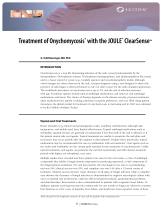
Treatment of Onychomycosis* with the JOULE® ClearSense™ G. Todd Bessinger, MD, PhD INTRODUCTION Onychomycosis is a non-life threatening infection of the nails caused predominantly by the dermatophytes Trichophyton rubrum, Trichophyton mentagrophytes, and Epidermophyton floccosum, and to a lesser extent by yeasts (e.g., Candida species) and non-dermatophytic molds. Although visual changes are often observed in the nail, a proper diagnosis using a test designed to detect the presence of nail fungus is often performed to rule out other causes for the nail’s changed appearance. The worldwide prevalence of onychomycosis is up to 5%, and the risk of infection increases with age. Treatment options include topical antifungal medications, nail removal, oral antifungal medications, and lasers. The choice of therapy depends on the disease severity, previous treatments, other medications the patient is taking, physician or patient preference, and cost. With rising patient awareness, the global market for treatment of onychomycosis is increasing and in 2010 was estimated to be $3.6 billion (Podiatry Today). Topical and Oral Treatments Home remedies (e.g., bleach and permanganate soaks, Castellani carbofuchsin), although safe, inexpensive, and widely used, have limited effectiveness. Topical antifungal medications such as terbinafine (Lamisil Cream) are generally recommended if less than half of the nail is affected or if the patient cannot take oral agents. Topical treatments are unable to penetrate the nail plate and recurrence may occur quickly after the regimen is discontinued1. Despite these drawbacks, topical medications may be recommended for use in combination with oral medicine2. Oral agents such as the azoles and terbinafine are the current gold standard for the treatment of onychomycosis. Unlike topical treatments, oral agents can penetrate the nail bed systemically and offer shorter treatment periods with higher, yet suboptimal, cure rates. Multiple studies have revealed less than optimal cure rates for the oral azoles, a class of antifungal compounds that inhibit a fungal enzyme important for producing ergosterol, a vital component of the fungal plasma membrane. For oral itraconazole, the mycological cure rate in a premarketing trial was 54%, clinical success was 35%, and complete cure was 14% after a 12-week course of treatment. (Clinical success denotes visual clearance of all signs of fungal infection while a complete cure denotes the clearance of fungal infection as demonstrated by negative mycological culture with clear or minimal nail involvement.) Adverse effects included headache, gastrointestinal problems, and skin disorders. Itraconazole is also contraindicated in patients with congestive heart failure. In addition, patients receiving itraconazole continuously for one month or longer are advised to monitor liver function as a few cases of hepatitis, liver failure, and death have been reported. Some of these *FDA Cleared for the temporary increase of clear nail for patients with onychomycosis 1 | SCITON White Paper
Open the catalog to page 1
Treatment of Onychomycosis with the JOULE ClearSense | cases had neither pre-existing liver disease nor a serious underlying medical condition. Fluconazole, another oral, antifungal, azole compound, is associated with nausea, pruritus, headache, and liver enzyme anomalies3. Furthermore, the azole class of compounds cannot be taken with many other oral medications such as the statins or calcium channel blockers due to dangerous drug interactions. Given the less than optimum cure rates and undesirable sequelae, the azoles are largely considered only moderately effective for treating nail fungus....
Open the catalog to page 2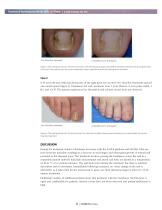
Treatment of Onychomycosis with the JOULE ClearSense | Pre-ClearToe treatment 2 months post 2 treatments Figure 2: The right great toe of a 50-year-old woman. The infected areas (gold color) before ClearToe treatment are along both sides of the nail. Two months post the second treatment there is significant proximal clearing of the nail plate. Case 2 A 53-year-old man with onychomycosis of the right great toe received two ClearToe treatments spaced one month apart (Figure 3). Parameters for each treatment were 5 J/cm2 fluence, 0.3 ms pulse width, 3 Hz, and 4.8 W. The patient experienced no discomfort...
Open the catalog to page 3
Treatment of Onychomycosis with the JOULE ClearSense | CONCLUSION The ineffective treatment of onychomycosis with home remedies, topical antifungals and oral antifungals means many practitioners and patients desire a safe therapy that can increase the aesthetic appearance of the nail safely and clear the fungus predictably. Sciton’s ClearSense Accessory with the JOULE platform and Nd:YAG 1064 nm laser is a safe, effective, and user-friendly modality for the treatment of onychomycosis. The temperature monitoring capability provides real-time feedback alerting the practitioner that the optimal...
Open the catalog to page 4All Sciton catalogs and technical brochures
 TempASSURE?
2 Pages
 ProLipo PLUS
4 Pages
 Halo Brochure
4 Pages
 Resurfacing Leave-behind
2 Pages
 Resurfacing Product Brochure
4 Pages
 Leave-behind Brochure
2 Pages
 BBL Product Brochure
16 Pages
 JOULE Product Brochure
2 Pages
 ClearScan YAG
2 Pages
 Halo
Halo4 Pages
 ProFractional
8 Pages
 Pro-V
Pro-V4 Pages
 SkinTyte
4 Pages
 ThermaScan
4 Pages
 Endovenous Ablation
4 Pages
 BBLs
BBLs2 Pages
 ClearSense
2 Pages


Archived catalogs
 TempASSURE
2 Pages
 Joule
Joule4 Pages