


SHORELINE® ACS

SHORELINE® ACS
The cervical spine consists of seven vertebrae that protect the spinal cord and allow neck movement. Discs between vertebrae have a fibrous outer layer and a gelatinous center, crucial for motion.
Causes of Pain
Pain can result from age, genetics, injury, or wear and tear, leading to conditions like herniated discs or spinal stenosis, causing symptoms such as numbness or radiating pain.
Anterior Cervical Discectomy and Fusion (ACDF)
ACDF is a surgical procedure to remove a damaged disc in the neck, replacing it with a spacer and securing it with screws or plates. The goal is to relieve nerve pressure and achieve vertebral fusion.
Suitability for ACDF
Shoreline® ACS is for patients with Degenerative Disc Disease (DDD) who have not responded to nonoperative treatments. The system uses a NanoMetalene® spacer and bone graft to promote fusion.
Degenerative Disc Disease (DDD)
DDD involves loss of disc flexibility and height, potentially leading to herniation and nerve compression, causing pain.
Preparing for Surgery
Pre-surgery involves diagnostic tests and following surgeon's instructions. Precautions are discussed to minimize risks.
Surgical Procedure
1. Approach: A small incision is made in the neck.
2. Disc Removal: The damaged disc is removed.
3. Implant: A spacer is placed to restore disc height.
4. Fixation: Screws and plates stabilize the area.
Postoperative Expectations
Post-surgery involves monitoring, possible use of a brace, and a prescribed activity program. Wound care and activity limitations are crucial.
Potential Risks
Risks include implant issues, pain, dural leaks, and serious complications like infection or paralysis. Immediate contact with a surgeon is advised for unexpected symptoms.
Technical Information
Shoreline® implants are made of PEEK with a titanium layer for durability and radiolucency. Compliance with postoperative instructions is essential.
Contact Information
Serious incidents should be reported to SeaSpine and TGA. The device is intended for use by trained surgeons only. For inquiries, contact SeaSpine via provided contact details.
Catalog excerpts

ANTERIOR CERVICAL DISCECTOMY AND FUSION PATIENT INFORMATION LEAFLET
Open the catalog to page 1
INTRODUCTION The cervical spine is made up of seven bones called vertebrae. These vertebrae start at the base of the skull and extend through the entirety of the neck. The bones and joints contain and protect the spinal cord, while also allowing motion such as bending and twisting. The main joint between two vertebrae is called a disc. Each disc is comprised of two parts, a tough and fibrous outer layer (annulus fibrosus), and a soft, gelatinous centre (nucleus pulposus). These two parts play a vital role in allowing and restricting motion.
Open the catalog to page 2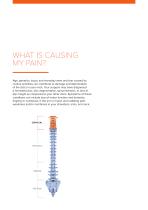
WHAT IS CAUSING MY PAIN? Age, genetics, injury, and everyday wear and tear caused by routine activities can contribute to damage and deterioration of the discs in your neck. Your surgeon may have diagnosed a herniated disc, disc degeneration, spinal stenosis, or loss of disc height as compared to your other discs. Symptoms of these conditions can include loss of motor function and dexterity, tingling or numbness in the arm or hand, and radiating pain, weakness and/or numbness in your shoulders, arms, and neck.
Open the catalog to page 3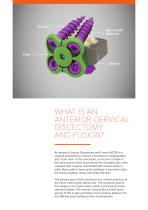
Bone Graft Material Plate Spacer WHAT IS AN ANTERIOR CERVICAL DISCECTOMY AND FUSION? An Anterior Cervical Discectomy and Fusion (ACDF) is a surgical procedure to remove a herniated or degenerative disc in the neck. In this procedure, an incision is made in the neck area to reach and remove the unhealthy disc, then replaced with a spacer and fixated with screws and/or a plate. Bone graft or bone graft substitute is inserted to fuse the bones together above and below the disc. The primary goal of this procedure is to relieve pressure on the nerve roots and/or spinal cord. The long-term goal of...
Open the catalog to page 4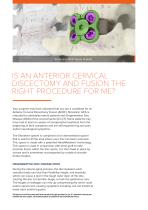
Shoreline® ACS Spinal Implant IS AN ANTERIOR CERVICAL DISCECTOMY AND FUSION THE RIGHT PROCEDURE FOR ME? Your surgeon may have indicated that you are a candidate for an Anterior Cervical Discectomy Fusion (ACDF). Shoreline® ACS is intended for skeletally mature patients with Degenerative Disc Disease (DDD) of the cervical spine (C2-C7). Some patients may have had at least six weeks of nonoperative treatment from the beginning of their symptoms and are still experiencing arm pain and/or neurological symptoms. The Shoreline system is comprised of an intervertebral spacer that is used to fill the...
Open the catalog to page 5
PREPARING FOR SURGERY Your surgeon will provide a clinical examination and may conduct some diagnostic tests to ensure you are a candidate for the procedure. These may include MRI, CT scans, and/or X-rays. Your surgeon may provide you with guidance on what to do or not do before your procedure. It is important that you follow your surgeon’s recommendations in preparation of your surgical procedure.
Open the catalog to page 6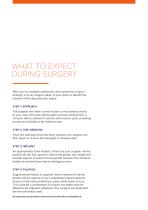
WHAT TO EXPECT DURING SURGERY After you are sedated, positioned, and covered by surgical draping, an X-ray image is taken of your spine to identify the location of the operative disc space. STEP 1: APPROACH The surgeon will make a small incision on the anterior (front) of your neck. Once the optimal path has been determined, a retractor will be utilised to hold the skin incision open, providing access and visibility to the affected area. STEP 2: DISC REMOVAL Once the operative level has been exposed, the surgeon will then begin to remove the damaged or diseased disc. STEP 3: IMPLANT An appropriately...
Open the catalog to page 7
WHAT TO EXPECT AFTER SURGERY After surgery you will wake up in the recovery room, where your vital signs will be monitored, and your immediate postoperative condition will be carefully observed. Once the medical staff feels that you are doing well, you will be returned to your room in the hospital. Your surgeon will determine the best postoperative course for you. The day after your surgery, your surgeon may instruct you to use a brace for a period of time to assist with the spinal fusion process. Supervised by trained medical professionals, your surgeon may ask you to carefully sit, stand, or...
Open the catalog to page 8
WHAT ARE THE POTENTIAL RISKS? POSSIBLE ADVERSE EVENTS Like other spinal system implants, the following adverse events are possible. This list is not exhaustive: • Delayed union or nonunion (pseudarthrosis). • Bending, disassembly or fracture of implant and components. • Loosening of spinal fixation implants may occur due to inadequate initial fixation, latent infection, and/or premature loading, possibly resulting in bone erosion, migration or pain. • Pain, discomfort, or abnormal sensations due to the presence of the device. • Dural leak requiring surgical repair. • Cessation of growth of the...
Open the catalog to page 9
TECHNICAL INFORMATION Shoreline® implants are made of a biocompatible material known as PEEK, with small tantalum markers used to help the surgeon clearly see the implant through X-ray images. Shoreline implants also have a one-micron thick layer of commercially pure titanium, known as Nanometalene®. • Submicron titanium layer bonded to entire PEEK implant. • Titanium surfacing resists wear debris.¹ • Radiolucent for post-op fusion assessment.² • Mechanical properties of PEEK unaltered, providing stiffness on par with bone.¹ IMPLANT MATERIALS • Polyetheretherketone (PEEK) per ASTM F2026 • Commercially...
Open the catalog to page 10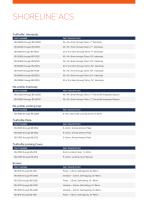
TruProfile® Interbody PART NUMBER PART DESCRIPTION No-profile Interbody PART NUMBER PART DESCRIPTION 16 x 14 x 6mm through 12mm, 7º, No-profile Integrated Spacer 18 x 15 x 6mm through 12mm, 7º, No-profile Integrated Spacer No-profile Locking Cap PART NUMBER PART DESCRIPTION 6-7mm, No-profile Locking Cover, 8–12mm TruProfile Plate PART NUMBER PART DESCRIPTION TruProfile Locking Cover PART NUMBER PART DESCRIPTION 5–12mm, Locking Cover Backup Screws PART NUMBER PART DESCRIPTION
Open the catalog to page 11
CONTACT INFORMATION A notice that any serious incident that occurs in relation to the device should be reported to the manufacturer and to the TGA. Any serious incident that occurs in relation to the device should be reported to SeaSpine® via phone, fax, or email. When possible, retain the product involved in the complaint and return to SeaSpine as instructed by SeaSpine Customer Service; [email protected] and the Therapeutic Goods Administration (TGA) www.tga.gov.au. SeaSpine intends that this device should be used only by surgeons having received proper training in the use of the device....
Open the catalog to page 12All SeaSpine catalogs and technical brochures
 SIERRA
12 Pages
 NORTHSTAR® OCT
12 Pages
 NEWPORT™
12 Pages
 REEF® TO & REEF TA
16 Pages
 MARINER® OUTRIGGER®
12 Pages
 MARINER® MIS
16 Pages
 MARINER® MIDLINE
12 Pages
 MARINER
16 Pages
 VENTURA™ NANOMETALENE
12 Pages
 REGATTA®
12 Pages
 SHORELINE RT
12 Pages
- Bone plate
- Interbody fusion cage
- PEEK interbody fusion cage
- Anterior interbody fusion cage
- Arthrodesis plate
- Spinal stabilization system
- Posterior spinal osteosynthesis unit
- Metallic arthrodesis plate
- Adult spinal osteosynthesis unit
- Cervical interbody fusion cage
- Titanium interbody fusion cage
- Locking arthrodesis plate
- Cervical vertebra arthrodesis plate
- Thoraco-lumbar osteosynthesis unit
- 2 levels arthrodesis plate