


VENTURA™ NANOMETALENE

VENTURA™ NANOMETALENE
The lumbar spine is composed of five vertebrae that protect the spinal cord and facilitate movement. Intervertebral discs have a fibrous outer layer and a gelatinous center, essential for motion and stability.
Causes of Pain
Pain may arise from aging, genetics, injury, or wear and tear, leading to conditions such as herniated discs, degeneration, or spinal stenosis, which can cause symptoms like numbness, pain, and weakness.
Posterior Lumbar Interbody Fusion (PLIF)
PLIF is a surgical procedure aimed at alleviating lower back pain by removing damaged discs and replacing them with a synthetic spacer, screws, and rods. The Ventura™ NanoMetalene® Implant assists in fusion and stabilization.
Candidate Suitability
PLIF is appropriate for patients with Degenerative Disc Disease, spondylolisthesis, or spinal stenosis, particularly when nonoperative treatments have failed.
Conditions Explained
- Degenerative Disc Disease (DDD): Discs lose flexibility with age, leading to herniation and nerve compression.
- Spondylolisthesis: A vertebra slips forward, compressing nerves.
- Spinal Stenosis: Narrowing of spinal canals, often in the lower back.
Preparing for Surgery
Preparation includes clinical exams and diagnostic tests like MRI or CT scans. Adhering to the surgeon's instructions is crucial.
Surgical Procedure
- Step 1: Incision and retraction for access.
- Step 2: Screw placement and decompression.
- Step 3: Disc removal and implant placement.
- Step 4: Fusion with rods and screws.
Post-Surgery Expectations
Post-surgery care involves monitoring, possible use of a brace, and a prescribed activity program. Instructions for wound care and medication will be provided.
Potential Risks
Risks include delayed union, implant issues, pain, dural leaks, and serious complications like infection or paralysis.
Technical Information
The Ventura™ NanoMetalene® implants are made of PEEK with a titanium layer, designed for biocompatibility and visibility in X-rays. Postoperative compliance is essential for recovery.
Implant Specifications
Various sizes of Ventura™ NanoMetalene® implants are available, with specific part numbers for different dimensions.
The document details various Ventura NanoMetalene Implants, specifying dimensions and configurations. Implants are categorized into lordotic and parallel types, with dimensions ranging from 9 x 20 x 11mm to 11 x 32 x 17mm.
Procedures and Usage
The implants are intended for use by surgeons trained in their application. The document emphasizes consulting with a surgeon to understand treatment options and associated risks, particularly for Posterior Lumbar Interbody Fusion surgery.
Standards and Compliance
Any serious incidents related to the device must be reported to both the manufacturer, SeaSpine, and the Therapeutic Goods Administration (TGA). Contact information for reporting and inquiries is provided.
Recommendations
Patients are advised to read the information leaflet thoroughly and discuss any questions with their surgeon before proceeding with surgery. The document also highlights that the sale of these products is restricted to orders by surgeons.
Contact Information
For inquiries outside the USA, contact details are provided, including phone numbers and email addresses for SeaSpine customer service and international inquiries.
Legal and Trademark Information
The document includes legal disclaimers about the trademarks and copyrights of SeaSpine Orthopedics Corporation, with a release date of December 31, 2021.
Catalog excerpts

VENTURA™ NANOMETALENE POSTERIOR LUMBAR INTERBODY FUSION PATIENT INFORMATION LEAFLET
Open the catalog to page 1
INTRODUCTION The lumbar spine is made up of five bones called vertebrae. The bones and joints contain and protect the spinal cord, while also allowing motion such as, bending and twisting. The main joint between two vertebrae is called a disc. Each disc is comprised of two parts, a tough and fibrous outer layer (annulus fibrosus), and a soft, gelatinous centre (nucleus pulposus). These two parts play a vital role in allowing and restricting motion.
Open the catalog to page 2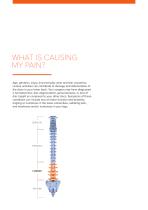
WHAT IS CAUSING MY PAIN? Age, genetics, injury, and everyday wear and tear caused by routine activities can contribute to damage and deterioration of the discs in your lower back. Your surgeon may have diagnosed a herniated disc, disc degeneration, spinal stenosis, or loss of disc height as compared to your other discs. Symptoms of these conditions can include loss of motor function and dexterity, tingling or numbness in the lower extremities, radiating pain, and weakness and/or numbness in your legs.
Open the catalog to page 3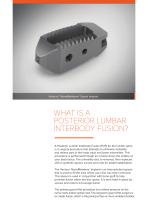
Ventura™ NanoMetalene® Spinal Implant WHAT IS A POSTERIOR LUMBAR INTERBODY FUSION? A Posterior Lumbar Interbody Fusion (PLIF) for the lumbar spine is a surgical procedure that attempts to eliminate instability and relieve pain in the lower back and lower extremities. This procedure is performed through an incision down the midline of your back tissue. The unhealthy disc is removed, then replaced with a synthetic spacer, screws and rods for added stabilisation. The Ventura™ NanoMetalene® Implant is an intervertebral spacer that is used to fill the area where your disc has been removed. This spacer...
Open the catalog to page 4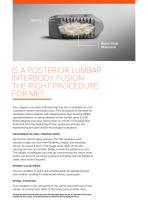
Bone Graft Materaial IS A POSTERIOR LUMBAR INTERBODY FUSION THE RIGHT PROCEDURE FOR ME? Your surgeon may have indicated that you are a candidate for a for a posterior lumbar interbody fusion. This procedure is intended for skeletally mature patients with Degenerative Disc Disease (DDD), spondylolisthesis, or spinal stenosis of the lumbar spine (L2-S1). Some patients may have had at least six months of nonoperative treatment from the beginning of their symptoms and are still experiencing arm pain and/or neurological symptoms. DEGENERATIVE DISC DISEASE (DDD) During the natural aging process, the...
Open the catalog to page 5
PREPARING FOR SURGERY Your surgeon will provide a clinical examination and may conduct some diagnostic tests to ensure you are a candidate for the procedure. These may include MRI, CT scans, and/or X-rays. Your surgeon may provide you with guidance on what to do or not do before your procedure. It is important that you follow your surgeon’s recommendations in preparation of your surgical procedure.
Open the catalog to page 6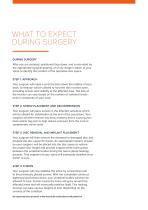
WHAT TO EXPECT DURING SURGERY DURING SURGERY After you are sedated, positioned face down, and surrounded by the appropriate surgical draping, an X-ray image is taken of your spine to identify the location of the operative disc space. STEP 1: APPROACH Your surgeon will make a small incision down the midline of your back. A retractor will be utilised to hold the skin incision open, providing access and visibility to the affected area. The size of the incision can vary based on the number of vertebral levels and/or complexity of your case. STEP 2: SCREW PLACEMENT AND DECOMPRESSION Your surgeon will...
Open the catalog to page 7
WHAT TO EXPECT AFTER SURGERY After surgery you will wake up in the recovery room, where your vital signs will be monitored, and your immediate postoperative condition will be carefully observed. Once the medical staff feels that you are doing well, you will be returned to your room in the hospital. Your surgeon will determine the best postoperative course for you. The day after your surgery, your surgeon may instruct you to use a brace for a period of time to assist with the spinal fusion process. Supervised by trained medical professionals, your surgeon may ask you to carefully sit, stand, or...
Open the catalog to page 8
WHAT ARE THE POTENTIAL RISKS? POSSIBLE ADVERSE EVENTS Like other spinal system implants, the following adverse events are possible. This list is not exhaustive. • Delayed union or nonunion (pseudarthrosis). • Bending, disassembly or fracture of implant and components. • Loosening of spinal fixation implants may occur due to inadequate initial fixation, latent infection, and/or premature loading, possibly resulting in bone erosion, migration or pain. • Pain, discomfort, or abnormal sensations due to the presence of the device. • Pressure on skin where inadequate tissue coverage exists over the...
Open the catalog to page 9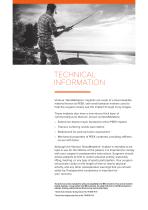
TECHNICAL INFORMATION Ventura™ NanoMetalene® implants are made of a biocompatible material known as PEEK, with small tantalum markers used to help the surgeon clearly see the implant through X-ray images. These implants also have a one-micron thick layer of commercially pure titanium, known as NanoMetalene. • Submicron titanium layer bonded to entire PEEK implant. • Titanium surfacing resists wear debris.¹ • Radiolucent for post-op fusion assessment.² • Mechanical properties of PEEK unaltered, providing stiffness on par with bone.¹ Although the Ventura™ NanoMetalene® implant is intended to be...
Open the catalog to page 10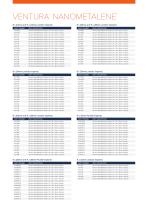
PART NUMBER PART DESCRIPTION PART NUMBER PART DESCRIPTION Ventura NanoMetalane Implant, 9 x 24 x 8mm, Lordotic Ventura NanoMetalene Implant, 9 x 28 x 8mm, Lordotic Ventura NanoMetalene Implant, 9 x 24 x 9mm, Lordotic Ventura NanoMetalene Implant, 9 x 28 x 9mm, Lordotic Ventura NanoMetalene Implant, 9 x 24 x 10mm, Lordotic Ventura NanoMetalene Implant, 9 x 28 x 10mm, Lordotic Ventura NanoMetalene Implant, 9 x 24 x 11mm, Lordotic Ventura NanoMetalene Implant, 9 x 28 x 11mm, Lordotic Ventura NanoMetalene Implant, 9 x 24 x 12mm, Lordotic Ventura NanoMetalene Implant, 9 x 28 x 12mm, Lordotic Ventura...
Open the catalog to page 11
CONTACT INFORMATION A notice that any serious incident that occurs in relation to the device should be reported to the manufacturer and to the TGA. Any serious incident that occurs in relation to the device should be reported to SeaSpine® via phone, fax, or email. When possible, retain the product involved in the complaint and return to SeaSpine as instructed by SeaSpine Customer Service; [email protected] and the Therapeutic Goods Administration (TGA) www.tga.gov.au. SeaSpine intends that this device should be used only by surgeons having received proper training in the use of the device....
Open the catalog to page 12All SeaSpine catalogs and technical brochures
 SIERRA
12 Pages
 NORTHSTAR® OCT
12 Pages
 NEWPORT™
12 Pages
 REEF® TO & REEF TA
16 Pages
 MARINER® OUTRIGGER®
12 Pages
 MARINER® MIS
16 Pages
 MARINER® MIDLINE
12 Pages
 MARINER
16 Pages
 REGATTA®
12 Pages
 SHORELINE® ACS
12 Pages
 SHORELINE RT
12 Pages
- Bone plate
- Interbody fusion cage
- PEEK interbody fusion cage
- Anterior interbody fusion cage
- Arthrodesis plate
- Spinal stabilization system
- Posterior spinal osteosynthesis unit
- Metallic arthrodesis plate
- Adult spinal osteosynthesis unit
- Cervical interbody fusion cage
- Titanium interbody fusion cage
- Locking arthrodesis plate
- Cervical vertebra arthrodesis plate
- Thoraco-lumbar osteosynthesis unit
- 2 levels arthrodesis plate