- Catalogs
- Sempermed Industrial
- CHANGES IN THE REGULATORY FRAMEWORK FOR PROTECTIVE GLOVES

CHANGES IN THE REGULATORY FRAMEWORK FOR PROTECTIVE GLOVES

CHANGES IN THE REGULATORY FRAMEWORK FOR PROTECTIVE GLOVES
The EN ISO 374-1:2016 standard outlines requirements for chemical protective gloves, categorizing them into three types based on their permeation resistance to chemicals. Type A gloves must resist at least six chemicals for over 30 minutes, Type B gloves must resist three, and Type C gloves must resist one for over 10 minutes.
From April 2018, the PPE Regulation (EU) 2016/425 replaces the previous directive, impacting the certification and labeling of protective gloves. Declarations of Conformity will be accessible online via QR codes on packaging.
The list of chemicals in EN ISO 374-1 has been expanded by six additional chemicals. EN 374-4 introduces degradation testing to assess changes in glove material properties after chemical exposure, though no performance requirements are set for degradation.
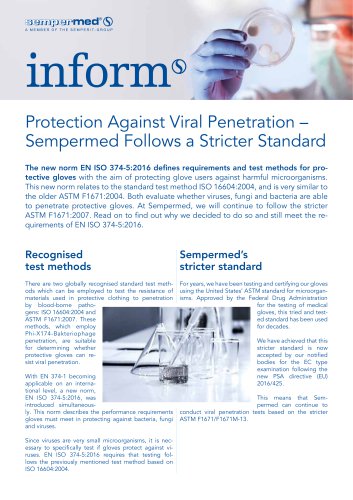
EN ISO 374-5:2016 specifies requirements for gloves protecting against micro-organisms, including viruses, fungi, and bacteria, using ISO 16604:2004 testing standards.
Sempermed continues to adhere to stringent ASTM standards for micro-organisms, recognized by the FDA and EU bodies. Transition plans are in place to ensure compliance with the new PPE Regulation, with ongoing testing and certification of gloves to the latest standards.
Catalog excerpts

YOUR GLOBAL GLOVE EXPERT YOUR GLOBAL GLOVE EXPERT CHANGES IN THE REGULATORY FRAMEWORK FOR PROTECTIVE GLOVES THE NEW PPE REGULATION In April 2018, a new PPE Regulation (EU) 2016/425 will become applicable and replace the existing P PE irective 89/686/EEC. D In future, the Declaration of Conformity for PPE-labelled gloves will be accessible on our website and packaging will include a direct link (QR Code) to access the Declaration of Conformity for each product! THE NEW EN ISO 374-1:2016 STANDARD FOR CHEMICAL PROTECTIVE GLOVES The new standard considers three types of chemical protective gloves: TYPE A GLOVES need to achieve at least a permeation level of 2 (longer than 30 min.) against six of the chemicals listed in EN ISO 374-1. As a minimum the six tested chemicals shall be identified by their code letters under the flask pictogram. TYPE B GLOVES need to achieve at least a permeation level of 2 (longer than 30 min.) against at least three of the chemicals listed in EN ISO 374-1. The tested chemicals shall be identified by their code letter under the flask pictogram. TYPE C GLOVES need to achieve at least a permeation level 1 (longer than 10 min.) against one of the chemicals listed in EN ISO 374-1. Sempermed Always keeping you up to date.
Open the catalog to page 1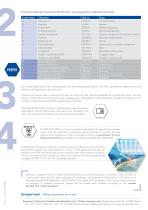
The list of challenge chemicals in EN ISO 374-1 was enlarged by 6 additional chemicals: As a newly added part to the standard series of chemical protective gloves, EN 374-4 specifies the determination of resistance to degradation by chemicals. Coming into contact with a chemical can have an impact on the material properties of a protective glove, not only during contact with the chemical but also subsequently. Degradation testing therefore includes the testing of the change of material's properties after exposure to chemicals. Although EN ISO 374-1 contains no performance requirements for degradation,...
Open the catalog to page 2All Sempermed Industrial catalogs and technical brochures
 inform
2 Pages
 Sempermed® SUPREME
3 Pages
 Sempermed® syntegra green
2 Pages
 SEMPERMED® SYNTEGRA UV
2 Pages
 Sempermed® VELVET
2 Pages
 Sempermed® supreme duo
4 Pages