

SenTec Digital Monitoring System

SenTec Digital Monitoring System
- Continuous Monitoring: Provides real-time data on tcPCO2, supporting therapy guidance for neonates.
- Noninvasive and Accurate: Utilizes a Stow-Severinghaus type electrode for reliable PCO2 measurement.
- Display Options: Offers trends for tcPCO2 and heating power, along with baseline and delta values.
- Smart Calibration: Automatic calibration management with a docking station ensures readiness and accuracy.
- Transportable Design: Lightweight with mounting options and up to 10 hours of battery life.
- Connectivity: Compatible with major patient monitoring systems like GE, Philips, and Dräger.
- Safe Sensor Temperature: Recommended low sensor temperature of 41°C allows up to 8 hours of continuous monitoring.
- Artifact Detection: Automatic data quality verification ensures reliable readings.
- Easy Application: Multi Site Attachment Rings (MAR) facilitate gentle sensor application and removal.
Catalog excerpts
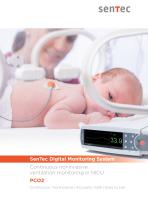
SenTec Digital Monitoring System Continuous noninvasive ventilation monitoring in NICU PCO2 Continuous | Noninvasive | Accurate | Safe | Easy to Use
Open the catalog to page 1
Transcutaneous, noninvasive blood gas monitoring End-tidal CO2 (etCO2) monitoring is sometimes inefficient in patients with small tidal volumes3 and inapplicable in certain ventilation modes such as HFO4. Overcoming limitations of arterial blood gases, etCO2 and SpO2 monitoring Assessing ventilation in neonatal patients is a challenge. Maintaining normal PaCO2 ranges in neonates is important as abnormal PaCO2 values may have detrimental effects on neonates’ brain and lungs. Neonates in critical care units often have fluctuations of PaCO21. Measuring SpO2 alone is not sufficient to detect hyperventilation...
Open the catalog to page 2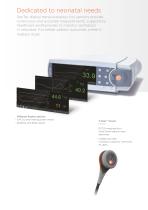
Dedicated to neonatal needs SenTec digital transcutaneous (tc) sensors provide continuous and accurate measurements, supporting healthcare professionals to monitor ventilation in neonates. For better patient outcomes where it matters most. Different display options: – tcPCO2 and heating power trends – baseline and delta values V-Sign™ Sensor PCO2 PCO2 measured by a Stow-Severinghaus type electrode. – reliable and safe – clinically trusted for more than 1
Open the catalog to page 3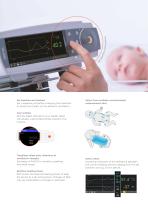
Set baseline and markers Set a baseline just before changing the treatment to assess the impact on the patient's ventilation. Select from multiple recommended measurement sites User profiles Quickly adapt settings to your needs: select individually customized profiles stored in the monitor. Trendlines allow early detection of ventilation changes Estimates of PaCO2 in trendline, baselines and delta values. Relative Heating Power RHP shows the required heating power to keep the sensor at a set temperature. Changes of RHP may be attributable to changes in perfusion. Delta values Numerical indication...
Open the catalog to page 4
Effective and efficient monitoring Save your time for the important tasks. Smart CalMem Disconnect the sensor (e.g. to untangle cables or to move the patient) without removing the sensor from the patient. No need to recalibrate the sensor when re-connecting. Multi Site Attachment Rings (MAR) The design enables a gentle sensor application and a smooth removal without damaging the sensitive skin. Transportable Lightweight, dedicated mounting plates / roll stands, and battery life up to 10 hours. Automatic calibration management Simply store the sensor in the Docking Station – calibration is fully...
Open the catalog to page 5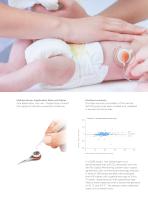
Making Sensor Application Safer and Easier One application, one vial – Single Dose Contact Gel supports infection prevention initiatives. Excellent accuracy The high accuracy and safety of the SenTec tcPCO2 sensor has been studied and validated in several clinical studies. Mean carbon dioxide tension [mmHg] In a 2018 study5, Van Weteringen et al. demonstrated that tcPCO2 measured with the SenTec Digital Monitoring System was in good agreement with conventional blood gas analysis. A total of 238 blood samples were analyzed from 69 infants with a gestational age of 24 to 31 weeks. Depending on...
Open the catalog to page 6
Safe sensor temperature and site time management – A low sensor temperature of 41 °C for tcPCO26,7 is recommended and allows for up to 8 hours continuous monitoring in neonatal patients. – Redundant sensor temperature controls to avoid the risk of skin irritations – Automatic, customizable site time control and site inspection intervals – Safety-relevant parameters are password protected. Automatic artifact detection – Automatic data quality verification and artifact detection Best signal quality Digital Sensor with integrated CPU. Measured signals are digitized and preanalyzed in the sensor...
Open the catalog to page 7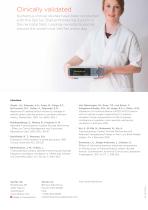
Clinically validated Numerous clinical studies have been conducted with the SenTec Digital Monitoring System in the neonatal field. Leading neonatal hospitals around the world trust SenTec every day. Mukhopadhyay, S., Maurer, R., Puopolo, K. M. Neonatal Transcutaneous Carbon Dioxide Monitoring - Effect on Clinical Management and Outcomes, Respiratory Care, 2016, 61(1), 90–97. Brouillette, R. T., Waxman, D.H. Evaluation of the newborn’s blood gas status, 1997, Clinical Chemistry 43:1, 215-221. Berkenbosch, J. W., Tobias, J. Transcutaneous carbon dioxide monitoring during high frequency oscillatory...
Open the catalog to page 8All Sentec catalogs and technical brochures
 Watch the lungs breathe!
4 Pages


- Patient monitor
- Blood pressure patient monitor
- SpO2 patient monitor
- Portable patient monitor
- NIBP patient monitor
- Intensive care patient monitor
- Non-invasive ventilator
- TEMP patient monitor
- Compact patient monitor
- Clinical patient monitor
- Respiratory frequency patient monitor
- CO2 patient monitor
- Heart rate patient monitor
- Portable ventilator
- Continuous patient monitor
- Intensive care ventilator
- Emergency ventilator
- CPAP ventilator
- Transport ventilator
- Tabletop patient monitor