

SenTec V-Sign™ Illuminate Ventilation and Oxygenation

SenTec V-Sign™ Illuminate Ventilation and Oxygenation
Catalog excerpts
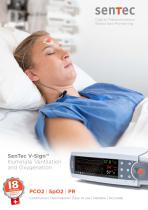
Digital Transcutaneous Blood Gas Monitoring SenTec V-Sign™ Illuminate Ventilation and Oxygenation PCO2 | SpO2 | PR Continuous | Noninvasive | Easy to use | Reliable | Accurate
Open the catalog to page 1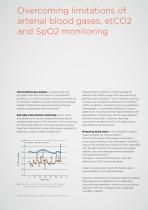
Overcoming limitations of arterial blood gases, etCO2 and SpO2 monitoring Arterial blood gas analysis is invasive and only provides snap-shot information on the patient’s condition. It is vital to provide continuous monitoring of critically ill patients, whose condition may change rapidly. Furthermore, frequent arterial blood gas analysis is associated with blood loss.1 * End-tidal CO2 (etCO2) monitoring has its limits for patients with chronic respiratory failure due to ventilation-perfusion (V/Q) mismatch. The monitoring of etCO2 also depends on the gas sampling quality (leak-free masks and...
Open the catalog to page 2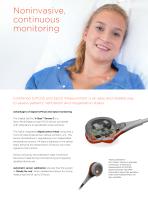
Noninvasive, continuous m onitoring Combined tcPCO2 and SpO2 measurement is an easy and reliable way to assess patients’ ventilation and oxygenation status. Advantages of digital tcPCO2 and SpO2 monitoring The Digital SenTec V-Sign™ Sensor 2 is a Stow-Severinghaus-type PCO2 Sensor combined with reflectance 2-wavelength pulse oximetry. The highly integrated digital sensor head comprises a micro pH-electrode and an optical oximetry unit. The sensor temperature is regulated by two independent temperature sensors. All data is digitized in the sensor head, allowing the transmission of robust, low-noise...
Open the catalog to page 3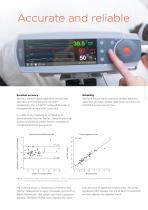
Excellent accuracy SenTec’s sophisticated algorithms ensure high accuracy and minimal technical drift.5 Additionally, the V-STATS™ software provides a retrospective residual drift correction. Reliability SenTec‘s unique transcutaneous artifact detection algorithm provides reliable data when conventional tcPCO2 monitors tend to fail. In a 2012 study, Prashant N. Chhajed et al. demonstrated that the SenTec Digital Monitoring System provided accurate results compared to conventional blood gas analysis. Linear regression plot 10 Bland-Altman difference plot 2 Fig. 2 0 patients were included in the...
Open the catalog to page 4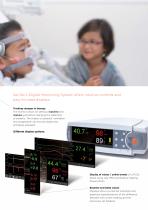
SenTec’s Digital Monitoring System offers intuitive controls and easy-to-read displays. Tracking changes in therapy The monitor allows for setting a baseline and markers just before changing the treatment of patients. The impact on patients’ ventilation and oxygenation can thus be objectively and easily assessed. Different display options: Display of values / online trends of tcPCO2, SpO2, pulse rate (PR) and Relative Heating Power (RHP). Baseline and Delta values Displays show a numerical indication and graphical representations of the difference between the current reading and the previously...
Open the catalog to page 5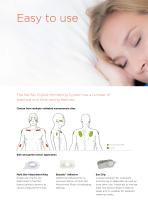
The SenTec Digital Monitoring System has a number of practical and time-saving features. Choose from multiple validated measurement sites Safe and gentle sensor application Multi Site Attachment Ring Single-use ring for the attachment of SenTec transcutaneous sensors to various measurement sites. Staysite™ Adhesive Additional adhesive film to improve fixation of Multi Site Attachment Ring in challenging settings. Ear Clip A great solution for overnight monitoring in sleep labs as well as long-term use. Attached to the ear lobe, the sensor doesn’t disturb sleep and is suitable for patients wearing...
Open the catalog to page 6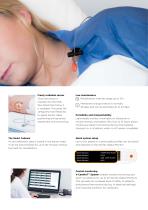
Freely rotatable sensor Once the sensor is inserted into the Multi Site Attachment Ring, it is rotatable. This gives the caregivers more flexibility to adjust sensor cable positioning during sensor attachment and monitoring. The Smart Calmem As the calibration data is stored in the sensor head, it can be disconnected for up to 30 minutes without the need for recalibration. Low maintenance 12h Recalibration intervals range up to 12 h. 42 Membrane change interval is normally 28 days and can be extended up to 42 days. Portability and transportability Lightweight monitor, mountable on rollstands...
Open the catalog to page 7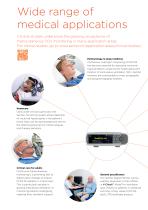
Wide range of medical applications Clinical studies underscore the growing acceptance of transcutaneous CO2 monitoring in many application areas. For clinical studies, go to www.sentec.ch/application-areas/clinical-studies/ Pulmonology & sleep medicine Continuous, overnight monitoring of tcPCO2 has become essential for assessing nocturnal hypoventilation, screening for hypercapnia and titration of noninvasive ventilation (NIV). SenTec monitors are connectable to most polygraphic and polysomnography systems. Homecare Used under clinical supervision, the SenTec monitoring system allows detection...
Open the catalog to page 8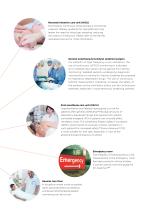
Neonatal intensive care unit (NICU) Noninvasive, continuous transcutaneous monitoring supports therapy guidance for neonatals and may lessen the need for blood gas sampling, reducing the chance of infections. Please refer to the SenTec neonatal brochure for more information. General anesthesia/procedural sedation/surgery For patients on high frequency or jet ventilation, the use of continuous tcPCO2 monitoring is indicated, as no reliable CO2 values can be gained from etCO2 monitoring. Sedated patients undergoing diagnostic interventions or minimally invasive surgeries are exposed to respiratory...
Open the catalog to page 9
Valuable insights Making treatment decisions based on data analysis. V-STATS™ software enables users to download trend data from the internal memory of the monitor and display it on the PC screen for further analysis, reporting, and generation of a printable report. Data download is possible via serial or LAN interface. Parameters and safety relevant settings such as alarm system management, site time and temperature management are easily configured and saved/stored as user profiles within the V-STATS™ software. All departments can have their specific profiles to support their transcutaneous...
Open the catalog to page 10
Broad connectivity Patient data from the SenTec Digital Monitor can be transferred to bedside monitors, PCs, nurse call systems, chart recorders or data loggers. Polygraphic (PG) and polysomnography (PSG) systems Various ready-made adapter cables and interfaces are available to connect the SenTec Digital Monitor to the most common PG or PSG systems, including innovative wireless solutions with Nox Medical. For more information, please refer to the following link: www.sentec.ch/fileadmin/PSG/ ProductInfoPSGAdapterCables.pdf Connectivity to patient monitoring systems and electronic medical record...
Open the catalog to page 11All Sentec catalogs and technical brochures
 Watch the lungs breathe!
4 Pages


- Patient monitor
- Blood pressure patient monitor
- SpO2 patient monitor
- Portable patient monitor
- NIBP patient monitor
- Intensive care patient monitor
- Non-invasive ventilator
- TEMP patient monitor
- Compact patient monitor
- Clinical patient monitor
- Respiratory frequency patient monitor
- CO2 patient monitor
- Heart rate patient monitor
- Portable ventilator
- Continuous patient monitor
- Intensive care ventilator
- Emergency ventilator
- CPAP ventilator
- Transport ventilator
- Tabletop patient monitor