
- Catalogs
- Sequana Medical
- alfapump brochure

alfapump brochure

alfapump brochure
The document introduces the alfapump® System, a medical device designed for the automatic and continual removal of ascites, offering an alternative to the traditional large volume paracentesis (LVP) procedure. The system aims to improve the quality of life for patients with refractory ascites, a condition often resulting from advanced liver disease.
Background and Need
Refractory ascites management through LVP is invasive and poses risks such as circulatory dysfunction and reduced mobility. With increasing cases due to liver diseases linked to hepatitis and obesity, there is a pressing need for improved treatment options.
alfapump® System Overview
The alfapump system is the first of its kind, automatically transferring ascites to the bladder for natural excretion. It significantly reduces the need for LVP, enhancing patient quality of life and reducing healthcare burdens. Clinical studies show a reduction in paracentesis frequency from once every 9 days to once every 127 days.
Benefits
- Reduces or eliminates the need for LVP, allowing patients to lead more normal lives.
- Decreases risks associated with repeated LVP.
- Does not affect liver transplant eligibility.
- Frees up healthcare resources and reduces costs.
- Proven safe and effective in clinical settings.
System Components and Functionality
The system includes subcutaneously implanted components such as catheters and a battery-powered pump. It features pressure sensors and a smart charger for efficient operation. The implantation procedure is minimally invasive, taking under an hour.
Patient Experience
A case study highlights the positive impact on a patient who previously required frequent paracentesis. Post-implantation, the patient experienced no further need for the procedure and reported improved quality of life.
Cost Efficiency
The alfapump system offers potential cost savings by reducing hospital visits and associated expenses. Initial costs are offset within 6 to 9 months through decreased reliance on paracentesis.
Conclusion
The alfapump system represents an advanced medical treatment option that addresses the challenges of managing refractory ascites, offering both clinical and economic benefits.
For more information, visit www.alfapump.com.
Catalog excerpts

The alfapump® System The first and only system for the automatic and continual removal of ascites Information for Healthcare Professionals
Open the catalog to page 1
Healthcare is about helping those who need help. But does paracentesis really help? We were sure that we could do better. The treatment of refractory ascites is and has always been a burden to both physicians and patients. The only option for many patients is large volume paracentesis (LVP), an invasive and lengthy procedure, which has remained largely unchanged for centuries. Managing refractory ascites with LVP exposes patients to the risk of repeated invasive procedures, circulatory dysfunction, reduced mobility, malnutrition and hernia, and this in a patient group already battling a serious...
Open the catalog to page 2
The alfapump® system The first and only system for the automatic and continual removal of ascites. The alfapump system automatically and continually collects ascites and moves it to the bladder, where it is excreted naturally from the body. We are proud, that by significantly reducing the need for paracentesis, alfapump benefits patients, physicians and nursing staff alike. In our clinical study, the alfapump sys- tem significantly reduced the median number of paracentesis procedures from 3.4 in the month prior to implant to 0.2 per month afterwards – in other words, from once every 9 days to...
Open the catalog to page 3
Custom designed and engineered for refractory ascites • Automatic and continual removal of ascites • Fully implantable system, with no external or visible components • Pump volumes tailored to the individual patient requirements • Unique mechanisms to ensure optimal performance, including anti-blockage system, bladder and abdominal pressure sensors and unidirectional flow design • Brief recharging using wireless smart charger • Minimally invasive implantation procedure takes under one hour Surgical implantation The alfapump system is implanted subcutaneously using a minimally invasive procedure....
Open the catalog to page 4
Components: alfapump® The alfapump is a subcutaneously implanted battery powered pump that is charged through the skin. It ensures controlled and continual removal of ascites according to a programmed schedule set by the physician. Pressure sensors monitor pressure in the peritoneal cavity and bladder to ensure optimal fluid management. The alfapump can move up to four litres of ascites per charge. Smart Charger The handheld smart charger is used by the patient to charge the alfapump through the skin. During charging the smart charger collects and records pump activity which can be downloaded...
Open the catalog to page 5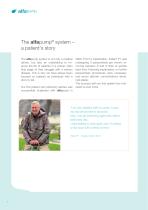
The alfapump® system – a patientʼs story The alfapump system is not only a medical device, but also an undertaking to improve the life of patients in a critical, often final stage of their struggle with a serious disease. This is why we have always been focused on patients as individuals with a story to tell. Our first patient with refractory ascites was successfully implanted with alfapump in 2009. Prior to implantation, Patient P1 was undergoing 3 paracentesis per month, removing between 6 and 8 litres of ascites each time. Following implantation, no further paracentesis procedures were necessary,...
Open the catalog to page 6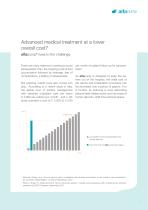
Advanced medical treatment at a lower overall cost? alfapump® rises to the challenge. There are many reasons for wanting to avoid paracentesis. Pain, the ongoing cycle of fluid accumulation followed by drainage, fear of complications, a feeling of helplessness. But lowering overall costs also comes into play. According to a recent study in Italy, the global cost of ascites management with standard outpatient care can reach € 3,893 per patient per month1, and a UK study reported a cost of £ 3,500 (€ 4,378) per month of patient follow-up for paracentesis2. As alfapump is designed to keep the patient...
Open the catalog to page 7
For more information on the alfapump® system visit Sequana Medical AG Technoparkstrasse 1 8005 Zurich Switzerland Telefon: +41 44 403 55 00 Fax: +41 44 403 55 09 www.sequanamedical.com Sequana Medical is a Swiss medical device company dedicated to improving patient lives by providing innovative solutions to manage fluid balance within the body. Refer to package insert provided with the product for complete Instructions for Use, Contraindications, Potential Adverse Effects, Warnings and Precautions prior to using this product. Information for use only in countries with applicable health authority...
Open the catalog to page 8