
- Catalogs
- SETARAM Instrumentation
- SOLUTIONS-STA-TGA-EGA

SOLUTIONS-STA-TGA-EGA

SOLUTIONS-STA-TGA-EGA
This document by Setaram discusses solutions for coupling STA/TGA with Evolved Gas Analysis (EGA) techniques, focusing on Mass Spectrometry (TGA-MS), Fourier Transformed Infra-Red Spectrometry (TGA-FTIR), and Gas Chromatography-Mass Spectrometry (TGA-GC/MS). These techniques are used to analyze gases evolved during thermal analysis, providing insights into the chemical reactions and decomposition processes of materials.
The TGA-MS coupling involves transferring gases evolved from the sample in the TGA furnace to a mass spectrometer via a heated capillary tube. The pressure difference facilitates rapid transfer, preventing exposure to temperatures below 300°C. The mass spectrometer separates ionized molecules by their mass-to-charge ratio (m/z), allowing for the monitoring of specific m/z signals and acquisition of full spectra. This method is effective for identifying gases like CO2 during processes such as the decarbonatation of dolomite.
EGA techniques are crucial for identifying the products of reactions or decompositions in thermogravimetry. While TG-DTA or TG-DSC can measure mass changes and heat effects, they do not identify reaction products. EGA, through techniques like TGA-MS, provides detailed insights into the chemistry of reactions by identifying evolved species.
This system accelerates evolved gases to supersonic speeds, ensuring instantaneous transfer to the ion source and preventing condensation. It is suitable for detecting heavy molecules, with mass spectrometers capable of handling amu ranges up to 1024.
In TGA-FTIR, gases flow through a heated transfer line into an FTIR gas cell, where chemical groups are identified by their IR absorption. The Gram-Schmidt signal overlays with mass variation, and spectra can be compared with reference libraries for substance identification. This method is effective for analyzing biopolymers and wood samples.
TGA-GC/MS is popular for analyzing complex organic substances. Gas chromatography separates evolved species before mass spectrometry identification. The system includes a heated sampling loop for precise coordination with the TGA oven. Three sampling modes are available: discrete, quasi-continuous, and timed, each offering different benefits for analyzing decomposition processes.
The techniques are applicable in various fields, including gasification, pyrolysis, combustion, adsorption, desorption, calcination, dehydration, dehydroxylation, decarbonatation, thermal stability, compositional analysis, oxidation, residual solvents, polycondensation, and curing. Typical materials analyzed include coal, biomass, wastes, catalysts, sorbents, minerals, pharmaceuticals, polymers, metals, and alloys.
Multiple coupling techniques like TG-GC/MS-FTIR or TG-MS-FTIR are available for TGA and STA instruments. Each technique offers specific features and benefits, such as best detection limits, fast transfer times, and applicability to small mass variations or complex gas blends. Instruments like Sensys Evo, Labsys Evo, and SETSYS Evolution support these techniques across a wide temperature range from -120°C to 2400°C.
Catalog excerpts
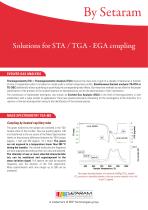
By Setaram Solutions for STA / TGA - EGA coupling EVOLVED GAS ANALYSIS Thermogravimetry (TG) or Thermogravimetric Analysis (TGA) measure the mass loss or gain of a sample of material as a function of time or temperature when it is heated or cooled under a certain temperature profile. Simultaneous thermal analysis (TG-DTA or TG-DSC) additionally allows qualifying or quantifying the corresponding heat effects. But these two methods do not allow for the proper identification of the products of the studied reactions or decompositions and for the determination of their mechanism. The contribution of hyphenated techniques, also known as Evolved Gas Analysis (EGA) in the field of thermogravimetry is well established, with a large number of applications. They have proved particularly interesting for the investigation of the chemistry of a reaction or thermal decomposition owing to the identification of the evolved species. MASS SPECTROMETRY TGA-MS Coupling by heated capillary tube The gases evolved by the sample are collected in the TGA furnace close to the crucible. They are quickly (approx. 100 ms) transferred to the ion source of the Mass Spectrometer thanks to the pressure difference between the TGA furnace (approx. 1 bar) and MS (approx. 10-7 mbar). The gases are not exposed to a temperature lower than 300 °C during the transfer. The ionized molecules and fragments are then separated according to their m/z ratio and detected. The intensity of one or more selected characteristic m/z can be monitored and superimposed to the mass variation signal. Full spectra can also be acquired frequently over the duration of the TGA experiment. Mass spectrometers with amu ranges up to 300 can be employed. Two-steps decarbonatation of a dolomite (CaMg) (CO3)2 sample CO2 evolution is identified thanks to the ion current intensity of m/z 44, 6 and 12 signals
Open the catalog to page 1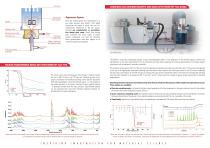
Sampling orifice Skimming cone orifice Skimming cone Primary pump Formation of Mach disk Beam of molecules at supersonic speed To the ionic source of the MS COMBINED GAS CHROMATOGRAPHY AND MASS SPECTROMETRY TGA-GC/MS Supersonic System Here the evolved gases are accelerated by a two steps pressure drop system. Their speed overcoming the speed of sound, they are instantaneously transferred to the ion source, avoiding any condensation or recombination during their route. Heavy, high boiling point molecules like metal vapors or polyaromatic compounds can thus be detected. Mass spectrometers with...
Open the catalog to page 2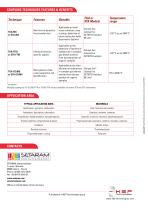
COUPLING TECHNIQUES FEATURES & BENEFITS A trademark of KEP Technologies group pirana.net • Specifications are given as indications only and are not contractual • 05/15
Open the catalog to page 3All SETARAM Instrumentation catalogs and technical brochures
 CALISTO
4 Pages
 BTC
BTC2 Pages
 96 Line TMA
8 Pages
 AlexSys
4 Pages
 96 Line DTA / DSC
8 Pages
 LABSYS evo DTA/DSC
5 Pages
 TCi
TCi6 Pages
 Brochure-LABSYS evo
5 Pages
 C80
C808 Pages
 Poster-µDSC7 evo
1 Page
 µDSC7 evo
3 Pages
