
- Catalogs
- Shandong Newheek Image Equipment
- Veterinary radiography flat panel detector NK3543W,Multipurpose radiography flat panel detector NK4343W,Multipurpose radiography flat panel detector NK3543Z,Multipurpose radiography flat panel detector NK4343V,Veterinary radiography flat panel detector NK


- Company
- Products
- Catalogs
- News & Trends
- Exhibitions
Veterinary radiography flat panel detector NK3543W,Multipurpose radiography flat panel detector NK4343W,Multipurpose radiography flat panel detector NK3543Z,Multipurpose radiography flat panel detector NK4343V,Veterinary radiography flat panel detector NK
1 / 3 PagesView full catalog
Veterinary radiography flat panel detector NK3543W,Multipurpose radiography flat panel detector NK4343W,Multipurpose radiography flat panel detector NK3543Z,Multipurpose radiography flat panel detector NK4343V,Veterinary radiography flat panel detector NK
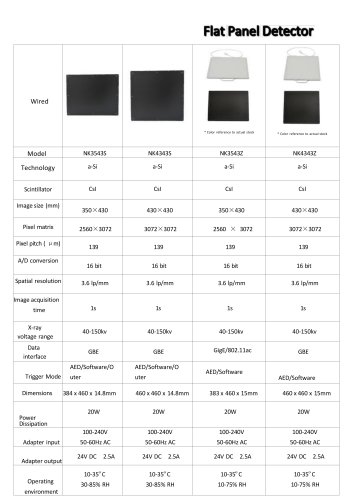
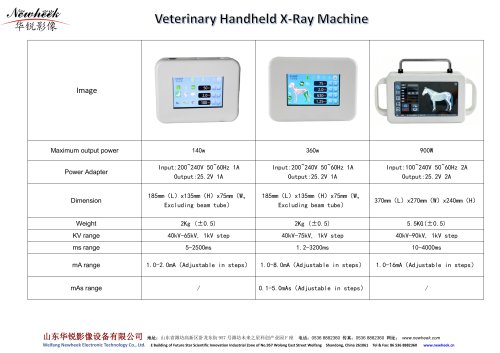
Product catalog summary
Overview: The document provides technical specifications for various models of wired and wireless imaging devices, focusing on their technology, image capabilities, power requirements, and operating conditions.
Specifications:
- Technology and Scintillator: All models use a-Si technology with CsI scintillators.
- Image Size and Pixel Matrix: Image sizes are either 350×430 mm or 430×430 mm, with pixel matrices ranging from 2304×2800 to 3072×3072.
- Pixel Pitch and A/D Conversion: Pixel pitch is either 139 μm or 150 μm, with 16-bit A/D conversion across all models.
- Spatial Resolution: Ranges from 3.4 lp/mm to 3.6 lp/mm.
- Image Acquisition Time: Wired models acquire images in 1 second, while wireless models take 2 to 2.5 seconds, with some variations up to 5 seconds.
- X-ray Voltage Range: Consistent across models at 40-150kv.
Data Interface and Power:
- Data Interface: Wired models use GBE, while wireless models support GBE/802.11ac and IEEE802.11 a/b/g/n/ac.
- Power Dissipation: All models have a power dissipation of 20W.
- Adapter Input/Output: Input is 100-240V, 50-60Hz AC, with an output of 24V DC, 2.5A.
Operating Environment:
- Temperature and Humidity: Operating temperatures range from 5-35ºC, with humidity levels between 10-90% RH depending on the model.
Additional Features:
- Trigger Mode: Options include AED, Software, and Outer, with some models offering AED as optional.
- Battery Standby: Wireless models offer up to 8 hours of standby time.
See more
Catalog excerpts
Pixel matrix Spatial resolution Image acquisition Flat Panel Detector NK3543Z Adapter output
Open the catalog to page 1All Shandong Newheek Image Equipment catalogs and technical brochures
 Image Intensifier
1 Page
 X-ray tube assembly
10 Pages
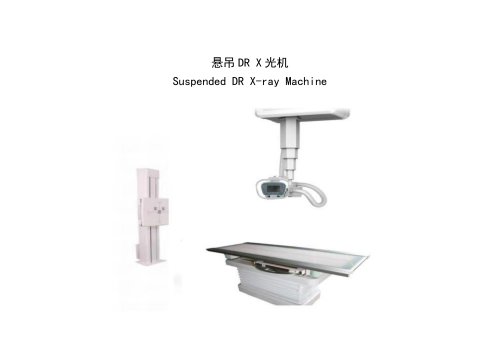 Suspended DR X-ray Machine
7 Pages
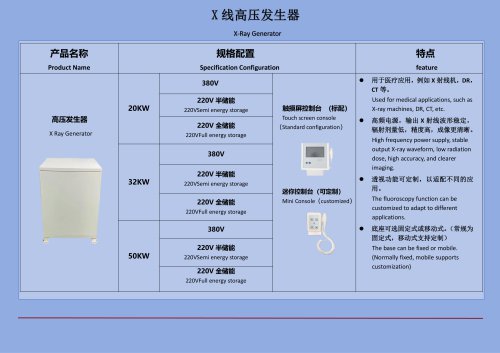 X-Ray Generator
4 Pages
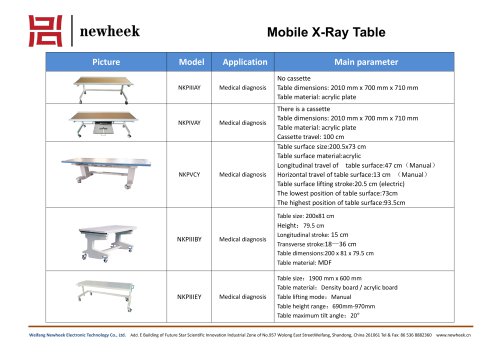 Mobile X-Ray Table
1 Page
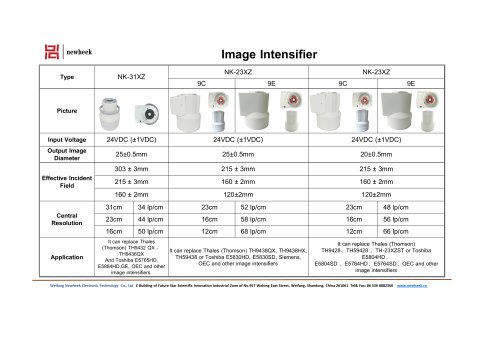 Image intensifier
1 Page
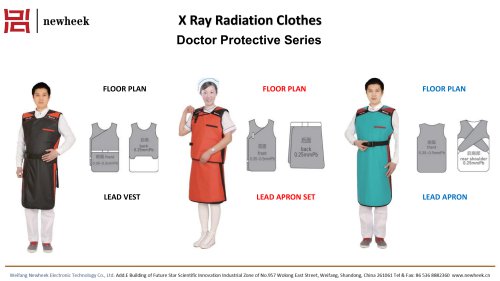 Radiology Accessories
8 Pages
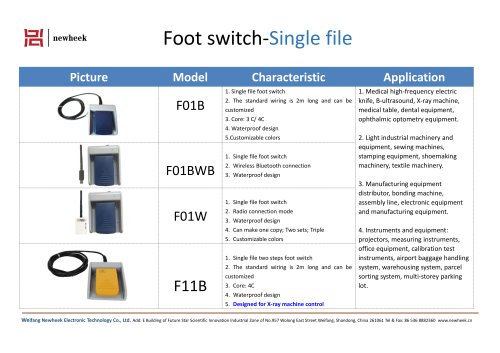 Foot Switch
3 Pages
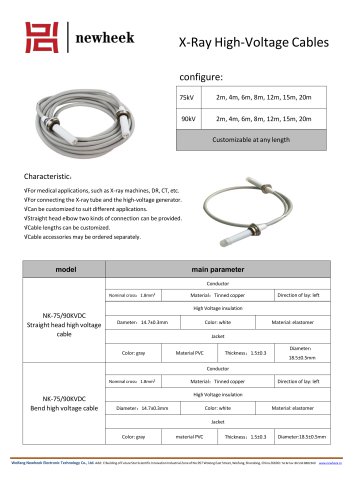 X-Ray High-Voltage Cables
2 Pages
 Bucky Stand
8 Pages
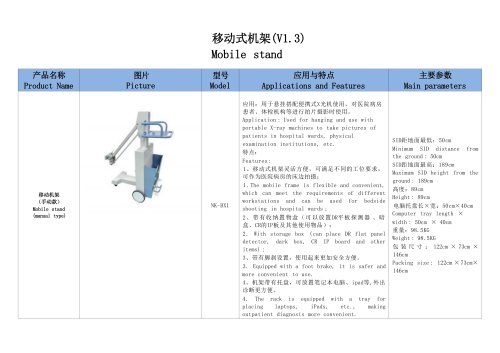 Mobile stand
5 Pages


Related Searches
- Medical support arm
- Digital radiography system
- Multipurpose radiography system
- X-ray system
- Articulated support arm
- Multipurpose radiography X-ray system
- Connector
- Front protection X-ray protective clothing
- Portable flat panel detector
- 0.50 mm X-ray protective clothing
- Dental radiography system
- Multipurpose radiography flat panel detector
- X-ray protective apron
- Front protection X-ray protective apron
- Radiography system with floor-standing bucky
- 0.35 mm X-ray protective clothing
- Digital dental radiography system
- Veterinary X-ray system
- 0.25 mm X-ray protective clothing
*Prices are pre-tax. They exclude delivery charges and customs duties and do not include additional charges for installation or activation options. Prices are indicative only and may vary by country, with changes to the cost of raw materials and exchange rates.
About MedicalExpo
MedicalExpo is a marketplace that offers B2B players a complete experience, from product sourcing to purchase. MedicalExpo is an entity of VirtualExpo Group.
Are you a buyer?
Are you a supplier?