

- Company
- Products
- Catalogs
- News & Trends
- Exhibitions
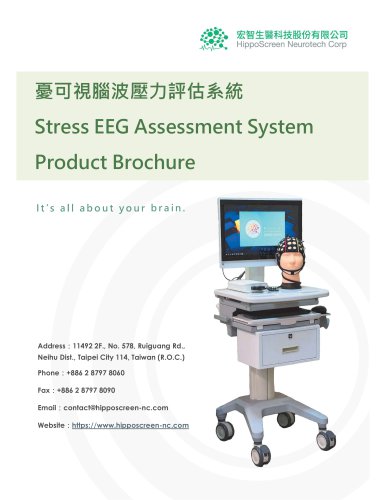
Brain Degeneration Risk Assessment System Brochure_ENG
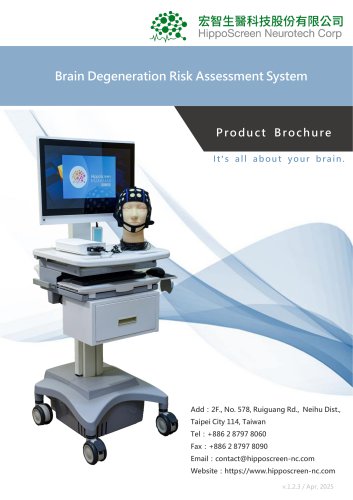
Brain Degeneration Risk Assessment System Brochure_ENG
The document highlights the growing global concern of dementia, with over 55 million people affected worldwide. The World Health Organization ranks dementia as the 7th leading cause of death, emphasizing the need for accurate and rapid assessments.
Introduction
The Brain Degeneration Risk (BDR) Assessment System is designed to detect mild cognitive impairment (MCI), a precursor to Alzheimer's disease. It uses an EEG device, a user interface, and AI algorithms to analyze brainwave data, providing objective assessments of cognitive decline risk.
Empirical Evidence
Research confirms the method's accuracy, with collaborations involving four medical centers in Taiwan. The system is fast, requiring only two minutes of brainwave data, and is safe and convenient, using non-invasive techniques.
Clinical Indicators
The system assesses two indicators: Normal Aging and Mild Degeneration, with probabilities of 36% and 81% respectively. It helps differentiate between normal aging and cognitive decline, allowing for timely medical intervention.
Device Specifications
The system includes an 8-channel EEG amplifier, cleared by the US FDA and Taiwan FDA, and is ISO 13485 certified. A portable version is available for increased mobility.
System Structure
Brainwave signals are collected and processed through an EEG cap and amplifier, with data analyzed via AI algorithms in the cloud. Reports are accessible remotely by healthcare professionals.
Examination Flow
The testing process takes 15-20 minutes, involving EEG cap fitting, data collection, and report generation. The subject relaxes while data is captured, ensuring minimal interference.
Practical Application
Testing requires an isolated environment to avoid interference. The setup includes a small space, table, chair, and monitor.
Assessment Report
Reports include basic subject information, power spectral density plots, and BDR indicator scores. The system categorizes results based on probability thresholds.
FDA Listing
The BDR system is the first Taiwan-developed EEG-based technology registered with the FDA for cognitive function assessment, aiding in early detection and monitoring of MCI.
Publications
Collaborations with international researchers have resulted in several publications, demonstrating high classification accuracy in detecting MCI and Alzheimer's disease using EEG data and machine learning techniques.
Catalog excerpts
HippoScreen Neurotech Corp Add : 2F., No. 578, Ruiguang Rd., Neihu Dist Taipei City 114, Taiwan Email : [email protected] Website: https://www.hipposcreen-nc.com
Open the catalog to page 1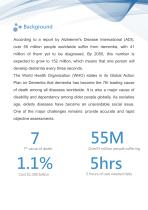
According to a report by Alzheimer's Disease International (ADI), over 55 million people worldwide suffer from dementia, with 41 million of them yet to be diagnosed. By 2050, this number is expected to grow to 152 million, which means that one person will develop dementia every three seconds. The World Health Organization (WHO) states in its Global Action Plan on Dementia that dementia has become the 7th leading cause of death among all diseases worldwide. It is also a major cause of disability and dependency among older people globally. As societies age, elderly diseases have become an unavoidable...
Open the catalog to page 3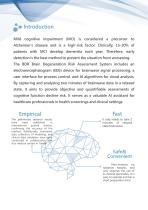
Introduction Mild cognitive impairment (MCI) is considered a precursor to Alzheimer's disease and is a high-risk factor. Clinically, 15-20% of patients with MCI develop dementia each year. Therefore, early detection is the best method to prevent the situation from worsening. The BDR Brain Degeneration Risk Assessment System includes an electroencephalogram (EEG) device for brainwave signal processing, a user interface for process control, and AI algorithms for cloud analysis. By capturing and analyzing two minutes of brainwave data in a relaxed state, it aims to provide objective and quantifiable...
Open the catalog to page 4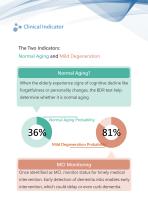
Clinical Indicator The Two Indicators: Normal Aging and Mild Degeneration Normal Aging? When the elderly experience signs of cognitive decline like forgetfulness or personality changes, the BDR test help determine whether it is normal aging Normal Aging Probability Mild Degeneration Probability MCI Monitoring Once identified as MCI, monitor status for timely medical intervention. Early detection of dementia risks enables early intervention, which could delay or even curb dementia.
Open the catalog to page 5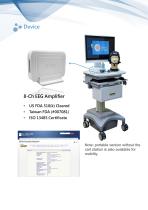
Note: portable version without the cart station is also available for mobili
Open the catalog to page 6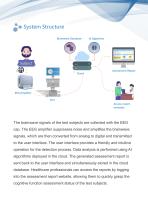
System Structure Brainwave Database Subject Cloud Assessment Report EEG Amplifier GUI Access report remotely The brainwave signals of the test subjects are collected with the EEG cap. The EEG amplifier suppresses noise and amplifies the brainwave signals, which are then converted from analog to digital and transmitted to the user interface. The user interface provides a friendly and intuitive operation for the detection process. Data analysis is performed using AI algorithms deployed in the cloud. The generated assessment report is sent back to the user interface and simultaneously stored in...
Open the catalog to page 7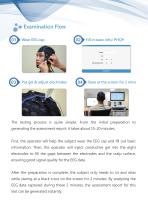
Fill in basic info/ PHQ9 Stare at the screen for 2 mins The testing process is quite simple. From the initial preparation to generating the assessment report, it takes about 15-20 minutes. First, the operator will help the subject wear the EEG cap and fill out basic information. Then, the operator will inject conductive gel into the eight electrodes to fill the gaps between the electrodes and the scalp surface, ensuring good signal quality for the EEG data. After the preparation is complete, the subject only needs to sit and relax while staring at a black cross on the screen for 2 minutes. By...
Open the catalog to page 8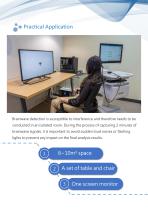
Practical Application Brainwave detection is susceptible to interference and therefore needs to be conducted in an isolated room. During the process of capturing 2 minutes of brainwave signals, it is important to avoid sudden loud noises or flashing lights to prevent any impact on the final analysis results.
Open the catalog to page 9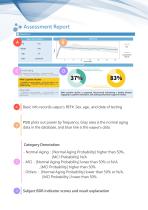
Assessment Report Mild Cognitive Decline rProbability of Normal Aging j is less than 50% or not displayed, and r Probability of Mild Cognitive Decline j is greater than 50%. r Probability of Normal Aging j is less than 50% or not displayed, and "Probability of Mild Cognitive Decline j is less than 50%. Mild cognitive decline is suspected. Recommend maintaining a healthy lifestyle, engaging in cognitive stimulation, and seeking professional support if needed. Basic info records subject's REF#. Sex. age., and date of testing PSD plots out power by frequency. Gray area is the normal aging data in...
Open the catalog to page 10
HippoScreen’s BDR Brain Degeneration Risk Assessment System was officially registered with the FDA in April 2023, making it the first regulatory status in the U.S. for cognitive function assessment support. The BDR system utilizes an AI model built on EEG data from patients with Mild Cognitive Impairment (MCI) and dementia, providing an objective, quantitative, and rapid risk assessment tool for brain function decline. This system aids in the early detection and monitoring of MCI, enhancing proactive cognitive health management.
Open the catalog to page 11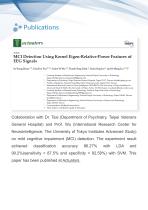
•» Publications Article 1 Graduate Institute of Mechatronic Engineering, National Taip>ei University of Technology, 2 Department of Psychiatry, Taipei Veterans General Hospital, Taipei 11217, Taiwan; [email protected] 3 Faculty of Medicine, National Vang Ming Chiao Tung University, Taipei 11221, Taiwan 4 International Research Center for Neurointelligence (WPI-IRCN), The University of Tokyo Institutes for Advanced Study (UTIAS), The University of Tokyo, Tokyo 113-0033, Japan; [email protected] 5 Graduate Institute of Manufacturing Technology, National Taipei University of Technology,...
Open the catalog to page 12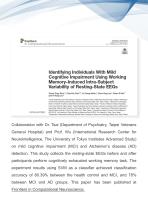
Identifying Individuals With Mild Cognitive Impairment Using Working Memory-Induced Intra-Subject Variability of Resting-State EEGs ’ Neural Engneemg and Smart Systems Laboratory. Gra&ate Institute of ManJactumg Technology. CoSege of PAechancal and EJectncal Engneemg National Taip& Unversty of Technology (Tapet Tech). Tape. Taiwan. > Department of Psychatry. DMsron of Genatnc Psychairy Tape Veterans General Hospital. Tape*. Taiwan 1 Facr/ty of Medkxne. National Yang King Chao Tung Unversrty. Tape*. Taiwan. 1 Noral Engneenng and Smart Systems Laboratory. Graduate Institute of Mechatronc Engneemg....
Open the catalog to page 13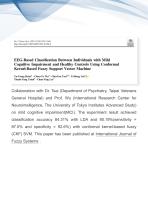
EEG-Based Classification Between Individuals with Mild Cognitive Impairment and Healthy Controls Using Conformal Kernel-Based Fuzzy Support Vector Machine Yu-Tsung Hsiao1 • Chien-Te Wu2 • Chiu-Fcn Tsai5'4 • Yi-Hung Liu5©' Thanh- l ung Trinh* • Chun-Ying Lee7 Collaboration with Dr. Tsai (Department of Psychiatry, Taipei Veterans General Hospital) and Prof. Wu (International Research Center for Neurointelligence, The University of Tokyo Institutes Advanced Study) on mild cognitive impairment(MCI). The experiment result achieved classification accuracy 84.31% with LDA and 90.19%(sensitivity = 87.5%...
Open the catalog to page 14All Shennona catalogs and technical brochures
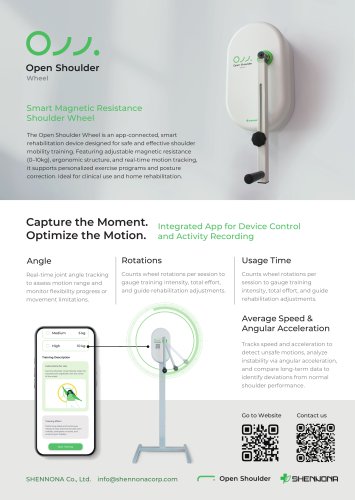
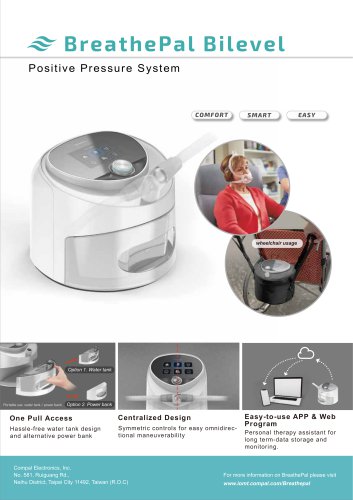 BreathePal Bilevel
2 Pages
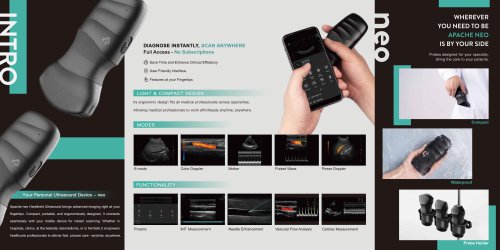
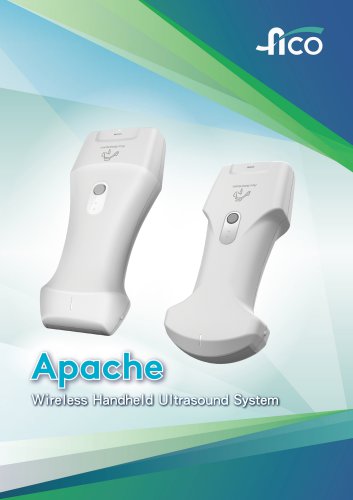 Apache C62 L154 Brochure_ENG
4 Pages


- Ultrasound system
- B/W ultrasound system
- Color doppler ultrasound system
- Portable ultrasound system
- Multipurpose ultrasound imaging system
- Convex-array ultrasound system
- Linear-array ultrasound system
- Veterinary ultrasound system
- Multipurpose veterinary ultrasound system
- Blood glucose meter
- Portable veterinary ultrasound system
- Multi-parameter monitor
- Hand-held ultrasound system
- Wireless probe ultrasound system
- Critical care multi-parameter monitor
- Phased-array ultrasound system
- Color doppler veterinary ultrasound system
- B/W veterinary ultrasound system
- Portable multi-parameter monitor
- Pet veterinary ultrasound system