
- Catalogs
- Shenzhen Yingchi Technology
- E-series YINGCHI TMS Brochure


- Company
- Products
- Catalogs
- News & Trends
- Exhibitions
E-series YINGCHI TMS Brochure
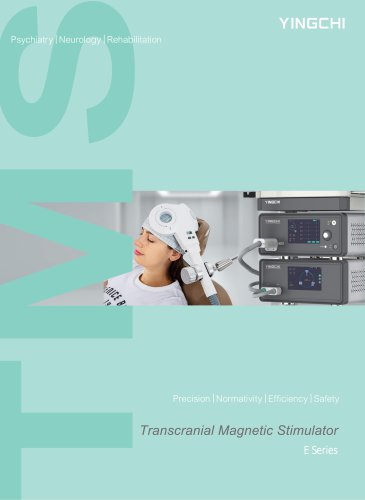
E-series YINGCHI TMS Brochure
TMS technology uses a pulsed magnetic field to induce an electric field in brain neurons, affecting the nervous system and treating mental and neurological diseases. It is a safe therapy with nearly 40 years of clinical use, primarily for refractory brain function diseases in Psychiatry, Neurology, and Rehabilitation.
- 2008: Major depressive disorder (MDD).
- 2013: Migraine treatment.
- 2018: iTBS protocol for MDD.
- 2020: Double cone coil for obsessive-compulsive disorder.
- 2022: SAINT for MDD.
- 2023: Peripheral nerve stimulation for chronic pain relief.
- 1998: Safety guidelines for repetitive TMS by the National Institute of Neurological Disorders and Stroke.
- 2010-2020: International guidelines from organizations like IFCN and CANMAT.
- 2020: China's National Health Commission included TMS in mental disorder treatment guidelines.
- 2021: Chinese guidelines standardized rTMS for Parkinson's disease treatment.
- 2016-2022: Recommendations from the Clinical TMS Society and the American Psychiatric Association on TMS treatment processes and safety.
Personalized interventions are being developed to address individual differences in TMS treatment effects, focusing on stimulation frequency, intensity, and target. Shenzhen Yingchi Technology Co., Ltd. has launched a system for precise brain function regulation.
Research emphasizes matching external driving forces with internal neural oscillations to enhance neuroplasticity, with studies from institutions like Harvard and UCLA highlighting the importance of precise frequency and amplitude.
The document describes the YINGCHI TMS E Series, a device for brain disease treatment and research, highlighting its features, applications, and support services.
The YINGCHI TMS E Series includes a stimulation generator, liquid cooling system, smart touch display, double cone coil, and Quickstim software. It offers a strong magnetic field output with a maximum frequency of 35Hz at 100% intensity and features intelligent liquid cooling technology.
The device supports conventional TBS protocols and allows parameter editing for research and clinical needs. It can be used with EEG/ERP, fNIRS, and fMRI for enhanced brain connectivity analysis and optimized treatment protocols.
The company offers international webinars, quick service response times, on-site support, online training, and free software upgrades. Several international hospitals and universities are listed as customers.
- Ultra-strong magnetic field output
- Intelligent liquid cooling technology
- Multi-parameter real-time monitoring
- Compatibility with EEG/ERP, fNIRS, and fMRI
- Personalized TMS protocol creation
The document suggests fostering scientific research cooperation and promoting multi-centre collaborations to advance TMS applications and research.
Catalog excerpts
Transcranial Magnetic Stimulation (TMS) technology uses a time-varying pulsed magnetic field to penetrate the skull to form an induced electric field in the neuron cells of the brain, and then generate an induced current to act on the nervous system, causing a series of physiological and biochemical reactions, thereby affecting brain metabolism and changes in neuron excitability to improve and treat mental and neurological diseases. TMS technology is a safe method of physical therapy. It has been clinically used for nearly 40 years. A large number of clinical trials of evidence-based medicine...
Open the catalog to page 2
Transcranial Magnetic Stimulation (TMS) technology uses a time-varying pulsed magnetic field to penetrate the skull to form an induced electric field in the neuron cells of the brain, and then generate an induced current to act on the nervous system, causing a series of physiological and biochemical reactions, thereby affecting brain metabolism and changes in neuron excitability to improve and treat mental and neurological diseases. TMS technology is a safe method of physical therapy. It has been clinically used for nearly 40 years. A large number of clinical trials of evidence-based medicine...
Open the catalog to page 3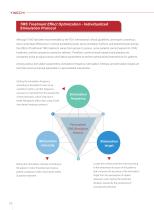
TMS Treatment Effect Optimization - Individualized Stimulation Protocol On the basis of the above research, Shenzhen Yingchi Technology Co., Ltd. has launched a precise brain function detection and regulation system, which integrates pulsed magnetic stimulation device, EEG recorders, MEP, TMS navigation, etc., and can be freely selected and matched according to clinical needs. Although rTMS has been recommended by the FDA, international clinical guidelines, and expert consensus, due to individual differences in cortical excitability levels, nerve oscillation rhythms, and anatomical structures,...
Open the catalog to page 4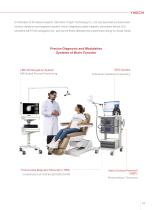
TMS Treatment Effect Optimization - Individualized Stimulation Protocol On the basis of the above research, Shenzhen Yingchi Technology Co., Ltd. has launched a precise brain function detection and regulation system, which integrates pulsed magnetic stimulation device, EEG recorders, MEP, TMS navigation, etc., and can be freely selected and matched according to clinical needs. Although rTMS has been recommended by the FDA, international clinical guidelines, and expert consensus, due to individual differences in cortical excitability levels, nerve oscillation rhythms, and anatomical structures,...
Open the catalog to page 5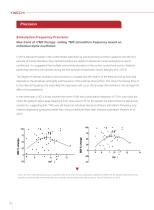
3-minute resting-state EEG data to determine individual rTMS treatment frequency YINGCHI provides a wireless dry electrode EEG system, which Stimulation Frequency Precision can automatically calculate the alpha peak frequency (IAF) after New trend of rTMS therapy: setting TMS stimulation frequency based on individual alpha oscillation 3 minutes of resting-state EEG examination with eyes closed, and guide the frequency of rTMS treatment. In 2019, Harvard Hospital in the United States published an article pointing out that in patients with the first episode of mental disorders, their mental disorders...
Open the catalog to page 6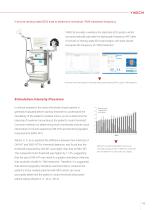
3-minute resting-state EEG data to determine individual rTMS treatment frequency YINGCHI provides a wireless dry electrode EEG system, which Stimulation Frequency Precision can automatically calculate the alpha peak frequency (IAF) after New trend of rTMS therapy: setting TMS stimulation frequency based on individual alpha oscillation 3 minutes of resting-state EEG examination with eyes closed, and guide the frequency of rTMS treatment. In 2019, Harvard Hospital in the United States published an article pointing out that in patients with the first episode of mental disorders, their mental disorders...
Open the catalog to page 7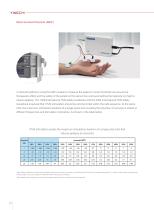
Precision of Target Positioning Motor Evoked Potential (MEP) There are three commonly used methods for locating therapeutic target. 5cm rule: After finding the RMT hotspot, move forward 5cm to find the DLPFC treatment target. Positioning Cap: Using YINGCHI positioning cap which is designed based on the EEG 10-20 electrode placement system to select the closest electrode position. For example, the left DLPFC can choose F3 electrode position as the target. Positioning caps are available in different sizes, suitable for patients of different ages. In clinical treatment, using the MEP module to measure...
Open the catalog to page 8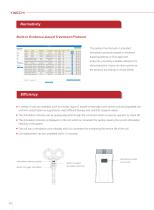
Data Management Supports creation and storage of patient and protocol information Built-in Evidence-based Treatment Protocol Support exporting patient treatment records and MEP detection reports, and the reports can be customized and edited. The system has the built-in standard stimulation protocols based on evidence based guidelines or FDA approved protocols, providing a reliable reference for clinical practice. Users can also customize the protocol according to clinical needs. A variety of coils are available, such as circular, figure-8, double-cone,single-cone, animal coil and angulated coil,...
Open the catalog to page 9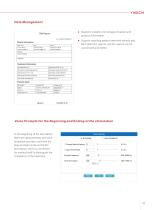
Supports creation and storage of patient and protocol information Built-in Evidence-based Treatment Protocol Support exporting patient treatment records and MEP detection reports, and the reports can be customized and edited. The system has the built-in standard stimulation protocols based on evidence based guidelines or FDA approved protocols, providing a reliable reference for clinical practice. Users can also customize the protocol according to clinical needs. A variety of coils are available, such as circular, figure-8, double-cone,single-cone, animal coil and angulated coil, and coil customization...
Open the catalog to page 10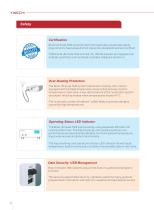
YINGCHI Products for Therapy and Research Clinical Therapy Certification Brain Ultimate TMS systems meet internationally recognized safety requirements, have passed strict inspection standards and are Certified. YINGCHI TMS includes TMS S series, TMS M series and TMS E series. The three series have been gradually upgraded in product performance, continuously enriched in product functions, and steadily improved in user experience. YINGCHI M Ultimate TMS is CFDA, CE, USFDA cleared, and registered in multiple countries such as Korea, Australia, Malaysia and so on. Over-Heating Protection The Brain...
Open the catalog to page 11All Shenzhen Yingchi Technology catalogs and technical brochures
 S-series YINGCHI TMS Brochure
14 Pages
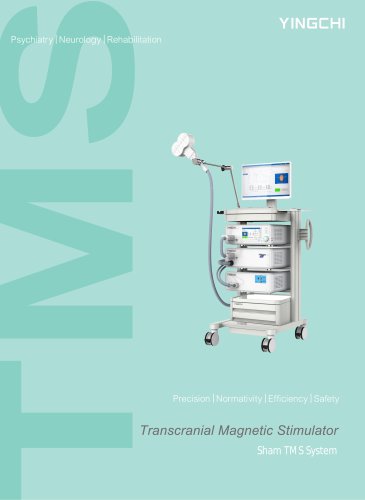 Sham YINGCHI TMS Brochure
5 Pages
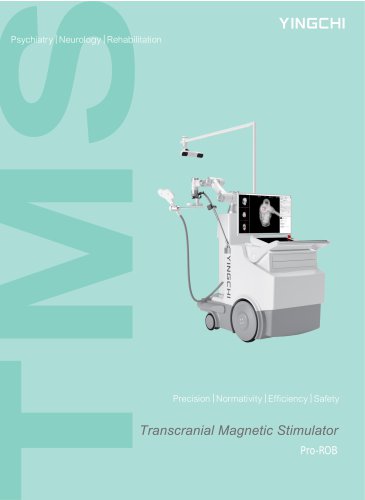 Pro-ROB YINGCHI TMS Brochure
5 Pages
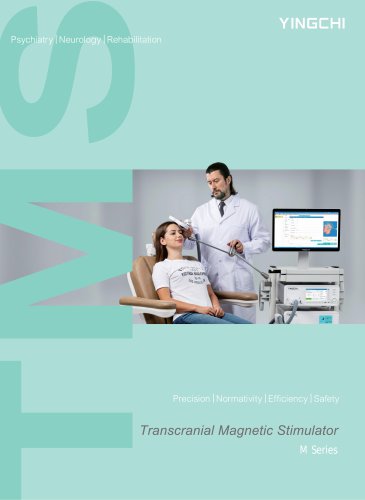 M-series YINGCHI TMS Brochure
16 Pages
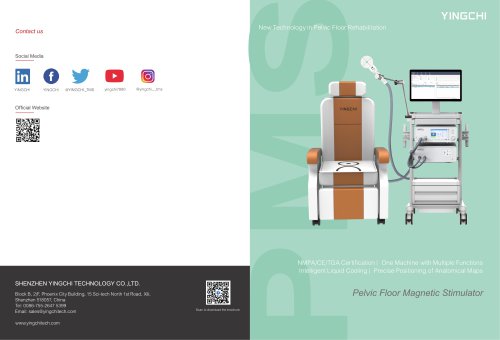

- Transcranial stimulator
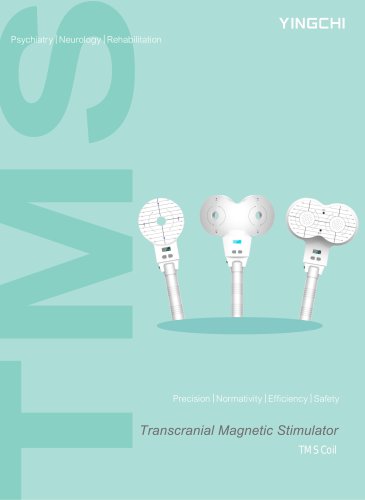
- TMS coil
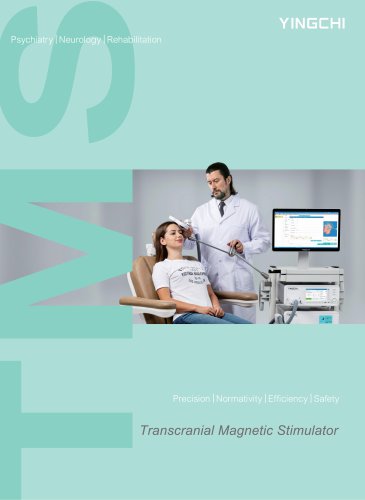
- Transcranial magnetic stimulator
- Magnetic transcranial magnetic stimulator
- Double TMS coil
- Robotic arm
- TMS + rTMS transcranial magnetic stimulator
- Single TMS coil
- Non-cooled TMS coil
- Liquid-cooled TMS coil
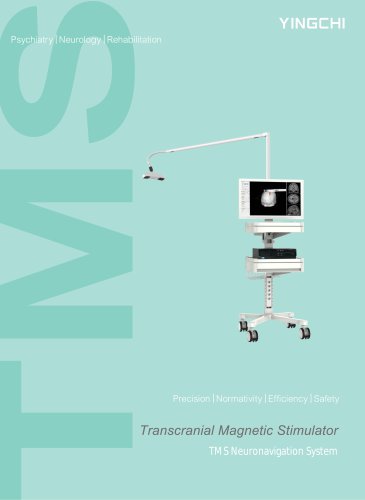
- TMS neuronavigation system
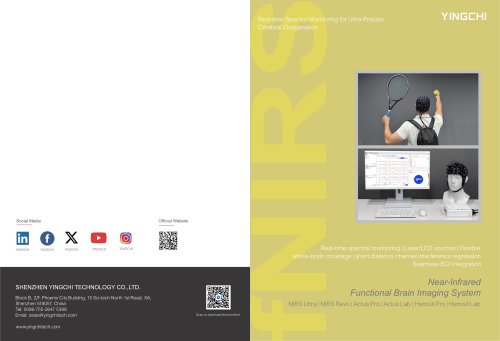
- Near infrared spectroscopy system
- Functional neuroimaging near infrared spectroscopy system
- Magnetic therapy armchair
- Air-cooled TMS coil
- Trolley-mounted magnetic therapy armchair