
- Catalogs
- Shimadzu Europa Analytical Instruments
- 5. TOC in daily practice


- Products
- Catalogs
- News & Trends
- Exhibitions
5. TOC in daily practice

5. TOC in daily practice
Shimadzu provides extensive support for TOC analysis through seminars and user meetings, highlighting the flexibility and user-friendly nature of their TOC systems. The document discusses various applications and methods related to TOC analysis.
TOC can be determined using three methods: the difference method, the addition method, and the direct method, each with specific procedures and limitations. The difference method calculates TOC by subtracting TIC from TC, while the addition method sums POC and NPOC. The direct method measures NPOC directly as TOC.
Calibration of POC is crucial due to volatile organic substances' instability. System testing ensures CO2 trap efficiency, with daily checks recommended.
TNb is determined through combustion and chemiluminescence detection, often simultaneously with TOC measurement.
High-salt samples pose challenges due to salt crystallization. Shimadzu offers a specialized kit to enhance catalyst stability.
Examples of TOC determination in various industries are provided, with recommended configurations for different applications.
The document provides an overview of TOC analysis using the TOC-L series, focusing on small sample volumes, calibration, and measurement principles.
The TOC-L system requires 10-20 mL of sample, with a kit available for small sample volumes, allowing the use of a 500 µL syringe.
The manual injection kit allows analysis of small water and gas samples, with specific measurement ranges and reproducibility.
The ISP module facilitates automated dilution, allowing for a 10-point calibration curve with a linear range and high correlation coefficient.
Blank values are crucial in TOC analysis, with methods discussed to minimize and determine these values.
TOC measurement involves oxidizing organic carbon to CO2, detected by an NDIR detector, using catalytic oxidation at 680°C.
High accuracy recovery rates are listed, with measurement parameters including a standard catalyst and a 10-point calibration curve.
The detection limit is 0.025 mg/L, and the quantification limit is 0.089 mg/L, depending on factors like injection volume.
The document provides comprehensive guidelines for TOC analysis using the TOC-L series, emphasizing calibration and optimized measurement techniques.
The document discusses methods for determining TOC, focusing on wet-chemical oxidation and combustion oxidation techniques.
Involves using UV irradiation and persulfate oxidation to generate OH radicals, with efficiency influenced by temperature.
Uses sodium persulfate and UV oxidation for powerful oxidation, with features to prevent contamination.
Wet-chemical oxidation is less effective for samples with particles, mainly used for ultra-pure water analysis.
The SSM-5000A module allows TOC determination in solid samples, integrating with TOC software for automatic calculation.
TOC provides a direct measure of organic pollution levels, unlike BOD and COD, which are influenced by other compounds.
Efforts are underway to correlate COD and TOC values, with varying factors depending on sample composition.
TOC analysis offers a reliable alternative to traditional methods for monitoring organic pollution.
The document provides an analysis of the conversion between TOC and COD, highlighting the importance of analytical quality assurance.
The relationship between TOC and COD is explained, with conversion factors derived from the molar ratio of carbon to oxygen.
Real water samples contain various organic substances, leading to a wide range of conversion factors.
Quality assurance is crucial, with control samples used to ensure system accuracy and software enabling automatic recalibration.
The TOC Control Software includes a control card program for managing control and warning limits.
Allows for TOC analysis in gases or liquids with small sample volumes, useful for valuable or limited samples.
Calibration using the manual injection kit is discussed, with a focus on achieving low detection limits.
The document recommends using the TOC-LCXH analyzer and manual gas sample injection kit for optimal results.
Catalog excerpts

5. TOC in daily practice 5.1. TOC determination methods according to EN 1484 5.2. Determination of the purgeable organic carbon (POC) 5.3. TNb – total bound nitrogen 5.4. Kit for high-salt samples 5.5. Kit for small sample volumes 5.6. Kit for manual injections 5.7. Calibration with automatic dilution function 5.8. Blank value consideration in TOC analysis 5.9. TOC – measurement principle – catalytic combustion at 680°C 5.10. TOC-L – detection limit normal catalyst 5.11. TOC determination with wet chemical UV-oxidation 5.12. Silanisation of syringe – TOC determination of surfactant 5.13. TOC...
Open the catalog to page 2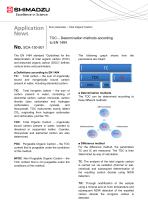
SHIMADZUExcellence in Science Application News NO. SCA-130-501 Sum parameter - Total Organic Carbon The EN 1484 standard “Guidelines for the determination of total organic carbon (TOC) and dissolved organic carbon (DOC)” defines various terms and parameters. ■ Definitions according to EN 1484 TC: Total carbon - the sum of organically bound and inorganically bound carbon present in water, including elemental carbon. TIC: Total inorganic carbon - the sum of carbon present in water, consisting of elemental carbon, carbon monoxide, carbon dioxide (also carbonates and hydrogen carbonates), cyanide,...
Open the catalog to page 3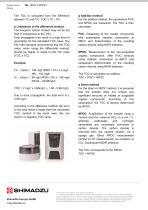
The TOC is calculated from the difference between TC and TIC: TOC = TC - TIC ■ Limitations of the difference method The inorganic carbon content may not be too high in comparison to the TOC. Error propagation can result in a high level of uncertainty for the calculated TOC value. The EN 1484 standard recommends that the TOC value, when using the differential method, should be higher or equal to the TIC value (TOC > TIC). Example: TC - Value = 100 mg/l (RSD = 2%) ± 2 mg/l (98 - 102 mg/l) IC - Value = 98 mg/l (RSD= 2%) ± 1,96 mg/l (96,04 - 99,96mg/l) TOC = 2 mg/l ± 3,96mg/l (- 1,96 - 5,96 mg/l) Due...
Open the catalog to page 4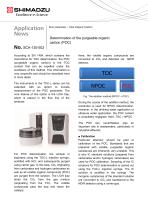
SHIMADZUExcellence in Science Application News NO. SCA-130-502 Sum parameter - Total Organic Carbon According to EN 1484, which contains the instructions for TOC determination, the POC (purgeable organic carbon) is the TOC content that can be expelled under the conditions of this method. This information is very unspecific and should be described here in more detail. The instruments in the TOC-L series can be extended with an option to include measurement of the POC parameter. The core feature of this option is the LiOH trap, which is placed in the flow line of the analyzer. For POC determination,...
Open the catalog to page 5
Fig. POC-Calibration with IC-standard ■ System testing In POC analysis, it is of great importance that the LiOH trap functions perfectly. A test should, therefore, be carried out to confirm the efficiency of the CO2 trap. This test should be carried out each working day: An IC control solution (TIC = 1000 mg/L) is prepared and analyzed as a POC sample. For efficient functioning of the LiOH trap, the POC measuring result must be < 0.1 mg/L. ■ Example of a POC measurement Sample: Toluene in ultrapure water Toluene is a compound that is fully purgeable. In the addition method, the toluene sample...
Open the catalog to page 6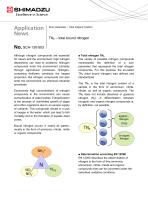
SHIMADZU Excellence in Science Sum parameter - Total Organic Carbon Application NewsTNb - total bound nitrogen NO. SCA-130-503 Although nitrogen compounds are essential for nature and the environment, high nitrogen depositions can lead to problems. Nitrogen compounds enter the environment primarily through agricultural processes. Nitrogen-containing fertilizers constitute the largest proportion. But nitrogen compounds can also enter the environment via chemical industrial processes. Excessively high concentrations of nitrogen compounds in the environment can cause eutrophication of water bodies....
Open the catalog to page 7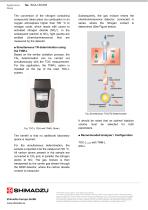
The conversion of the nitrogen containing compounds takes place via combustion in an oxygen atmosphere higher than 700 °C to nitrogen oxide, which reacts with ozone to activated nitrogen dioxide (NO2*). In the subsequent reaction to NO2, light quanta are emitted (chemiluminescence) that are measured by the detector. ■ Simultaneous TN determination using the TNM-L Based on the similar oxidation process, the TNb determination can be carried out simultaneously with the TOC measurement. For this application, the TNM-L option is installed on the top of the main TOC-L system. Subsequently, the gas...
Open the catalog to page 8
Application News Kit for high-salt samplesNO. SCA-130-504 Compound Tab. Melting point of different salts Samples with high-salt loads generally are a problem for TOC analysis. The problem is less the conversion of organic compounds to CO2 than the effects of the salt on the catalyst. This leads to higher maintenance needs, as the salt can crystallize in the combustion system. In many applications for the instruments in the TOC-L and the TOC-4110/4200 series, the kit for salt-containing samples is an important component. It consists of a combustion tube of a special geometry and a unique mixture...
Open the catalog to page 9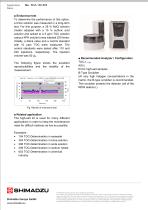
■ Endurance test To determine the performance of this option, a brine solution was measured in a long-term test. For this purpose, a 28 % NaCl solution (matrix adapted with a 15 % sulfuric acid solution and spiked to a 5 ppm TOC solution using a KPH solution) was injected 220 times. Initially, a blank value and a control standard with 10 ppm TOC were measured. The control standards were tested after 110 and 220 injections, respectively. The injection volume was 50 pL. The following figure shows the excellent reproducibilities and the stability of the measurement. ■ Recommended Analyzer / Configuration...
Open the catalog to page 10
Application News Sum parameter - Total Organic Carbon Kit for small sample volumesNO. SCA-130-505 The instruments of the TOC-L series are designed to successively analyze many different types of samples of different concentrations. For the autosampler, sample trays for different sample numbers and sample volumes are available. To eliminate cross-contamination between analyses of the different samples, the number of rinsing steps can be defined in the software. There is usually enough sample volume available to rinse the tubing and the injection system of the TOC-L several times. Depending on...
Open the catalog to page 11All Shimadzu Europa Analytical Instruments catalogs and technical brochures
 LCMS-8065XE
12 Pages
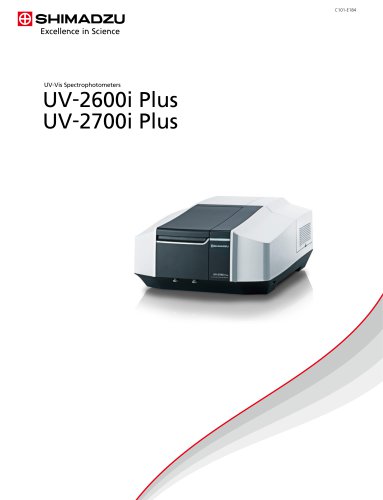 UV-2600i Plus UV-2700i Plus
20 Pages
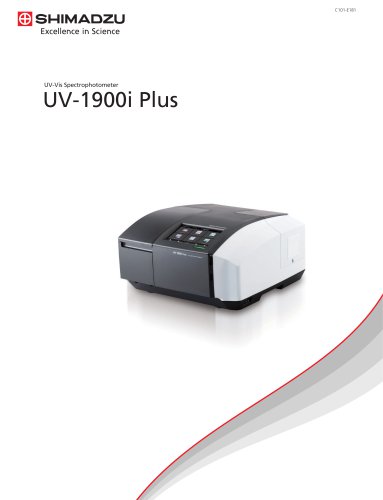 UV-1900i Plus
16 Pages
 LCMS-8060NX
12 Pages
 ATX/ATY Series
4 Pages
Archived catalogs
 TOC process analysis
16 Pages
 Application Handbook
127 Pages
 TOC process analysis
18 Pages
 LC / HPLC / UHPLC
108 Pages
 TOC-L
TOC-L2 Pages
 Tracera
8 Pages
 TX/TXB/TW Series
8 Pages
 Catalog BL-Series
2 Pages
 Catalog EL
2 Pages
 Catalog ELB - Series
2 Pages
 Catalog BW-K/BX-K Series
2 Pages
 MALDI-7090
8 Pages
 New issue Shimadzu News 1/2015
32 Pages
 MOC-120H
4 Pages
 GCMS-QP2010
6 Pages
 MOC 63u
6 Pages
 Catalog UW-Series
6 Pages
 TOC-L Series
2 Pages
 Edman Sequencer PPSQ-31A/33A
8 Pages
 LC 2010
3 Pages
 AXIMA Resonance
6 Pages
 AXIMA Performance
2 Pages
 AXIMA Assurance
2 Pages
 AXIMA Confidence
2 Pages
 LCMS-IT-TOF
2 Pages
 LCMS-2020
14 Pages
 LCMS-8030
14 Pages
 Prominence nano
8 Pages
 Chemical industry
22 Pages
 ICPMS-2030 Series
16 Pages
 Pharmaceutical industry
14 Pages
 FTIR TALK LETTER
8 Pages


- Analysis software
- Laboratory testing system
- Laboratory balance
- Electronic laboratory balance
- Benchtop laboratory balance
- Laboratory software
- SHIMADZU spectrometer
- Control analyser
- Data management software
- Measurement software
- Laboratory balance with digital display
- Spectrophotometer
- SHIMADZU benchtop spectrometer
- SHIMADZU chromatography system
- Flow testing system
- Benchtop spectrophotometer
- Calibration analyser
- Electrophoresis system
- Security software