
- Catalogs
- Shimadzu Europa Analytical Instruments
- Pharmaceutical industry


- Products
- Catalogs
- News & Trends
- Exhibitions
Pharmaceutical industry

Pharmaceutical industry
Pharmaceuticals focus on creating remedies to alleviate pain and heal illnesses. The production of drugs requires pure substances and equipment to avoid side effects from contaminants. Pharmacopoeias are mandatory guidelines for drug manufacturers, detailing methods and rules for drug manufacture, storage, quality, and testing.
TOC determination is crucial for assessing contamination by organic compounds in pharmaceuticals. The European Pharmacopoeia specifies methods for TOC analysis, including testing the suitability of TOC analyzers. TOC content is particularly important in ultrapure water and water for injections, with specific maximum limits set.
Two primary oxidation techniques are used: catalytic combustion and wet chemical oxidation. Catalytic combustion converts carbon compounds into CO2 at high temperatures, while wet chemical oxidation uses UV irradiation and persulfate. Both methods are applicable for ultrapure water analysis, each offering distinct advantages in sensitivity and precision.
Cleaning validation ensures production equipment is free from residues of previous drug batches. TOC analysis evaluates the effectiveness of cleaning processes, detecting contaminants from drugs and cleaning agents. Shimadzu offers TOC analyzers that comply with FDA and Pharmacopoeia requirements, suitable for various pharmaceutical applications.
Clean in Place (CIP) cleaning is automated and does not require disassembly, making it efficient and easily validated. Clean out of Place (COP) cleaning involves disassembling the system for individual component cleaning, allowing for visual inspection but being more labor-intensive.
TOC analysis measures the total organic carbon content in cleaning validation, reflecting contamination levels. Shimadzu's TOC-L series offers modular designs for both final rinse and swab sample analysis, providing flexibility and high sensitivity for detecting residues.
Both catalytic combustion and wet chemical oxidation methods are suitable for TOC determination according to the European Pharmacopoeia. Each method offers unique benefits, such as high oxidation potential or high sensitivity, making them valuable tools in ensuring pharmaceutical purity and compliance.
The EP 2.2.44 guidelines do not mandate a specific oxidation technique for TOC determination but require systems to differentiate between inorganic and organic carbon. The TOC detection limit should be at least 0.05 mg/L, and the method's applicability must be verified through a system suitability test.
A standard sucrose solution and a control solution of 1,4-benzoquinone, both with a carbon content of 0.5 mg/L, are used. The blank water should not exceed a TOC content of 0.1 mg/L. The recovery of the benzoquinone standard is calculated relative to the sucrose standard, with acceptable results ranging from 85% to 115%.
The TOC-Control L and V software facilitate system suitability tests with integrated templates for calibration curves and control sample measurements. The software supports compliance with regulations and offers user-friendly features, including user access rights and audit trails.
The USP <643> distinguishes between 'bulk water' and 'sterile water,' with specific TOC determination conditions for each. The guidelines align with the EP in terms of detection limits and system suitability requirements.
Shimadzu offers TOC systems suitable for both EP and USP guidelines. The TOC-VWP/WS uses wet-chemical oxidation, while the TOC-LCPH uses catalytic combustion. Both systems support a wide range of applications, from ultra-pure to highly polluted waters.
The document recommends specific configurations for Shimadzu TOC systems, including the TOC-L CPH with a high-sensitive catalyst and the TOC-VWP with an external sparge kit.
Catalog excerpts

SHIMADZU Excellence in Science
Open the catalog to page 1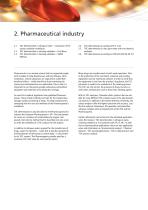
2. Pharmaceutical industry 2.1. TOC determination in ultrapure water – comparison of the various oxidation techniques 2.2. TOC determination in cleaning validation – final Rinse 2.3. TOC determination in cleaning validation – SWAB Method 2.4. TOC determination according to EP 2.2.44 2.5. TOC determination in ultra pure water with wet chemical oxidation 2.6. TOC determination according to USP 643 (USP 36-NF 31) Pharmaceutics is an ancient science that has supported people with remedies to help alleviate pain and heal illnesses. After medication, certain substances are expected to unfold their...
Open the catalog to page 2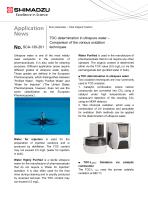
SHIMADZUExcellence in Science Application News NO. SCA-130-201 Sum parameter - Total Organic Carbon Ultrapure water is one of the most widely used excipients in the production of pharmaceuticals. It is also used for cleaning purposes. Different application areas require different grades of ultrapure water quality. These grades are defined in the European Pharmacopoeia, which distinguishes between ‘Purified Water’, ‘Highly Purified Water’ and ‘Water for Injection’ (‘The United States Pharmacopoeia, however, does not use the same classification as the European Pharmacopoeia’). Water for injection...
Open the catalog to page 3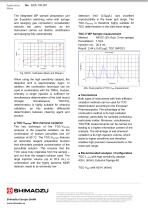
The integrated ISP sample preparation unit (an 8-position switching valve with syringe and sparging gas connection) considerably reduces the users’ workload, as the instrument carries out dilution, acidification and sparging fully automatically. Fig. NPOC- Calibration (Blank and 500|jg/L) When using the high sensitivity catalyst, the detection limit is approximately 4jg/L. In addition, the combustion technique can be used in combination with the TNM-L module, whereby a single injection is sufficient for simultaneous determination of the total bound nitrogen. Simultaneous TOC/TNb determination...
Open the catalog to page 4
SHIMADZUExcellence in Science Application News NO. SCA-130-202 Sum parameter - Total Organic Carbon The highest purity and most careful handling of substances and active ingredients is an important requirement in the manufacture of pharmaceuticals. An effective removal of production residues in pharmaceutical plants is an essential precondition. A well-cleaned pharmaceutical production system prevents contamination and, consequently, the adulteration of the produced drug. This is particularly important in the production of active ingredients in batch processes, as the system is used for different...
Open the catalog to page 5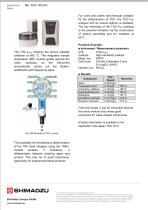
The TOC-Lcph employs the proven catalytic oxidation at 680 °C. The integrated sample preparation (ISP) module greatly reduces the users’ workload, as the instrument automatically carries out the dilution, acidification and degassing steps. For users who prefer wet-chemical oxidation for the determination of TOC, the TOC-Vwp analyzer with its various options, is available. The key technique of the TOC-Vwpanalyzer is the powerful oxidation via the combination of sodium persulfate and UV oxidation at 80°C. Practical Example: ■ Instrument / Measurement parameter Unit: TOC-Lcph Catalyst: High...
Open the catalog to page 6
SHIMADZU Excellence in Science Sum parameter - Total Organic Carbon TOC -Determination in cleaning validation - swab method Application News NO. SCA-130-203 Cleaning validation substantiates the effectiveness of a cleaning process and ensures that no residues remain on the surfaces of the production equipment. For the detection of contaminations, validated analytical methods must be used that are sensitive enough to determine the defined acceptable residue level. In general, residue limits of 10 ppm or 1/1000 of the usual therapeutic dose of an active substance are used as acceptance criteria....
Open the catalog to page 7
There, all carbon compounds are oxidized to CO2. To ensure complete oxidation, there is an additional catalyst in the combustion tube. The resulting CO2 is then transported to the detector in the main instrument. The NDIR detector of the TOC-L series contains a tandem cell that consists of a long cell (200 mm) and a short cell (1 mm). By default, the long cell is used for water analysis and the short cell for solid-sample analysis. To attain a higher sensitivity for the analysis of solids, the solid-sample module can also be connected to the long, and thus the more sensitive, measuring cell....
Open the catalog to page 8
Sum parameter – Total Organic Carbon SCA-130-204 Since the USP (United States Pharmacopoeia) regulations for the determination of Aqua Purificata and Aqua ad injectabilia has been implemented into the European Pharmacopoeia (EP), TOC analysis has become increasingly established in quality control. Users who test the TOC content in pharmaceutical water must regularly test their TOC system using a system suitability test according to the method described in the EP 2.2.44 guidelines. ■ System suitability test For the system suitability test, a standard sucrose solution with a carbon content of 0.5...
Open the catalog to page 9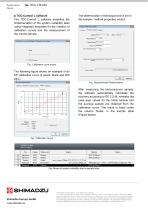
■ TOC-Control L software The TOC-Control L software simplifies the implementation of the system suitability tests using integrated templates for the creation of calibration curves and the measurement of the control sample. The following figure shows an example of an EP calibration curve (2 points, blank and 500 The determination of benzoquinone is set in the sample / method properties wizard. After measuring the benzoquinone sample, the software automatically calculates the recovery according to EP 2.2.44, whereby the peak area values for the blank sample and the sucrose sample are obtained from...
Open the catalog to page 10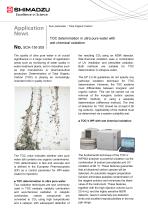
SHIMADZUExcellence in Science Application News NO. SCA-130-205 Sum parameter - Total Organic Carbon The quality of ultra pure water is of crucial significance in a large number of application areas such as monitoring of water quality in water treatment plants, and in industries such as chip manufacture or pharmaceutical production. Determination of Total Organic Carbon (TOC) is playing an increasingly important role in quality control. The TOC value indicates whether ultra pure water still contains any organic contaminants. TOC determination is fast and accurate and is defined in the European...
Open the catalog to page 11All Shimadzu Europa Analytical Instruments catalogs and technical brochures
 LCMS-8065XE
12 Pages
 UV-2600i Plus UV-2700i Plus
20 Pages
 UV-1900i Plus
16 Pages
 LCMS-8060NX
12 Pages
 ATX/ATY Series
4 Pages
Archived catalogs
 TOC process analysis
16 Pages
 5. TOC in daily practice
33 Pages
 Application Handbook
127 Pages
 TOC process analysis
18 Pages
 LC / HPLC / UHPLC
108 Pages
 TOC-L
TOC-L2 Pages
 Tracera
8 Pages
 TX/TXB/TW Series
8 Pages
 Catalog BL-Series
2 Pages
 Catalog EL
2 Pages
 Catalog ELB - Series
2 Pages
 Catalog BW-K/BX-K Series
2 Pages
 MALDI-7090
8 Pages
 New issue Shimadzu News 1/2015
32 Pages
 MOC-120H
4 Pages
 GCMS-QP2010
6 Pages
 MOC 63u
6 Pages
 Catalog UW-Series
6 Pages
 TOC-L Series
2 Pages
 Edman Sequencer PPSQ-31A/33A
8 Pages
 LC 2010
3 Pages
 AXIMA Resonance
6 Pages
 AXIMA Performance
2 Pages
 AXIMA Assurance
2 Pages
 AXIMA Confidence
2 Pages
 LCMS-IT-TOF
2 Pages
 LCMS-2020
14 Pages
 LCMS-8030
14 Pages
 Prominence nano
8 Pages
 Chemical industry
22 Pages
 ICPMS-2030 Series
16 Pages
 FTIR TALK LETTER
8 Pages


- Analysis software
- Laboratory testing system
- Laboratory balance
- Electronic laboratory balance
- Benchtop laboratory balance
- Laboratory software
- SHIMADZU spectrometer
- Control analyser
- Data management software
- Measurement software
- Laboratory balance with digital display
- Spectrophotometer
- SHIMADZU benchtop spectrometer
- SHIMADZU chromatography system
- Flow testing system
- Benchtop spectrophotometer
- Calibration analyser
- Electrophoresis system
- Security software