


- Products
- Catalogs
- News & Trends
- Exhibitions
Tracera

Tracera
- Detector Type: Barrier Discharge Ionization Detector (BID)
- Detection Sensitivity: Over 100 times higher than Thermal Conductivity Detector (TCD) and twice as high as Flame Ionization Detector (FID)
- Detectable Compounds: All except Helium (He) and Neon (Ne)
- Operating Temperature: Up to 350°C, capable of analyzing compounds up to n-C44
- Plasma Technology: Employs a Helium-based dielectric barrier discharge plasma for ionization, ensuring high sensitivity and stability.
- Single Detector Approach: Simplifies the analysis of permanent gases and light hydrocarbons by eliminating the need for multiple detection schemes.
- Long-Term Stability: The BID design minimizes sensitivity fluctuations over extended operation periods.
- Sensitivity Comparison: BID offers over 200 times higher sensitivity for organic compounds and significantly higher sensitivity for permanent gases compared to TCD.
- Repeatability: Demonstrates repeatability with RSD% ranging from 0.84 to 1.80 for trace gas analysis.
- Applications: Ideal for analyzing reaction products in artificial photosynthesis, lithium-ion battery gases, and impurities in ethylene.
- Temperature Range: Up to 350 °C
- Minimum Detectable Amount: 1 pgC/s (dodecane, discharge gas flow rate 50 mL/min)
- Dynamic Range: 105
- Permitted Gas: Helium with 99.9999% purity
- Dimensions: 515 mm (W) x 490 mm (H) x 640 mm (D)
- Weight: 31 kg
- Power Requirements: AC100V/115V/230V ±10%, 1800VA (Normal oven type) or 2600VA (High power oven type), 50/60Hz
- Artificial Photosynthesis Research: Analyzes reaction products like CO and H2 generated in photochemical-carbon dioxide reduction reactions.
- Lithium Ion Battery Gas Analysis: Assesses the deterioration of lithium-ion batteries by analyzing decay gases.
- Impurity Analysis in Ethylene: Detects trace impurities such as H2, CO, CO2, and CH4 in ethylene feedstock.
- Utilizes a Barrier Discharge Ionization Detector (BID) for high-sensitivity measurements.
- Allows simultaneous measurement of multiple gases using a single detector and carrier gas.
Catalog excerpts
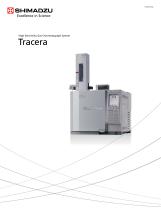
High Sensitivity Gas Chromatograph System
Open the catalog to page 1
Highly Versatile GC Analyzer for Trace Analysis Plasma Technology is the Future of GC Detection The new Tracera GC System is now ready to solve your trace analysis needs. This system utilizes the new Barrier Discharge Ionization Detector technology coupled with a GC-2010 Plus capillary gas chromatograph to create a GC system that makes it possible to reveal trace components that are difficult to see by other GC detectors.
Open the catalog to page 2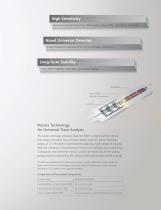
High Sensitivity Detection Sensitivity Over 100x Higher than TCD, 2x Higher than FID Novel Universal Detector Single Detector Approach for Your Complex Analyses Long-Term Stability Long-Term Stability with New Discharge Design He He plasma Quartz tube (dielectric substance) Plasma Technology for Universal Trace Analysis The barrier discharge ionization detector (BID) is a highly sensitive device that creates ionization from a Helium-based, dielectric barrier discharge plasma. A 17.7 eV plasma is generated by applying a high voltage to a quartz dielectric chamber, in the presence of helium at...
Open the catalog to page 3
High Sensitivity Detection Sensitivity Over 100x Higher than TCD, 2x Higher than FID Sensitivity Comparison Between BID and TCD Sensitivities were compared using the responses of permanent gases. BID achieved over 200× higher sensitivity for organic compounds and several tens of times higher sensitivity for permanent gases. 10 ppm concentration each component in He, 1:39 split analysis, 500 µL sample volume High-Sensitivity Analysis of Permanent Gases and Light Hydrocarbons Conventional analytical techniques require a system configuration with multiple detection schemes to analyze for permanent...
Open the catalog to page 4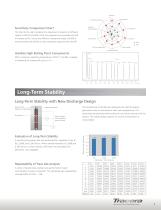
Sensitivity Comparison Chart The chart to the right compares the responses of solvents of different classes to the FID and BID. All of the responses are normalized to that of hexane by FID. Across the different compound classes, the BID is more sensitive and exhibits a more consistent response than the FID. Handles High Boiling Point Components With a maximum operating temperature of 350 °C, the BID is capable of analyzing for compounds up to n-C44. Long-Term Stability Long-Term Stability with New Discharge Design He plasma High-voltage, low-frequency power source The architecture of the BID...
Open the catalog to page 5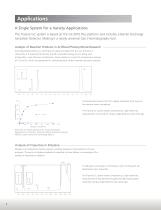
Applications A Single System for a Variety Applications The Tracera GC system is based on the GC-2010 Plus platform and includes a Barrier Discharge Ionization Detector. Making it a nearly universal Gas Chromatography tool. Analysis of Reaction Products in Artificial Photosynthesis Research Artificial photosynthesis is a technique to capture energy from the sun and store it chemically. It is expected to become the 4th renewable energy source along with photovoltaic, solar thermal, and biomass. Shown below is a result of simultaneous analysis of CO and H 2, which are generated in a photochemical-carbon...
Open the catalog to page 6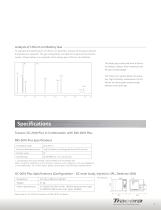
To evaluate the deterioration of lithium ion batteries, analysis of the gas produced during decay is required. The gas components are ideal for analysis by the Tracera system. Shown below is an example of the decay gas of lithium ion batteries. The decay gas is extracted from a lithium ion battery, diluted, then introduced into the gas chromatograph. The Tracera GC system allows simultaneous, high-sensitivity measurement of the lithium ion decay gases using a single detector and carrier gas. SpecificationsTracera: GC-2010 Plus in Combination with BID-2010 Plus BID-2010 Plus Specifications Temperature...
Open the catalog to page 7
© Shimadzu Corporation, 2013 Printed in Japan 3655-01307-40AIT
Open the catalog to page 8All Shimadzu Europa Analytical Instruments catalogs and technical brochures
 LCMS-8065XE
12 Pages
 UV-2600i Plus UV-2700i Plus
20 Pages
 UV-1900i Plus
16 Pages
 LCMS-8060NX
12 Pages
 ATX/ATY Series
4 Pages
Archived catalogs
 TOC process analysis
16 Pages
 5. TOC in daily practice
33 Pages
 Application Handbook
127 Pages
 TOC process analysis
18 Pages
 LC / HPLC / UHPLC
108 Pages
 TOC-L
TOC-L2 Pages
 TX/TXB/TW Series
8 Pages
 Catalog BL-Series
2 Pages
 Catalog EL
2 Pages
 Catalog ELB - Series
2 Pages
 Catalog BW-K/BX-K Series
2 Pages
 MALDI-7090
8 Pages
 New issue Shimadzu News 1/2015
32 Pages
 MOC-120H
4 Pages
 GCMS-QP2010
6 Pages
 MOC 63u
6 Pages
 Catalog UW-Series
6 Pages
 TOC-L Series
2 Pages
 Edman Sequencer PPSQ-31A/33A
8 Pages
 LC 2010
3 Pages
 AXIMA Resonance
6 Pages
 AXIMA Performance
2 Pages
 AXIMA Assurance
2 Pages
 AXIMA Confidence
2 Pages
 LCMS-IT-TOF
2 Pages
 LCMS-2020
14 Pages
 LCMS-8030
14 Pages
 Prominence nano
8 Pages
 Chemical industry
22 Pages
 ICPMS-2030 Series
16 Pages
 Pharmaceutical industry
14 Pages
 FTIR TALK LETTER
8 Pages


- Analysis software
- Control software
- Laboratory testing system
- Laboratory balance
- Electronic laboratory balance
- Benchtop laboratory balance
- Laboratory software
- SHIMADZU spectrometer
- Control analyser
- Data management software
- Measurement software
- Laboratory balance with digital display
- Spectrophotometer
- SHIMADZU benchtop spectrometer
- SHIMADZU chromatography system
- Flow testing system
- Benchtop spectrophotometer
- Calibration analyser
- Electrophoresis system
- Security software