

Pectoral Implants

1 / 2 PagesView full catalog
Pectoral Implants
Product catalog summary
Overview: This document provides information on pectoral implants, which are medical devices restricted to sale by or on the order of a physician. These implants are not intended for use as breast implants, and their safety and effectiveness for breast augmentation, reconstruction, or revision have not been established.
Purpose: Pectoral implants are designed for the surgical repair of deficiencies such as congenital pectoral aplasia. They are used to enhance the appearance of patients with underdeveloped or disproportionate chests. The implants have a textured surface and come in various sizes.
Surgical Procedure: The incision for implant insertion is made in the axillary region and should be approximately 5 cm wide. The pocket for the implant is created beneath the largest pectoral muscle, ensuring not to remove it from the smaller pectoral muscle. The undermining should stop 1 to 2 cm below the areola to avoid a low implant position, which could result in a feminine appearance. The pocket must be inspected for any remaining muscle fibers. The implant is inserted using long tongs, ensuring it is positioned correctly between the two pectoral muscles.
Device Features: The implants contain a polyester reinforcement to aid in the insertion process. They are supplied in different shapes for the left and right sides to ensure symmetry.
Dimensions and Reference: The document provides a table with dimensions and volume for different implant sizes, including specific references for right and left side implants.
Contact Information: Sientra, located in Santa Barbara, CA, provides contact details including phone numbers and a website for further information.
See more
Catalog excerpts
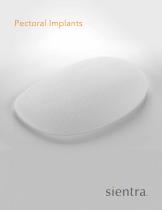
Pectoral Implants
Open the catalog to page 1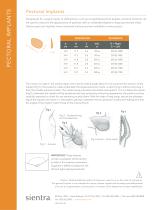
pectoral IMPLANTs Pectoral Implants Developed for surgical repair of deficiencies, such as congenital pectoral aplasia, pectoral implants can be used to improve the appearance of patients with an underdeveloped or disproportionate chest. Sientra pectoral implants have a textured surface and are available in various sizes. REFERENCE D = Right E = Left The incision is made in the axillary region and must be wide enough (about 5 cm) to permit the insertion of the implant (Fig 1); the pocket is made underneath the largest pectoral muscle, undermining it without removing it from the smaller pectoral...
Open the catalog to page 2All Sientra catalogs and technical brochures
 Sientra Patient Planning Guide
48 Pages
 Patient Educational Brochure
88 Pages
 The Sientra Choice
12 Pages
 Product catalog
22 Pages
 HSC+ Sizers
2 Pages
 Quick Facts
16 Pages
 Patient Label Reconstruction
100 Pages
 Patient Label Augmentation
88 Pages
 Medgel Accessories
2 Pages
 Facial Implants
4 Pages
 Gluteal Implants
2 Pages
 Calf Implants
2 Pages
 Additional Tissue Expanders
4 Pages


Related Searches
- Cosmetic implant
- Anatomical implant
- Silicone implant
- Facial implant
- Round implant
- Silicone gel implant
- Chin implant
- Textured implant
- Smooth implant
- Tissue expander
- Nasal dorsal implant
- Malar implant
- Nasal implant
- Gluteal implant
- Calf implant
- Rectangular tissue expander
- Breast-shaped tissue expander
- Breast tissue expander
*Prices are pre-tax. They exclude delivery charges and customs duties and do not include additional charges for installation or activation options. Prices are indicative only and may vary by country, with changes to the cost of raw materials and exchange rates.
About MedicalExpo
MedicalExpo is a marketplace that offers B2B players a complete experience, from product sourcing to purchase. MedicalExpo is an entity of VirtualExpo Group.
Are you a buyer?
Are you a supplier?