

- Company
- Products
- Catalogs
- News & Trends
- Exhibitions
Jaw Thrust

Jaw Thrust
This document provides guidance on the correct procedure for performing a jaw thrust, particularly in situations where a cervical spine injury is suspected. It is a critical technique used to open the airway without moving the head, which is essential in cases of potential spinal injuries.
Procedure Overview
- Positioning: The rescuer should position themselves at the patient's head.
- Hand Placement: Place fingers behind the angles of the lower jaw and move the jaw in and upward without tilting the head back.
- Mouth Opening: Use thumbs to open the patient's mouth to facilitate breathing through both the mouth and nose.
Application During CPR
The jaw thrust can be used during CPR to ensure effective ventilation. Real-time feedback on the volume and rate of ventilation helps assess the effectiveness of the jaw thrust.
Partial Airway Opening
If the jaw thrust does not sufficiently move the jaw upward, only a partial airway opening may occur. This highlights the importance of proper technique.
Training with SmartMan BLS
SmartMan BLS provides a training tool with a moveable jaw connected to the airway opening, designed to practice the jaw thrust procedure effectively. This tool allows visualization of ventilation volume and rate, aiding in the evaluation of technique effectiveness.
Key Considerations
- The jaw thrust is particularly important in cases of suspected cervical spine injury, such as head injuries or diving accidents.
- Approximately 2% of blunt trauma victims have a spinal injury, with increased risk if craniofacial injuries are present.
Catalog excerpts

Jaw Thrust SmartMan BLS provides a moveable jaw which is connected to the airway opening. This is designed for training in the jaw thrust procedure. Jaw thrust is used to open the airway if you suspect a cervical spine injury such as when there is a collapse with a head injury, or from diving into shallow water. Jaw Thrust Tongue lifted off palate The American Heart Association says that “” Approximately 2% of victims with blunt trauma have a spinal injury, and this risk is tripled if the victim has a craniofacial injury” It requires that you pull the jaw inward and upward with the head in the neutral position. This will open the airway. It can be used in conjunction with an immobilization collar. Specifically do the following: Airway Opened 1. Position yourself at the patient’s head. 2. Place your fingers behind the angles of the lower jaw and move the jaw in and upward. Do NOT tilt the head back. 3. Use your thumbs to open the patient’s mouth to allow breathing through the mouth and nose. Indications of Correct procedure Feel. You will feel the movement in the hinge of the jaw Partial Air Opening. If the jaw thrust has not moved the jaw upward far enough, there may be only a partial opening. Ventilations Feedback During CPR. The Jaw Thrust can be used during CPR. The ventilation will respond to the effectiveness of the jaw thrust and this will be indicated in the real time feedback. Ventilations Tutor. Jaw Thrust can be used in conjunction with the Ventilation Tutor. The volume and rate of the ventilation will be displayed in real time. This allows you to visualize the volume and rate of air as it is given. Thus you will be able to evaluate whether the jaw thrust has been partially or totally effective.
Open the catalog to page 1All SmartMan catalogs and technical brochures
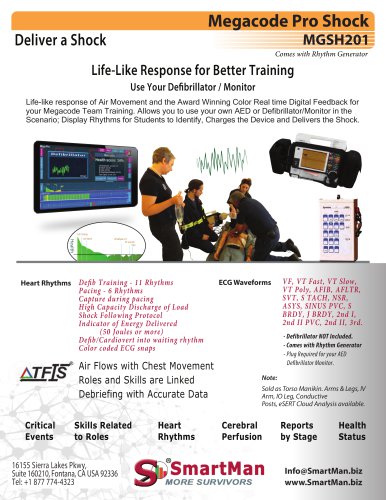 Megacode Pro Shock
3 Pages
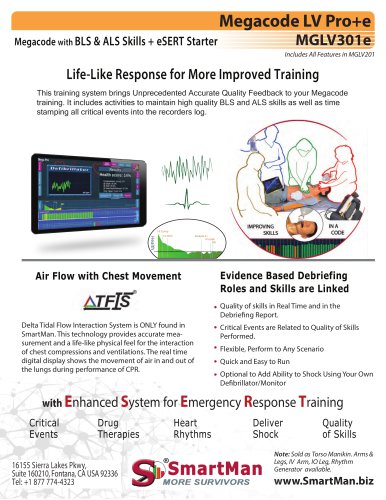 Megacode LV Pro+e
3 Pages
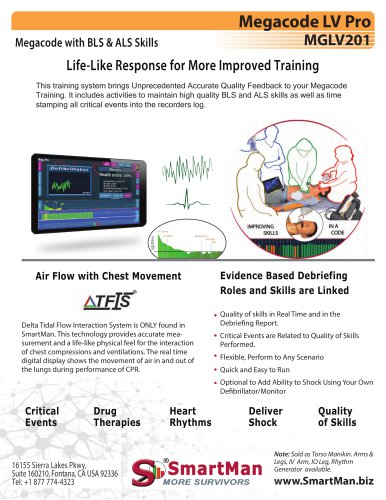 Megacode LV Pro
2 Pages
 Smartman AM1
3 Pages
 RS RSIM ARDS
3 Pages
 BLS CPR Pro
1 Page
 BLS CPR Pro+
1 Page
 Megacode Pro
1 Page
 Baby Pro
1 Page


Archived catalogs
 ALS CPR Pro+
1 Page
 Baby Pro+
1 Page
 ALS CPR Pro
1 Page
 ALS CPR
1 Page
 BLSLV CPR Pro+
1 Page
 BLSLV CPR Pro
1 Page
 Multi-Manikin Viewer
1 Page
 Megacode
1 Page
 Megacode Pro+
1 Page
 SmartMan Arms and Legs
1 Page
 LOW VOLUME (LV)
1 Page
 SmartMan Wheeled Duffle
1 Page
 SmartMan General Brochure
2 Pages
 Neonate Pro
1 Page
 Neonate Pro+
1 Page
 IV Trainer
1 Page
 IO Kit
1 Page
 Megacode Features Sheet
1 Page
 Low Volume
1 Page
 Wireless
1 Page
 ALS CPR Features Sheet
1 Page
 Laptop
1 Page
 Computer Caddy
1 Page


- Training phantom
- General care phantom
- Upper body simulator
- SmartMan training manikin
- Patient simulation unit
- Injection simulator
- Monitoring simulator
- General care training manikin
- Upper body training manikin
- Emergency care simulator
- Whole body simulator
- Whole body patient simulator
- Torso simulator
- General care patient simulator
- Childbirth demonstration simulator
- Intubation simulator
- SmartMan cardio-pulmonary reanimation training manikin
- Baby training manikin
- Heart rate simulator
- SmartMan emergency care training manikin