
- Catalogs
- Smith & Nephew
- Locking Small Fragment Overview


- Products
- Catalogs
- News & Trends
- Exhibitions
Locking Small Fragment Overview

Locking Small Fragment Overview
Catalog excerpts
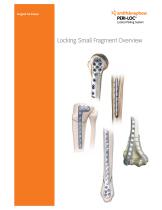
Surgical Technique Locking Small Fragment Overview
Open the catalog to page 1
PERI-LOC™ Locked Plating System Locking Small Fragment Overview Surgical Technique Nota Bene The technique description herein is made available to the healthcare professional to illustrate the treatment for the uncomplicated procedure. In the final analysis, the preferred treatment is the individual surgeon’s decision, which addresses the needs of the specific patient.
Open the catalog to page 3
Product overview Introduction The PERI-LOC™ Periarticular Locked Plating System from Smith & Nephew offers the advantages of locked plating with the flexibility and benefits of traditional plating in one system. Offering both locking and non-locking screw options, the PERI-LOC system can provide a construct that resists angular (e.g. varus, valus, torsional and axial) collapse while simultaneously acting as an effective aid to fracture reduction. A simple and straight forward instrument set features standardized drill bits and color-coded instrumentation, making PERI-LOC efficient and easy to...
Open the catalog to page 4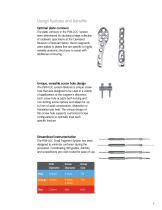
Design features and benefits Optimal plate contours The plate contours in the PERI-LOC™ system were determined by studying a large collection of cadaveric specimens at the Cleveland Museum of Natural History. Recon segments were added to plates that are specific to highly variable anatomic structures to assist with additional contouring. Unique, versatile screw hole design The PERI-LOC system features a unique screw hole that was designed to be used in a variety of applications at the surgeon’s discretion. Each screw hole accepts both locking and non-locking screw options and allows for up to...
Open the catalog to page 5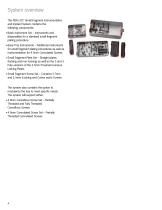
System overview The PERI-LOC™ Small Fragment Instrumentation and Implant System contains the following components: • Basic Instrument Set – Instruments and disposables for a standard small fragment plating procedure Tray Instruments – Additional instruments for small fragment plating procedures as well as instrumentation for 4.0mm Cannulated Screws Fragment Plate Set – Straight plates (locking and non-locking) as well as the 3 and 5 hole versions of the 3.5mm Proximal Humerus Locking Plates Fragment Screw Set – Contains 2.7mm and 3.5mm (Locking and Cortex each) Screws The system also contains...
Open the catalog to page 6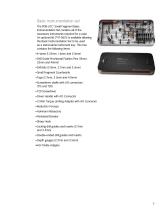
Basic instrumentation set The PERI-LOC™ Small Fragment Basic Instrumentation Set contains all of the necessary instruments required for a case. An optional lid (7117-0651) is available allowing the Basic Instrumentation Set to be used as a stand-alone instrument tray. This tray contains the following items: • K-wires Guide Provisional Fixation Pins (14mm, 25mm and 40mm) Fragment Countersink shafts with AO connectors (T15 and T20) Handle with AO Connector Torque Limiting Adapter with AO Connector drill guides and inserts (2.7mm and 3.5mm) • Double-ended • Depth drill guides and inserts
Open the catalog to page 7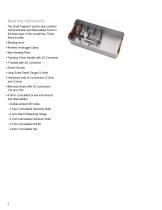
Base tray instruments The Small Fragment System also contains instrumentation and disposables found in the base layer of the overall tray. These items include: • Bending Verbrugge Clamp Bending Pliers Driver Handle with AO Connector • Screw • Long Screw Depth Gauge (3.5mm) drivers with AO connectors (T15 and T20) Cannulated Screw instruments and disposables: - Double-ended Drill Guide - 2.5mm Cannulated Hexdriver Shaft - K-wire Direct Measuring Gauge - 4.7mm Cannulated Hexdriver Shaft - 2.7mm Cannulated Drill Bit - 4.0mm
Open the catalog to page 8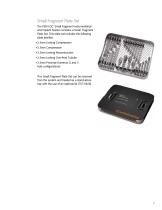
Small Fragment Plate Set The PERI-LOC™ Small Fragment Instrumentation and Implant System contains a Small Fragment Plate Set. This plate set includes the following plate families: • 3.5mm Locking Compression Locking Reconstruction Locking One-third Tubular Proximal Humerus (3 and 5 hole configurations) This Small Fragment Plate Set can be removed from the system and treated as a stand-alone tray with the use of an optional lid (7117-
Open the catalog to page 9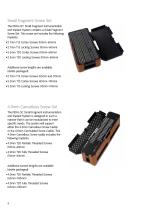
Small Fragment Screw Set The PERI-LOC™ Small Fragment Instrumentation and Implant System contains a Small Fragment Screw Set. This screw set includes the following implants: • .7mm T15 Cortex Screws (10mm–60mm) 2 • .7mm T15 Locking Screws (10mm–60mm) 2 • .5mm T20 Cortex Screws (10mm–60mm) 3 • .5mm T20 Locking Screws (10mm–60mm) 3 Additional screw lengths are available (sterile packaged): • .7mm T15 Cortex Screws (65mm and 70mm) 2 • .5mm T15 Cortex Screws (65mm–110mm) 3 • .5mm T15 Locking Screws (10mm–110mm) 3 4.0mm Cancellous Screw Set The PERI-LOC Small Fragment Instrumentation and Implant System...
Open the catalog to page 10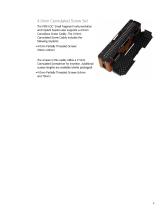
4.0mm Cannulated Screw Set The PERI-LOC™ Small Fragment Instrumentation and Implant System also supports a 4.0mm Cancellous Screw Caddy. The 4.0mm Cannulated Screw Caddy includes the following implants: • 4.0mm Partially Threaded Screws (10mm–60mm) The screws in this caddy utilize a 2.5mm Cannulated Screwdriver for insertion. Additional screws lengths are available (sterile packaged): • 4.0mm Partially Threaded Screws (65mm and 70m
Open the catalog to page 11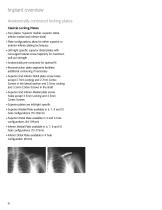
Implant overview Anatomically contoured locking plates Clavicle Locking Plates • Four plates: Superior medial, superior distal, inferior medial and inferior distal configurations allow for either superior or anterior-inferior plating techniques specific superior distal plates with convergent lateral screw trajectory for maximum pull-out strength plate segments facilitate additional contouring if necessary and Inferior Distal plate screw holes accept 2.7mm Locking and 2.7mm Cortex Screws in the lateral section and 3.5mm Locking and 3.5mm Cortex Screws in the shaft and Inferior Medial plate screw...
Open the catalog to page 12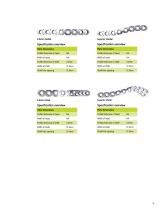
Inferior Medial Superior Medial Specification overview Specification overview Plate dimensions Plate dimensions Profile thickness of head Profile thickness of head Profile thickness of shaft Profile thickness of shaft Shaft hole spacing Shaft hole spacing Inferior Distal Superior Distal Specification overview Specification overview Plate dimensions Plate dimensions Profile thickness of head Profile thickness of head Profile thickness of shaft Profile thickness of shaft Shaft hole spacing Shaft hole spacing
Open the catalog to page 13All Smith & Nephew catalogs and technical brochures
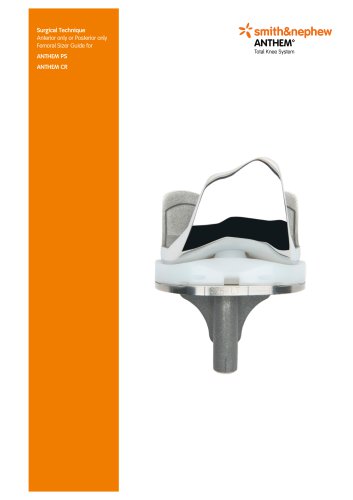 ANTHEM 2024
40 Pages
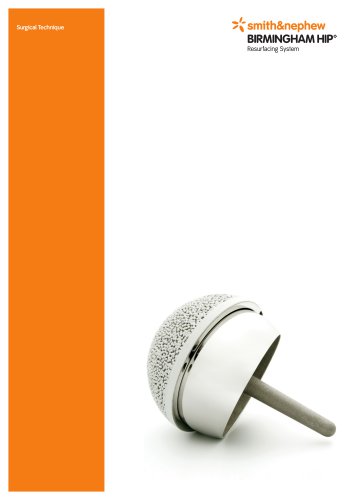 BIRMINGHAM HIP
32 Pages
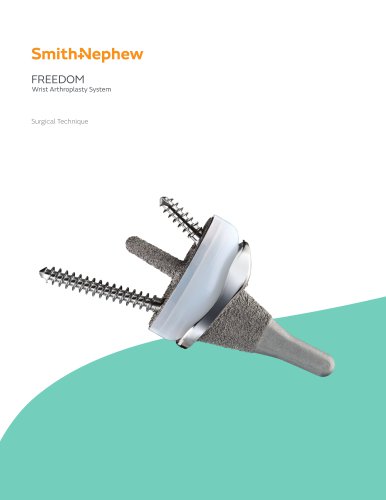 FREEDOM
16 Pages
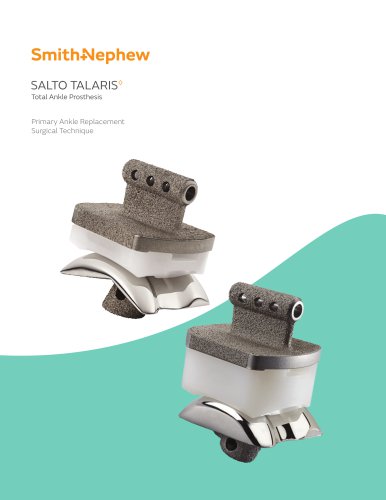 SALTO TALARIS
48 Pages
 polarstem
28 Pages
Archived catalogs
 Locking Large Fragment Overview
32 Pages
 Rediscover normal
4 Pages
 TWINFIX ULTRA HA and PK
2 Pages
 TRIGEN™ INTERTAN
12 Pages
 EVOS SMALL Resources
12 Pages
 NAVIO Message Brochure
8 Pages
 Small footprint, big impact
8 Pages
 TAYLOR SPATIAL FRAME◊
8 Pages
 Recertification Program
8 Pages
 anthem
4 Pages
 Ordering information
1 Page
 BST-CarGel ®
20 Pages
 RAPID RHINO™ NASASTENT™
6 Pages
 clancy anatomic cruiciate
2 Pages
 Electrosurgery
20 Pages
 Powered Instruments
11 Pages
 Shaver Systems
7 Pages
 Knee
Knee73 Pages
 HIP
HIP21 Pages


- Bone plate
- Compression plate
- Metallic compression plate
- Locking compression plate
- Surgery electrode
- Wound care
- Medical kit
- Electrosurgical electrode
- Surgical system
- Cutting electrosurgical system
- Reusable electrode
- Coagulation surgical system
- Monopolar electrode
- Endoscopy forceps
- Wound dressing
- Sealing forceps
- Straight electrode
- Coagulation electrode
- Bandage
- Proximal compression plate
- VirtualExpo Group
- Our Partners
- Recruitment
- Testimonials