
- Catalogs
- Solis BioDyne
- RiboGrip® RNase Inhibitor The Guardian of RNA


- Company
- Products
- Catalogs
- News & Trends
- Exhibitions
RiboGrip® RNase Inhibitor The Guardian of RNA
RiboGrip® RNase Inhibitor The Guardian of RNA
RiboGrip® RNase Inhibitor is a unique chimeric protein designed to protect RNA from degradation by ribonucleases. It is characterized by its increased temperature tolerance and is suitable for various RNA-related applications.
- First-strand cDNA synthesis
- RT-PCR, RT-qPCR, and RT-LAMP
- In vitro transcription and translation
- RNA isolation and purification
- RNA sequencing
- Exceptional stability due to Stability TAG technology, tolerating up to 60 minutes at 60 °C or 1 month at room temperature.
- High concentration formulation (220 U/µl) for flexible assay design.
- Efficient protection of RNA at low DTT concentrations.
- Strong inhibition of eukaryotic RNases, including RNase A, B, and C.
- Compatibility with reverse transcriptases, Taq, and Bsm Polymerase.
- Glycerol-free formulations available for specific applications.
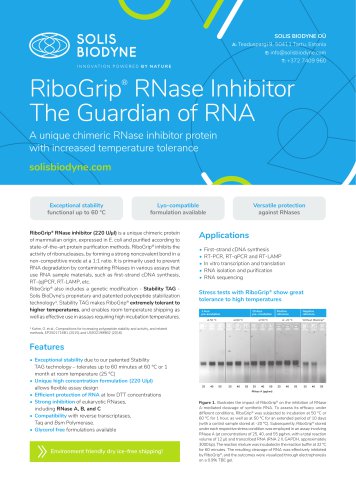
RiboGrip® demonstrates remarkable RNase inhibition across a broad range of RNase A concentrations (100-2000 pg) without compromising RNA amplification in RT-PCR reactions. It maintains functionality at high temperatures and is suitable for assays requiring high incubation temperatures.
- Available in various sizes: 2000 U, 4000 U, and 10,000 U.
- Glycerol-free and standard formulations are available to suit different assay requirements.
RiboGrip® RNase Inhibitor is an effective solution for protecting RNA integrity in various molecular biology applications, offering exceptional stability and compatibility with high-temperature assays.
Catalog excerpts

SOLIS BIODYNE OÜ A: Teaduspargi 9, 50411 Tartu, Estonia E: [email protected] T: +372 7409 960 RiboGrip RNase Inhibitor The Guardian of RNA ® A unique chimeric RNase inhibitor protein with increased temperature tolerance solisbiodyne.com Exceptional stability functional up to 60 °C Lyo-compatible formulation available RiboGrip® RNase inhibitor (220 U/µl) is a unique chimeric protein of mammalian origin, expressed in E. coli and purified according to state-of-the-art protein purification methods. RiboGrip® inhibits the activity of ribonucleases, by forming a strong noncovalent bond in a non-competitive mode at a 1:1 ratio. It is primarily used to prevent RNA degradation by contaminating RNases in various assays that use RNA sample materials, such as first-strand cDNA synthesis, RT-(q)PCR, RT-LAMP, etc. RiboGrip® also includes a genetic modification - Stability TAG Solis BioDyne’s proprietary and patented polypeptide stabilization technology1. Stability TAG makes RiboGrip® extremely tolerant to higher temperatures, and enables room temperature shipping as well as effective use in assays requiring high incubation temperatures. Versatile protection against RNases Applications • First-strand cDNA synthesis • RT-PCR, RT-qPCR and RT-LAMP • In vitro transcription and translation • RNA isolation and purification • RNA sequencing Stress tests with RiboGrip® show great tolerance to high temperatures 1 hour pre-incubation Positive reference Negative reference Without RiboGrip® ¹ Kahre, O. et al., Compositions for increasing polypeptide stability and activity, and related methods, EP2501716B1 (2015) and US9321999B2 (2016) Features • Exceptional stability due to our patented Stability TAG technology – tolerates up to 60 minutes at 60 °C or 1 month at room temperature (25 °C) • Unique high concentration formulation (220 U/µl) allows flexible assay design • Efficient protection of RNA at low DTT concentrations • Strong inhibition of eukaryotic RNases, including RNase A, B, and C • Compatibility with reverse transcriptases, Taq and Bsm Polymerase. • Glycerol free formulations available Environment friendly dry ice-free shipping! Figure 1. Illustrates the impact of RiboGrip® on the inhibition of RNase A-mediated cleavage of synthetic RNA. To assess its efficacy under different conditions, RiboGrip® was subjected to incubation at 50 °C or 60 °C for 1 hour, as well as at 50 °C for an extended period of 10 days (with a control sample stored at -20 °C). Subsequently, RiboGrip® stored under each respective stress condition was employed in an assay involving RNase A (at concentrations of 25, 40, and 55 pg/rxn, with a total reaction volume of 12 μl) and transcribed RNA (RNA 2 II, GAPDH, approximately 3000 bp). The reaction mixture was incubated in the reaction buffer at 32 °C for 60 minutes. The resulting cleavage of RNA was effectively inhibited by RiboGrip®, and the outcomes were vi
Open the catalog to page 1
RNase A added (pg/rxn) Figure 2. Demonstrates the broad inhibition range of RNase A by RiboGrip®. In this experiment, 1 ng of Human Total RNA (Agilent) served as the template in a 20 pl 1-step RT-PCR reaction. Various amounts of RNase A (100, 1000 and 2000 pg) were introduced into the reaction mixture. The addition of 1.37 U/pl of RiboGrip® exhibited efficient inhibition of RNase A across the entire range of 100-2000 pg. Notably, this inhibitory effect did not compromise the amplification of the RNA target in the 1-step RT-PCR reaction. In stark contrast, in the absence of RiboGrip®, the reaction...
Open the catalog to page 2All Solis BioDyne catalogs and technical brochures
 Product catalog 24/25
58 Pages
 SolisFAST® qPCR range
2 Pages
 SolisFAST® Probe qPCR Mix
2 Pages
 SolisFAST® Master Mix
2 Pages


- Solvent reagent
- Molecular biology reagent
- Research reagent
- Laboratory reagent
- Diagnostic reagent
- Enzyme reagent
- Dye reagent kit
- Cytology reagent
- Buffer solution reagent
- Medium reagent
- PCR reagent
- Microbiology reagent
- Reagent for nucleic acids
- DNA extraction reagent
- Real-time PCR reagent kit
- DNA polymerase reagent
- Enzymatic reagent
- High-sensitivity reagent
- RNA extraction reagent
- Taq DNA polymerase reagent