
- Catalogs
- SOUTHERN IMPLANTS (Pty) Ltd.
- OsteoBiol®

OsteoBiol®

OsteoBiol®
OsteoBiol biomaterials are inspired by natural bone structures to enhance bone regeneration. They focus on healing bone deficits efficiently by leveraging the morphological similarities of natural bone to human bone. Collagen plays a crucial role in clinical success by aiding in platelet activation, mesenchymal stem cell differentiation, and osteoblast proliferation.
OsteoBiol products, such as Gen-Os, are biocompatible and preserve collagen matrices to support bone regeneration. New products like Putty and Gel 40 offer plastic consistency for easy application in bone defects.
Guided Bone Regeneration (GBR) is essential for treating bone deficits, with collagen supporting new bone tissue formation. Scientific evidence shows collagen's ability to induce osteoblast differentiation and enhance proliferation, forming the basis for OsteoBiol's collagen-based biomaterials.
OsteoBiol biomaterials maintain collagen's biological functions while ensuring biocompatibility and effective handling properties. Tecnoss processes preserve natural hydroxyapatite structure, allowing osteoclastic remodeling similar to physiological bone turnover.
- Absence of foreign body response.
- Gradual resorption over time.
- Stimulation of physiological tissue healing.
- Protection from infection and capability to carry medication to surgical sites.
OsteoBiol's biomaterials provide effective solutions for bone regeneration, leveraging natural components to enhance healing processes and achieve optimal clinical outcomes.
The document details OsteoBiol bone substitutes, focusing on composition, physical characteristics, clinical applications, and handling procedures. It includes data on products like Gen-Os, mp3, Putty, Gel 40, Gel 0, and Apatos, highlighting their uses in oral surgery, periodontology, and implantology.
OsteoBiol products are made from heterologous bone tissue, preserving collagen and available in various forms such as granules and gels. Particle size varies among products, with granules ranging from 250-1000 µm and gels ≤ 300 µm. Estimated re-entry times range from 4 to 5 months.
- Gen-Os: A natural replicate of autologous bone, facilitating blood clotting and supporting bone neoformation.
- mp3: Pre-hydrated collagenated cortico-cancellous granules, ideal for maxillary sinus lift procedures.
- Putty: A bone paste with high collagen content, used for filling sockets and peri-implant defects.
- Gel 40 and Gel 0: Collagen gels used as graft stabilizers or cicatrizing agents.
- Apatos: Biomaterial with characteristics similar to mineralized human bone.
- Oral Surgery: Used for granulomas, cysts, and split crests.
- Periodontology: Filler for deep intrabony defects and furcations.
- Implantology: Universal filler for dehiscences, periimplantitis, and sinus lift procedures.
- Products like Gen-Os and Apatos require hydration with sterile saline or patient’s blood before application.
- mp3 is ready-to-use, minimizing contamination risk.
- Putty should be applied without compression and requires stable cavities.
OsteoBiol products mimic natural bone, facilitating new bone formation and preserving graft volume. They offer flexibility in clinical applications with specific formulations for different surgical needs.
The document discusses equine and porcine-derived biomaterials in oral surgery and implantology, focusing on Duo-Teck and Derma membranes.
- Duo-Teck: Made from equine lyophilized collagen felt and equine bone tissue, with a resorption time of about 15 days.
- Derma Membranes: Derived from porcine derma, completely resorbable with varying thickness and resorption times.
- Duo-Teck: Rehydrate with lukewarm physiological solution and place appropriately.
- Derma Membranes: Shape, hydrate, and adapt to the grafting site, stabilizing with sutures.
- Duo-Teck: Used for soft tissue separation, maxillary sinus membrane protection, and antrostomy closure.
- Derma Membranes: Applied for stabilization, protection, and space-making in gingival recessions.
Numerous case studies demonstrate the effectiveness of these biomaterials in dental procedures, highlighting successful outcomes in bone regeneration and implant stability.
Equine and porcine-derived biomaterials show promising results in tissue integration, bone regeneration, and clinical outcomes. Proper handling and application techniques are crucial for optimal results.
This document provides case studies and technical evaluations related to dental implant procedures and the use of OsteoBiol biomaterials, highlighting their effectiveness in bone regeneration and implant integration.
- Implant Rehabilitation: Successful implant placement using a monophasic protocol.
- Bone Augmentation: Successful bone regeneration using OsteoBiol Cortical Lamina and Gen-Os grafts.
- Peri-implant Regeneration: Procedure addressing bone defect using OsteoBiol Gen-Os.
- Maxillary Sinus Lift: Documented procedures using OsteoBiol mp3 for bone defect filling.
- Crestal Atrophy Rehabilitation: Sinus lift with OsteoBiol Evolution membrane showing significant bone defect filling.
- OsteoBiol Gen-Os: Confirmed as non-cytotoxic, non-toxic, non-sensitizing, and non-mutagenic through various tests.
- OsteoBiol Evolution: Similar biocompatibility tests confirmed safety and effectiveness.
OsteoBiol products comply with European regulations, ensuring biocompatibility and safety, certified by the Italian National Veterinary Health Service and ISO standards.
The document highlights the clinical benefits of OsteoBiol biomaterials in dental surgery, emphasizing their role in successful bone regeneration and implant procedures.
The cell culture study evaluated the biological reactivity of the OsteoBiol Evolution resorbable membrane, confirming it as non-cytotoxic.
Test confirmed the absence of local toxic effects using rabbit models.
Systemic toxicity evaluation using mice indicated the membrane is non-toxic.
Test using guinea pigs classified the membrane as non-sensitizing.
Mutagenic effects analysis showed no mutagenic activity.
Outlines clinical applications of OsteoBiol products, including post-extractive sockets, sinus lifts, and defect treatments.
Detailed list of OsteoBiol products with specifications on packaging, content, and sizes.
Catalog excerpts

REGENERATION SCIENCE INSPIRED BY NATURE Bone Grafting Materials
Open the catalog to page 1
New Putty packaging in syringe Pag. 17 New Curved Cortical Lamina Pag. 24 International Journal of Periodontics and Restorative Dentistry, 2008, 28: 283-289 Clinical Oral Implants Research, 2008, 19: 511-515 International Journal of Periodontics and Restorative Dentistry, 2008, 28:469-477 Clinical Implant Dentistry and Related Research, 2008, 10: 264-270 Journal of Immunopathology and Pharmacology, 2007, 20: 89-93
Open the catalog to page 2
Origin of OsteoBiol biomaterials Pag. 2 A significant step ahead Pag. 4 Collagen: a key factor for clinical success Pag. 5 Collagen and bone regeneration Pag. 6 From heterologous bone to biomaterial Pag. 8 Product Specifications OsteoBiol fillers composition Pag. 12 Soft Cortical Lamina Pag. 23 Curved Cortical Lamina Pag. 24 Publications and Case Reports Deep infrabony defect Pag. 38 Maxillary sinus lift with crestal access Pag. 39 Bilateral sinus lift Pag. 40 Lateral augmentation: self containing area Pag. 41 Regeneration of peri-implantitis defects Pag. 42 Augmentation beyond the skeletal envelope...
Open the catalog to page 3
Nature provides all the necessary elements for bone regeneration Our aim is to accelerate and guide this process
Open the catalog to page 4
A natural bone matrix Detail of a Gen-Os granule: vascular canal entrance with evident centralized osteonic structure. Source: Nobil Bioricerche (Italy) 10 years of scientific research
Open the catalog to page 5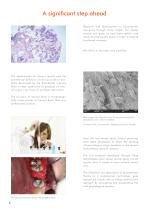
A significant step ahead Research and development of biomaterials has gone through many stages, but always toward one goal: to heal bone deficit with newly-formed quality tissue in order to achieve functional recovery. All of this in the least time possible. The examination of clinical results and the commercial diffusion of various kinds of products developed by the biomedical industry show a clear superiority of products of natural origin over those of synthetic derivation. The structure of animal bone is morphologically more similar to human bone than any synthesized product. SEM image of...
Open the catalog to page 6
Collagen: a key factor for clinical success COMPOSITION OF GEN-OS Tecnoss exclusive manufacturing process is able to neutralize the antigenic components present in heterologous bone (achievement of biocompatibility) and to preserve the collagen matrix inside biomaterial granules. Moreover, the molecular structure of natural hydroxyapatite is not significantly altered thanks to the limited maximum process temperature. MINERAL BONE (1) - COLLAGEN (2) These characteristics of OsteoBiol products allow a consistent bone neo-formation and a close contact between mature neo-formed bone and biomaterial...
Open the catalog to page 7
Collagen and bone regeneration Gui de d bon e r e ge n e r ati on ( GBR ) i s n e c e s s ar y to tr e at bon e de f i c i ts due to l e s i on s or bac te r i al i n f e c ti on s . Graphic representation of collagen triple helix. Th e bon e de f e c t r e c ov e r y oc c ur s th r ough th e ge n e r al m e c h an i s m s of ti s s ue h e al i n g, th at i s , by c om pl e x dyn am i c m e c h an i s m s di r e c te d towar ds th e r e pai r of ti s s ue f un c ti on an d an atom i c i n te gr i ty. Electronic microscopic view of OsteoBiol dried membrane with indication of its thickness (215...
Open the catalog to page 8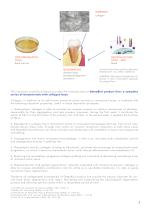
SUBSTRATE: collagen OSTEOPROGENITOR CELLS: bone marrow GROWTH FACTORS TGFß1 – BMP: blood REGENERATION: alveolar bone periodontal ligament cementum Key elements for tissue and bone regneration (Nakashima N. et al., 2003, modified; 3). SUBSTRATE: TEM image of OsteoBiol Gen-Os granule, in which it is possible to appreciate the collagen fibers. This important scientific evidence provides the rationale behind OsteoBiol product line: a complete series of biomaterials with collagen base. Collagen, in addition to its well-known structural action carried on connective tissues, is endowed with the following...
Open the catalog to page 9
From heterologous bone to biomaterial A biomaterial for the reconstruction of bone defects must be biocompatible and have good handling and mode ling properties; in specific clinical situations, it must also provide sufficient resistance to loading. Te c n os s l abor ator i e s ar e s pe c i al i z e d i n pr oc e s s i n g h e te r ol ogous bon y an d c ol l age n i c ti s s ue s . O s te oBi ol bon e pr oc e s s , i n par ti c ul ar, h as be e n de v e l ope d to m odi f y but m ai n tai n th e or i gi n al c ol l age n m atr i x of h e te r ol o gous ti s s ue , i n or de r to pr e s e r...
Open the catalog to page 10
The basic research for development of OsteoBiol product line has thus been driven by the ideal biomaterial concept: a material with the highest affinity to the new endogenous bone. To pursue this aim, Tecnoss developed a biotechnology, able, by avoiding the high temperature cera-mization phase, to preserve the structure of natural hydroxyapatite and therefore allow an osteoclastic-type remodeling of biomaterial, similar to physiological bone turnover time (1). Thanks to this innovative technology, the OsteoBiol line has the following important characteristics: 1. absence of a foreign body response...
Open the catalog to page 11
Product Specifications
Open the catalog to page 13
* Approximate percentages in volume subjet to a variability range depending on the heterologous origin of the bony tissue organic component (collagen etc.) cortical bone cancellous bone inorganic component (mineral) heterologous bone composition Collagenated fillers composition
Open the catalog to page 14
GRANULOMETRY The average reported values are indicative and subject to a variability range depending on the heterologous origin of the products. COMPOSITION The average reported values are indicative and subject to a variability range depending on the composition of the tissues of origin. RE-ENTRY TIME The reported values are estimates and purely indicative: these values can therefore vary depending on the patient and grafting site.
Open the catalog to page 15
Gen-Os TISSUE OF ORIGIN TISSUE COLLAGEN PHYSICAL FORM GRANULOMETRY RE-ENTRY TIME CATALOG LINKS PACKAGING AND CODES 0373 MIX OF CANCELLOUS AND CORTICAL HETEROLOGOUS BONE PRESERVED GRANULES SLIGHTLY RADIOPAQUE STANDARD 250-1000 µm 4/5 MONTHS DEPENDING FROM GRAFTING SITE CHARACTERISTICS CASE REPORTS PAG. 34 - 36 - 37 - 41 - 42 - 45 BIOCOMPATIBILITY TESTS PAG. 52 - 53 VIAL 0,25 gr. - VIAL 0,5 gr. - VIAL 1,0 gr. - VIAL 2,0 gr. Characteristics: a natural replicate of autologous bone, Gen-Os conserves the same intimate structures (matrix and porous form) and presents a high osteoconductive activity....
Open the catalog to page 16All SOUTHERN IMPLANTS (Pty) Ltd. catalogs and technical brochures
 IT CONNECTION
28 Pages
 TIB Abutment
2 Pages
 MSc EXTERNAL HEX
40 Pages
 Southern Implants Hex Family
6 Pages
 PROSTHETIC REHABILITATION
4 Pages
 OSSEOINTEGRATED FIXTURES
16 Pages
 MAX IMPLANT
4 Pages
 QDT 2019
12 Pages
 Product Catalogue
100 Pages
 Osteobiol
1 Page
 TRI-NEX
52 Pages
 Deep Conical Surgical
40 Pages
 Co-Axis®
1 Page
 INVERTA
36 Pages
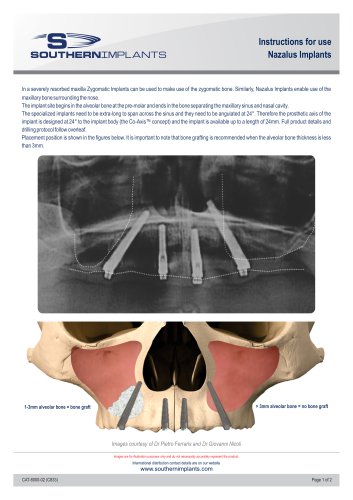




- Implant abutment
- Titanium implant abutment
- Straight implant abutment
- Titanium dental implant
- Internal implant abutment
- Conical dental implant
- Angled implant abutment
- Hexagonal implant abutment
- Screw implant abutment
- Internal dental implant
- Cylindrical dental implant
- Dental implant analog
- Internal hexagon implant abutment
- Straight dental implant analog
- Hexagonal dental implant
- Dental screwdriver
- Multi-unit implant abutment
- Internal hexagon dental implant