


- Company
- Products
- Catalogs
- News & Trends
- Exhibitions
Detection of Drug-Resistant Mutationsin Mycobacterium tuberculosis

Detection of Drug-Resistant Mutationsin Mycobacterium tuberculosis
Tuberculosis, caused by Mycobacterium tuberculosis, is a major communicable disease. Drug-resistant mutations pose a significant challenge to treatment, requiring accurate detection for effective diagnosis and management.
The document describes the use of Matrix-Assisted Laser Desorption/Ionization Time-of-Flight Mass Spectrometry (MALDI-TOF-MS) for detecting drug-resistant mutations. This technique involves ionizing biological molecules and measuring their molecular weight to identify and separate them accurately.
The document lists several drug-resistant genes associated with resistance to six anti-tuberculosis drugs: Rifampicin, Ethambutol, Fluoroquinolones, Isoniazid, Streptomycin, and Pyrazinamide. Specific mutations in genes such as embB, inhA, katG, gyrA, gyrB, rpsL, pncA, and rpoB are identified.
- Technological Advancement: Combines PCR technology for rapid testing without in vitro culture.
- Stability and Reliability: Unaffected by common lung microorganisms.
- Specificity: Can tolerate 100 ng of wild-type human genomic DNA without non-specific results.
- Sensitivity: Detects Mycobacterium tuberculosis DNA with as low as 200 copies in 20 ng of human DNA.
The process includes DNA extraction, template addition, mass spectrometry analysis, data analysis, and report generation.
Accurate identification of drug-resistant mutations aids in the clinical treatment of tuberculosis by covering six major anti-tuberculosis drugs.
The Mycobacterium tuberculosis resistance mutation site detection kit uses nucleic acid mass spectrometry and is validated for use with paraffin-embedded tissue samples. It is intended for research use only.
Catalog excerpts
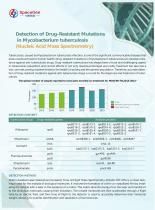
Detection of Drug-Resistant Mutations in Mycobacterium tuberculosis (Nucleic Acid Mass Spectrometry) Tuberculosis, caused by Mycobacterium tuberculosis infection, is one of the significant communicable diseases that pose a serious threat to human health. Drug-resistant mutations in Mycobacterium tuberculosis can develop resistance against anti-tuberculosis drugs. Drug-resistant tuberculosis has always been a focal and challenging aspect in tuberculosis prevention and control efforts. It not only requires prolonged and costly treatment but also has a low cure rate, posing a severe threat to the health of society and the general population. Therefore, accurate detection of drug-resistant mutations against anti-tuberculosis drugs is crucial for the diagnosis and treatment of tuberculosis. The global number of people reported to have been enrolled on treatment for MDR/RR-TB,2015-2021a Adults aged ≥15 years or age not reported Children aged 0-14 years DETECTION CONTENT Tuberculosis drugs Drug-resistant genes Analysis projects DETECTION METHOD Matrix-Assisted Laser Desorption/Ionization Time-of-Flight Mass Spectrometry (MALDI-TOF-MS) is a novel technique used for the analysis of biological molecules. It involves the formation of a thin co-crystallized film by irradiating the sample with a laser in the presence of a matrix. The matrix absorbs energy from the laser and transfers it to the biological molecules, causing their ionization. The ionized molecules are then accelerated through a flight tube by an electric field, and their time of flight to the detector is used to accurately determine their molecular weight, allowing for pre
Open the catalog to page 1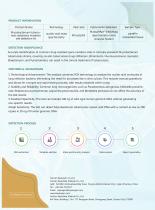
PRODUCT INFORMATION Product Name Mycobacterium tuberculosis resistance mutation site detection kit nucleic acid mass spectrometry Pack Size Instruments Validated Sample Type MassARRAY®DNAMass Spectrometry Gene Analysis System paraffin embedded tissue DETECTION SIGNIFICANCE Accurate identification of common drug-resistant gene mutation sites in clinically prevalent Mycobacterium tuberculosis strains, covering six anti-tuberculosis drugs (Rifampin, Ethambutol, Fluoroquinolones, Isoniazid, Streptomycin, and Pyrazinamide), can assist in the clinical treatment of tuberculosis. FEATURES & ADVANTAGES...
Open the catalog to page 2All SPACEGEN catalogs and technical brochures


- Detection kit
- Blood detection kit
- Immunoassay detection kit
- Plasma detection kit
- Analysis software
- Infectious disease detection kit
- Molecular detection kit
- Whole blood detection kit
- Respiratory disease assay kit
- Optical test kit
- Clinical detection kit
- Visualization software
- Fluorescence detection kit
- Real-time PCR assay kit
- Windows software
- Laboratory software
- Research detection kit
- Cloud-based software
- Cell detection kit
- Oncology detection kit