


- Company
- Products
- Catalogs
- News & Trends
- Exhibitions
Human Lung Cancer RET Gene Fusion Detection Kit

Human Lung Cancer RET Gene Fusion Detection Kit
The document describes the Human Lung Cancer RET Gene Fusion Detection Kit, which utilizes a Real-Time PCR assay to detect KIF5B-RET rearrangement patterns in non-small cell lung cancer (NSCLC). The RET proto-oncogene, located at 10q11.2, is implicated in cellular proliferation and malignancy when fused with other genes.
Detected Genes
The kit detects several genes and exons, including RET-1, RET-2, RET-5, RET-6, CCDC6 E1, NCOA4 E8, PRKAR1A E7, and various KIF5B exons.
Features & Advantages
- Accuracy and Reliability: Pre-loaded PCR tubes minimize cross-contamination.
- High Sensitivity: Detects as low as 100 RNA copies.
- Comprehensive Coverage: Includes the 7 most common KIF5B-RET variants in NSCLC.
Detection Process
- Nucleic Acid Extraction
- Set up qPCR
- Amplification
- Data Analysis
Detection Significance
- RET gene fusion detection is crucial for inoperable stage III and IV NSCLC patients before systemic treatment.
- Guides targeted treatment based on RET positivity.
Product Information
- Product Name: Human Lung Cancer RET Gene Fusions Detection Kit
- Technology: Real-Time PCR assay
- Pack Size: 24 Tests/Kit
- Instruments Validated: Stratagene Mx3000P™, ABI7500, etc.
- Sample Type: Tumor tissue, Pleural, and Ascites
- Note: For Research Use Only
Contact Information
Xiamen Spacegen Co., Ltd. and Suzhou SpaceSeq MedLab Co., Ltd. provide contact details for further inquiries.
Catalog excerpts
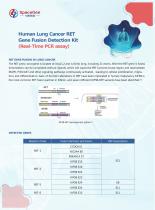
Human Lung Cancer RET Gene Fusion Detection Kit (Real-Time PCR assay) RET GENE FUSION IN LUNG CANCER The RET proto-oncogene is located at 10q11.2 and is 60 kb long, including 21 exons. After the RET gene is fused, dimerization can be completed without ligands, which will cause the RET tyrosine kinase region and downstream MAPK, PI3K/AKT and other signaling pathways continuously activated,leading to cellular proliferation, migration, and differentiation. Gain-of-function alterations in RET have been implicated in human malignancy. KIF5B is the most common RET fusion partner in NSCLC, and seven different KIF5B-RET variants have been identified [1] DETECTED GENES Reaction Tube Fusion Partners and Exons
Open the catalog to page 1
PRODUCT INFORMATION Product Name Pack Size Instruments Validated Sample Type Human Lung Cancer RET Gene Fusions Detection Kit Tumor tissue, Pleural and Ascites DETECTION SIGNIFICANCE ﹡Inoperable stage III and IV NSCLC patients should be detected for RET gene fusion before systemic treatment, and treatment should be guided by molecular classification. ﹡Select patients for the targeted treatment of NSCLC based on the presence of RET positivity. FEATURES & ADVANTAGES Accuracy and Reliability: Use pre-load PCR tube to effectively avoid cross-contamination. High Sensitivity: Sensitivity can reach...
Open the catalog to page 2All SPACEGEN catalogs and technical brochures


- Detection kit
- Blood detection kit
- Immunoassay detection kit
- Plasma detection kit
- Analysis software
- Infectious disease detection kit
- Molecular detection kit
- Whole blood detection kit
- Respiratory disease assay kit
- Optical test kit
- Clinical detection kit
- Visualization software
- Fluorescence detection kit
- Real-time PCR assay kit
- Windows software
- Laboratory software
- Research detection kit
- Cloud-based software
- Cell detection kit
- Oncology detection kit