


- Company
- Products
- Catalogs
- News & Trends
- Exhibitions
PolyJet Materials and Systems

PolyJet Materials and Systems
PolyJet 3D printers by Stratasys utilize curable liquid photopolymers to create fine layers, resulting in smooth surfaces, intricate details, and vivid colors. This technology supports a wide range of material properties, enabling the creation of prototypes and models with varying translucency, opacity, rigidity, and elasticity.
- Time-saving: Designers can save up to 50% of their time by creating realistic prototypes with full-color elements in one operation.
- Healthcare: Full-color, flexible materials enable lifelike anatomical models for training and pre-surgical planning, improving patient outcomes and reducing costs.
- Education: Enhances learning experiences by allowing students to design, test, and discover quickly.
- Dental: Increases productivity by printing multiple models in a single operation.
- Single-material Printers: Affordable desktop models using one or several base resins, offering rigid or flexible characteristics. They use SUP705 support material, removable with a water jet, and some models are compatible with SUP706B for soluble support removal.
- Multimaterial Printers: Offer versatility by combining several base resins in one part, creating new materials with distinct properties. They support mixed trays for increased efficiency and include models like the J4100 with the largest build volume.
- J55 and J8 Series: Pantone Validated models offering full-color capabilities suitable for office environments. The J8 Series includes the J826 Prime and J850 Prime, providing over 500,000 colors and texture mapping.
- Objet30 Series: Offers a maximum build size of 294 x 192 x 148.6 mm with various material options including rigid opaque, transparent, and simulated polypropylene.
- J750 Digital Anatomy and J4100: The J750 focuses on anatomical models with unique materials like TissueMatrix and BoneMatrix, while the J4100 handles large-capacity needs with a build size of 1000 x 800 x 500 mm.
- Digital Materials: Offers a wide range of flexibility and vibrant colors, with over 500,000 options available on certain models.
- Digital ABS Plus: Simulates ABS plastics, combining strength with high temperature resistance.
All PolyJet printers use GrabCAD Print software, facilitating the printing process and material management.
PolyJet 3D printers utilize a range of photopolymers with properties from rubberlike to transparent, offering high toughness and heat resistance. Digital Materials allow for blending base resins to create thousands of material combinations, achieving full-color capabilities, translucencies, and various Shore A values for realistic product prototypes.
- Digital ABS2 Plus: Offers enhanced dimensional stability for thin-walled parts, suitable for functional prototypes, snap-fit parts, electrical components, and engine parts.
- High Temperature Materials: Provide exceptional dimensional stability for thermal testing, ideal for high-definition models, exhibition models, and household appliances.
- Transparent Materials: VeroClear and VeroUltraClear families allow for clear and tinted parts, suitable for see-through parts like glass, consumer products, and medical applications.
- Rigid Opaque Materials: Offer brilliant color options for design freedom, ideal for fit and form testing, sales, marketing models, and electronic components.
- Simulated Polypropylene: Mimics polypropylene's appearance and functionality, suitable for prototyping containers, packaging, and automotive components.
- Rubberlike Materials: Provide various elastomer characteristics, ideal for rubber surrounds, soft-touch coatings, and nonslip surfaces.
- Biocompatible Materials: Feature high dimensional stability and colorless transparency, suitable for applications requiring prolonged skin contact and short-term mucosal contact.
The document provides detailed specifications for various materials, including tensile strength, elongation at break, modulus of elasticity, flexural strength, flexural modulus, heat deflection temperature (HDT), Izod notched impact, water absorption, glass transition temperature (Tg), Shore hardness, Rockwell hardness, polymerized density, and ash content. These properties vary across different material families such as Digital ABS Plus, Vero family, and rubberlike materials.
Stratasys offers a wide range of advanced materials designed to enhance the accuracy, flexibility, and reliability of 3D printing processes. The company is committed to continuous development and investment in hardware, software, and services to deliver optimal results with less time and hassle.
Catalog excerpts

PolyJet Systems and Materials
Open the catalog to page 1
Precision, Power, Pace and Productivity
Open the catalog to page 2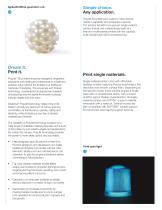
Simple choice. Any application. PolyJet 3D printers are scaled to meet diverse needs in capability and production capacity. The printers fall within two groups: single-material printers that jet one material (base resin) at a time and multimaterial printers with the capacity to jet several base resins simultaneously. Dream it. Print it. PolyJet™ 3D printers empower designers, engineers, educators and healthcare professionals to create and problem-solve without the limitations of traditional methods of modeling. The power lies with PolyJet technology, curable liquid photopolymers capable of producing...
Open the catalog to page 3
Print multiple materials. Multimaterial printers offer the most in PolyJet versatility, performance and productivity, exploiting the benefits of multi-jetting technology. Multimaterial printers enable mixed parts — the combination of several base resins in the same part — and Digital Materials, which is the blending of individual base resins to create new materials with distinct properties. Mixed trays are also possible, meaning one build tray can accommodate multiple parts made with different materials, increasing production efficiency. Largecapacity needs are easily handled by the J4100™, boasting...
Open the catalog to page 4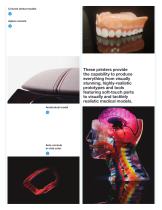
Colored dental models Agilus console These printers provide the capability to produce everything from visually stunning, highly-realistic prototypes and tools featuring soft-touch parts to visually and tactilely realistic medical models. Anatomical model Auto console in vivid color
Open the catalog to page 5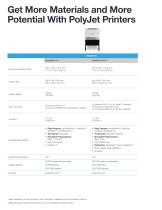
Get More Materials and More Potential With PolyJet Printers Maximum Build Size (XYZ) System Size System Weight Layer Thickness 28 microns (0.0011 in.) 16 microns (0.0006 in.) for VeroClear™ material 28 microns (0.0011 in.) for Tango™ materials 36 microns for fast draft mode 16 microns (0.0006 in.) for all other materials • Rigid Opaque: VeroWhitePlus™, VeroGray™, VeroBlue™, VeroBlackPlus™ • Transparent: VeroClear • Simulated Polypropylene: Rigur™, Durus™ • High Temperature • DraftGrey™ • Rigid Opaque: VeroWhitePlus, VeroGray, VeroBlue, VeroBlackPlus • Transparent: VeroClear, RGD720 • Simulated...
Open the catalog to page 6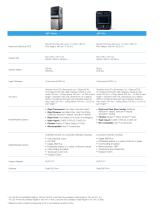
Round Print Tray with up to 1,174cm2 (182 in2) Print Height: 190 mm* (7.48 in.)* Round Print Tray with up to 1,174cm2 (182 in2) Print Height: 158 mm* (6.22 in.)* System Size System Weight Layer Thickness Deviation from STL dimensions, for 1 Sigma (67%) of models printed with rigid materials, based on size: under 100 mm – ±150μ; above 100 mm – ±0.15% of part length.** Deviation from STL dimensions, for 2 Sigma (95%) of models printed with rigid materials, based on size: under 100 mm – ±180μ; above 100 mm – ±0.2% of part length.** Deviation from STL dimensions, for 1 Sigma (67%) of models printed...
Open the catalog to page 7
Maximum Build Size (XYZ) System Size System Weight Layer Thickness Horizontal build layers range between 14 microns - 27 microns (.00055 in. - .001 in.) depending on the print mode. Typical deviation from STL dimensions, for models printed with rigid materials, based on size: under 100 mm – ±100μ; above100 mm – ±200μ. Model Material Options • Rigid Opaque: Vero family including natural and color shades and VeroUltra opaque materials in black and white. • Rigid Transparent: Vero Vivid family that includes VeroCyanV, VeroMagentaV, VeroYellowV • Rubberlike: Agilus family of flexible materials •...
Open the catalog to page 8
Maximum Build Size (XYZ) Layer Thickness Horizontal build layers range between 14 microns - 27 microns (.00055 in. - .001 in.) depending on the print mode and 55 microns (.002 in.) for super high speed printing mode. Horizontal build layers range between 14 microns - 27 microns (.00055 in. - .001 in.) depending on the print mode and 55 microns (.002 in.) for super high speed printing mode. Typical deviation from STL dimensions, for models printed with rigid materials, based on size: under 100 mm – ±100μ; above100 mm – ±200μ or ± 0.06% of part length, whichever is greater. Typical deviation from...
Open the catalog to page 9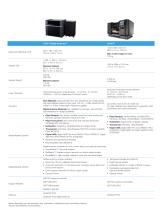
Maximum Build Size (XYZ) System Size System Weight J4100™ 1000 x 800 x 500 mm (39.3 x 31.4 x 19.6 in.) Max model weight on tray: 135 kg Horizontal build layers range between 27 microns - 55 microns (0.001 in. - 0.002 in.) depending on the print mode. Layer Thickness Horizontal build layers range between 14 microns - 27 microns (.00055 in. - .001 in.) depending on the print mode. Vero Materials: Typical deviation from STL dimensions, for models printed with rigid materials, based on size: under 100 mm – ±100μ; above100 mm – Up to 600 microns for full model size ±200μ or ± 0.06% of part length,...
Open the catalog to page 10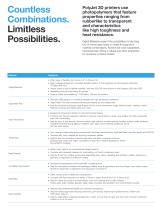
Countless Combinations. Limitless Possibilities. PolyJet 3D printers use photopolymers that feature properties ranging from rubberlike to transparent and characteristics like high toughness and heat resistance. Digital Materials expand the possibilities by blending two or more base resins to create thousands of material combinations. Achieve full-color capabilities, translucencies, Shore A values and other properties for maximum product realism. Digital Materials • Wide range of flexibility, from Shore A 27 to Shore A 95 • Rigid materials ranging from simulated standard plastics to the toughness...
Open the catalog to page 11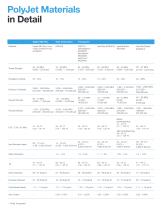
PolyJet Materials in Detail Digital ABS Plus High Temperature Digital ABS Plus, Ivory, made of RGD515 Plus & RGD531 Tensile Strength Flexural Strength Flexural Modulus Izod Notched Impact Water Absorption Shore Hardness Rockwell Hardness
Open the catalog to page 12
Rigid Opaque (Vero Family) Materials Rigid Opaue (VeroUltra Family) Vero PureWhite (RGD837), VeroGray (RGD850), VeroBlackPlus (RGD875), VeroWhitePlus (RGD835), VeroYellow (RGD836), VeroCyan (RGD843), VeroMagenta (RGD851), VeroMagentaV (RGD852)*, VeroYellowV (RGD838)*, VeroCyanV (RGD845)* Tensile Strength Flexural Strength Flexural Modulus Izod Notched Impact Water Absorption Shore Hardness Rockwell Hardness Polymerized Density
Open the catalog to page 13All Stratasys catalogs and technical brochures
 J3 DentaJet 3D printer
2 Pages
 J750 Digital Anatomy
8 Pages
 FDM Materials and Systems
12 Pages
 F123 Series
4 Pages
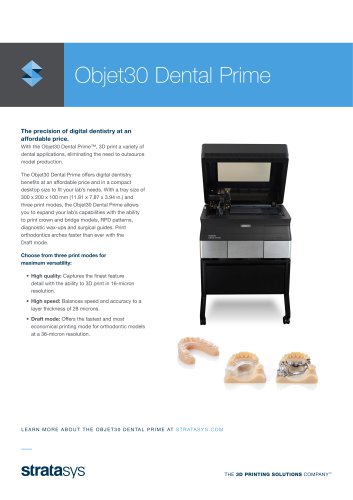 Objet30 Dental Prime
2 Pages
 Fortus 450mc
8 Pages
 J5 DentaJet
8 Pages
Archived catalogs
 J700 Dental
4 Pages
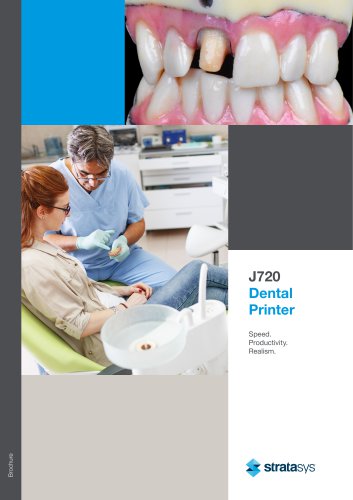 J720 Dental
4 Pages
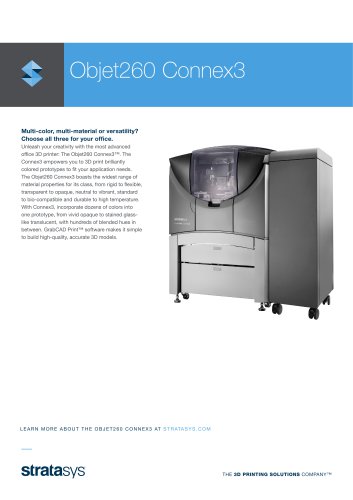 Objet 260 Connex 3
2 Pages
 J5 MediJet
8 Pages
 Biocompatible Clear MED610
2 Pages
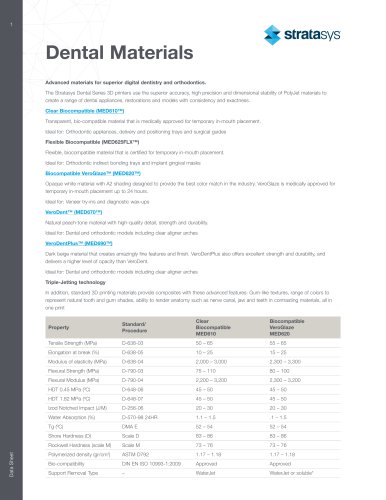 Dental Materials
2 Pages
- Dental material
- Dental restoration material
- Resin dental material
- Modeling dental material
- Biocompatible dental material
- Translucent dental material
- Impression tray dental material
- 3D printing dental material
- Opaque dental material
- Casting dental material
- Orthodontic material
- White dental material
- Temporary dental material
- Transparent dental material
- Dental 3D printer
- Medical 3D printer
- Gel dental material
- Dental veneer material
- Desktop 3D printer