
- Catalogs
- STT Systems
- A segmentable normative database for gait analysis based on the Helen Hayes markerset


- Company
- Products
- Catalogs
- News & Trends
- Exhibitions
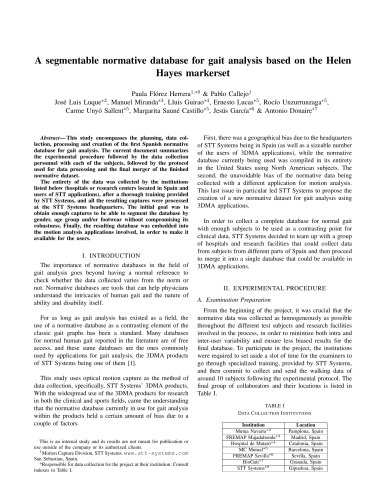
A segmentable normative database for gait analysis based on the Helen Hayes markerset
A segmentable normative database for gait analysis based on the Helen Hayes markerset
The document outlines the development of a Spanish normative database for gait analysis using the Helen Hayes markerset. This database is intended to serve as a comprehensive reference for gait analysis, with data segmented by gender, age, and footwear.
Examination Preparation: Participating institutions received training from STT Systems to ensure consistent data collection, focusing on the current normative database, marker placement, and exclusion criteria.
Markerset: The STT Helen Hayes protocol was employed, with modifications such as the removal of greater trochanter markers and the addition of heel markers for improved foot tracking.
Testing Criteria: Subjects with conditions affecting gait were excluded. Data was collected from subjects walking normally in a controlled environment.
Acquisition: Over 8 months, data was collected from 59 subjects, resulting in 73 captures.
Filtering: Noise and turning strides were filtered out using 3DMA applications.
Data Export: Processed data was exported to CSV files and analyzed with GNU Octave.
Segmentation: Data was segmented by gender, age group, and footwear for tailored comparisons.
Merge: The final dataset includes 13 joint angles with mean and standard deviation values.
Pelvis: Normative curves for pelvic tilt, obliquity, and rotation were established.
Hips: Hip joint angles for flexion, abduction, and rotation were calculated.
Knees: Knee joint angles for flexion, varus/valgus, and rotation were calculated.
Normative curves for knee, ankle, and foot direction were provided. Knee flexion, abduction, and rotation were analyzed, as well as ankle flexion, abduction, and rotation, and foot rotation in the transverse plane.
The study successfully created a comprehensive normative database to aid in interpreting complex biomechanical data, minimizing statistical bias and ensuring consistency. The database segmentation allows for detailed analysis of gait patterns across demographics.
STT Systems plans to expand the database with more trials and develop a tool for users to create their own normative databases, potentially including references for specific gait pathologies.
The document cites foundational works in gait analysis by Kadaba et al. and Bell et al.
Catalog excerpts
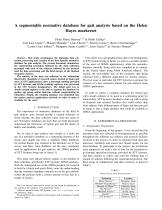
Paula Florez Herrera1’*8 & Pablo Callejo1 Jose Luis Luque*2, Manuel Miranda*3, Lluis Guirao*4, Ernesto Lucas*5, Rocfo Unzurrunzaga*5, Carme Unyo Sallent*5, Margarita Saune Castillo*5, Jesus Garcia*6 & Antonio Donaire*7 Abstract—This study encompasses the planning, data collection, processing and creation of the first Spanish normative database for gait analysis. The current document summarizes the experimental procedure followed by the data collection personnel with each of the subjects, followed by the protocol used for data processing and the final merger of the finished normative dataset. The entirety of the data was collected by the institutions listed below (hospitals or research centers located in Spain and users of STT applications), after a thorough training provided by STT Systems, and all the resulting captures were processed at the STT Systems headquarters. The initial goal was to obtain enough captures to be able to segment the database by gender, age group and/or footwear without compromising its robustness. Finally, the resulting database was embedded into the motion analysis applications involved, in order to make it available for the users. The importance of normative databases in the field of gait analysis goes beyond having a normal reference to check whether the data collected varies from the norm or not. Normative databases are tools that can help physicians understand the intricacies of human gait and the nature of ability and disability itself. For as long as gait analysis has existed as a field, the use of a normative database as a contrasting element of the classic gait graphs has been a standard. Many databases for normal human gait reported in the literature are of free access, and these same databases are the ones commonly used by applications for gait analysis, the 3DMA products of STT Systems being one of them [1]. This study uses optical motion capture as the method of data collection, specifically, STT Systems’ 3DMA products. With the widespread use of the 3DMA products for research in both the clinical and sports fields, came the understanding that the normative database currently in use for gait analysis within the products held a certain amount of bias due to a couple of factors. This is an internal study and its results are not meant for publication or use outside of the company or its authorized clients. 1Motion Capture Division, STT Systems. www.stt-systems.com San Sebastian, Spain. ♦Responsible for data collection for the project at their institution. Consult indexes in Table I. First, there was a geographical bias due to the headquarters of STT Systems being in Spain (as well as a sizeable number of the users of 3DMA applications), while the normative database currently being used was compiled in its entirety in the United States using North American subjects. The second, the unavoidable bias of the normative data being collected with a different application for motion analysis. This last issue in particular led STT Systems to propose the creation of a new normative dataset for gait analysis using 3DMA applications. In order to collect a complete database for normal gait with enough subjects to be used as a contrasting point for clinical data, STT Systems decided to team up with a group of hospitals and research facilities that could collect data from subjects from different parts of Spain and then proceed to merge it into a single database that could be available in 3DMA applications. II. EXPERIMENTAL PROCEDURE A. Examination Preparation From the beginning of the project, it was crucial that the normative data was collected as homogeneously as possible throughout the different test subjects and research facilities involved in the process, in order to minimize both intra and inter-user variability and ensure less biased results for the final database. To participate in the project, the institutions were required to set aside a slot of time for the examiners to go through specialized training, provided by STT Systems, and then commit to collect and send the walking data of around 10 subjects following the experimental protocol. The final group of collaborators and their locations is listed in Table I. Data Collection Institutions
Open the catalog to page 1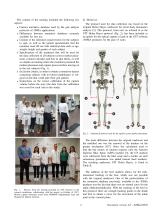
The content of the training included the following key aspects: • • • B. Markerset The protocol used for data collection was based on the original Helen Hayes markerset for lower-body kinematics analysis [2]. This protocol, from now on referred to as the STT Helen Hayes protocol (Fig. 2), has been included as an option for the optical capture of gait in the STT software (3DMA products) for the past 15 years. Current normative database used by the gait analysis protocols of 3DMA applications. Differences between normative databases currently available for free use. Content of the informed consent...
Open the catalog to page 2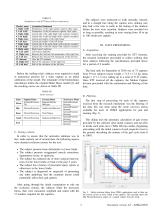
Markers in the STT Helen Hayes protocol Before the walking trials, subjects were required to stand in anatomical position for a static capture as an initial calibration of the model. The remainder of the biomechanic calculations follow the original Helen Hayes model [2], and the resulting curves are shown in Table III. In order to ensure that the normative database was in fact, made entirely out of normal data, the following aspects were deemed exclusion criteria for the test: • The subject presents bone deformities in lower limbs. • The subject presents exaggerated muscle retractions, ligamentous...
Open the catalog to page 3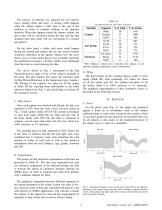
Segmentation of the Final Dataset *N/D: Subjects wished not to disclose the statistic or all optional statistical questions in the consent form. The process of filtering was required for two specific cases: turning stride and noise. A turning stride happens when the subject makes a 180° turn at the end of the walkway in order to continue walking in the opposite direction. When this happens inside the capture volume, the gait events will be calculated during the turn and the data obtained from that stride will not correspond to a normal gait pattern. On the other hand, a stride with noise could...
Open the catalog to page 4All STT Systems catalogs and technical brochures
 Gait & Running 2DMA
2 Pages
 Cycling 2DMA
2 Pages
 Generic 2DMA
2 Pages
 Cycling 3DMA
2 Pages
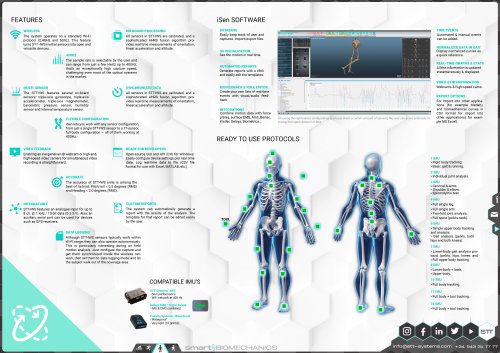 iSen Generic
1 Page
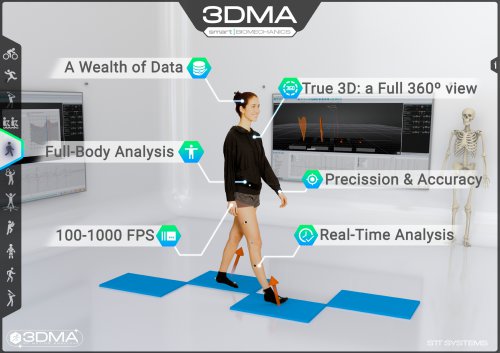 Generic 3DMA
2 Pages
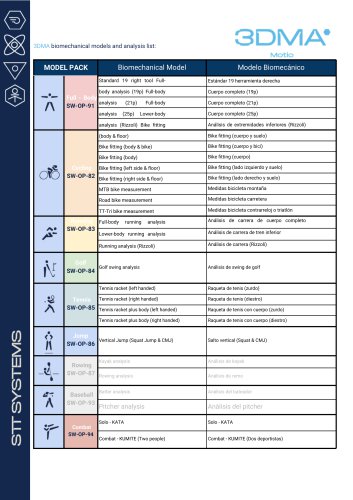 3DMA MODELS
2 Pages
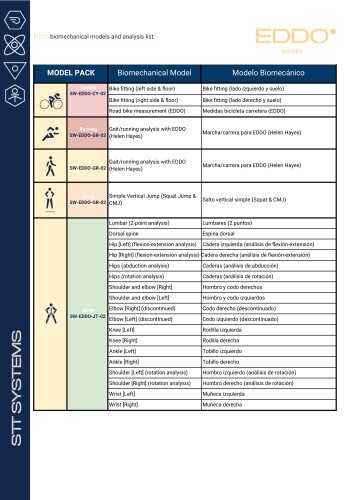 EDDO MODELS
1 Page
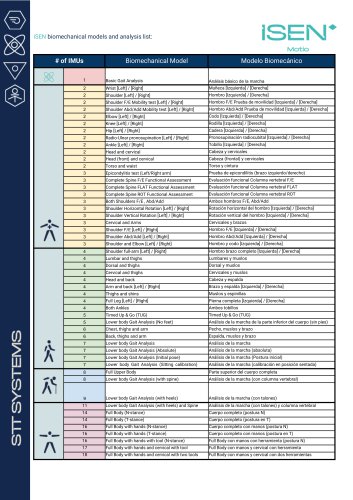 ISEN MODELS
1 Page
Archived catalogs
 STT SYSTEMS
59 Pages
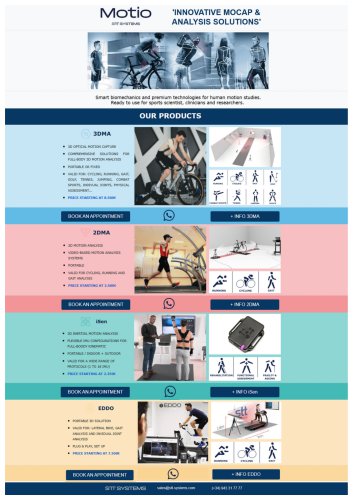 Products
1 Page
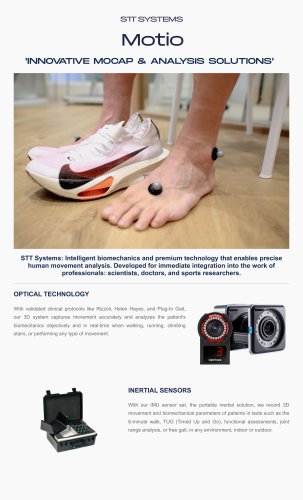 Medical Sector Products
3 Pages
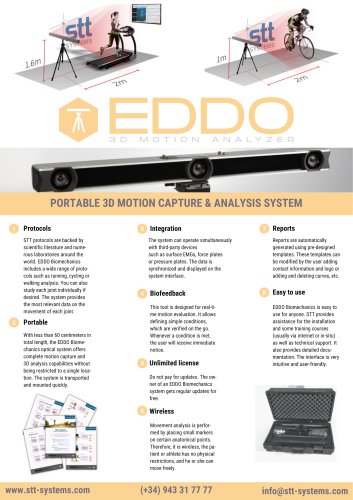 EDDO
EDDO1 Page
 2DMA
2DMA2 Pages
 GAIT & RUNNING 3DMA
2 Pages
 CYCLING 3DMA
2 Pages
 2DMA GAIT RUNNING
2 Pages