


M.8 ATEX

M.8 ATEX
- ATEX Certification: Applicable for zones 1, 2, and 22, based on combustible material type.
- Rated Voltage and Current: 10 to 250 VAC/DC, with model-specific current ratings.
- Temperature Resistance: Depends on seal material, ranging from -20°C to +80°C.
- Mechanical Life Expectancy: 1,000,000 cycles.
- Protection Class: IP65.
- Design: Compact with user-adjustable switching points during operation.
- Materials: Housing made from aluminium or zinc-plated steel, with seal materials like NBR, EPDM, and FKM.
- Switching Frequency: Up to 200 cycles per minute.
- Hysteresis: Non-adjustable, varies by type and application.
- Functionality: Monitors liquid or gaseous media, opening or closing an electrical circuit at set thresholds.
- Adjustment Range: Pressure range for setting the switching point.
- Switching Point Tolerances: Specified for room temperature, may vary with conditions.
- Hysteresis: Difference between rising and falling switching points, influenced by design and adjustment range.
- Seal Material Selection: Based on chemical resistance and temperature range, with specific recommendations for different media.
- Application Suitability: Ensure compatibility with medium and operating conditions, especially for sensitive applications.
- EPDM: Suitable for drinking water, not for oil. Denoted by '2'.
- EPDM-TW: Approved for drinking water and medical applications, not oil-resistant. Denoted by '5'.
- FKM/FPM (Viton®): High temperature and chemical resistance, suitable for hydraulic oils. Denoted by '3'.
- FFKM: Withstands up to 120°C and aggressive chemicals. Denoted by '6'.
- TPE: Compatible with mineral oil, hydraulic fluids, diluted acids, bases, and cold water. Denoted by '7'.
- Suitable for gaseous applications below 10 bar with high IP class.
- Oxygen applications require specific diaphragms and housing materials with defined pressure limits.
- Underpressure safety down to 300 mbar; overpressure safety up to 20 or 35 bar depending on type.
- cCSAus approval for Canadian and American markets ensures quality and reliability.
- Standard piston switches are not suitable for water; stainless steel with EPDM seal recommended.
- Pressure switches suitable for liquid and gaseous media, with specific demands on leak-tightness.
- Installation by authorized specialists only, observing safety regulations.
- No mounting position limitations for pressure measurement accuracy.
- IP protection classes define protection against dust and water penetration.
- Cylindrical and conical threads have specific sealing and tightening torque requirements.
- RoHS compliance and CE marking requirements outlined.
- Products designed according to good engineering practices under the Pressure Equipment Directive.
Catalog excerpts

Mechanical Pressure Switches sehctiwS erusserP lacinahceM
Open the catalog to page 1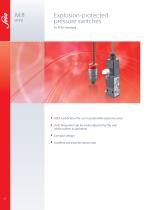
Explosion-protected pressure switches ATEX-certification for use in potentially explosive areas Switching point can be easily adjusted by the user whilst system in operation Compact design Excellent price/performance
Open the catalog to page 2
Technical explanations Explosion-protected pressure switches are classified according to the respective combustible material-type. This division is: Gases and vapours 0165 Dusts 0340 / 0341 Methane dust not suitable Our pressure switches are generally designed for use with gases, vapours or dust. Our explosion-protected pressure switches are not approved for use with methane dust (mining applications). The table provides an overview of the zone divisions, equipment groups and equipment categories. Conditions in potentially explosive atmosphere Combustible materials Temporary behaviour of combustible...
Open the catalog to page 3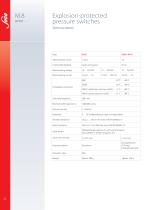
Explosion-protected pressure switches Technical details Type:
Open the catalog to page 4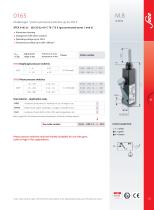
0165 Diaphragm / piston pressure switches up to 250 V ATEX 0102CC ©II 2G Ex d II C T6 /T5 X (gas-protected zones 1 and 2) • Aluminium housing • Changeover with silver contacts • Operating voltage up to 250 V • Overpressure safety up to 200 / 600 bar1) Seal material - Application areas Refer to page 82 for the temperature range and application thresholds of sealing materials. Your order number: 0165 - XXX 14 - X - 001 Piston pressure switches only have limited suitability for use with gases (refer to Page 14 for explanations). Contact assignment: O 1 = white 0 2 = green 0 4 = brown 11 Static...
Open the catalog to page 5
Adjustment screw hexagon socket hex 3 Contact assignment • 1 = black 0 2 = red 0 4 = white 0340 / 0341 Diaphragm / piston pressure switches up to 250 V ATEXCC ©41 3D IP65 T90°C (dust protection zone 22) • Zinc-plated steel housing (CrVI-free), with anodised aluminium protective cap • Changeover with silver contacts • Operation voltage up to 250 V, protection class 2, protective insulation [□] • Overpressure safety up to 300 / 600 bar11 Refer to page 82 for the temperature range and application thresholds of sealing materials. Your order number: 034X - XXX 03 - X - XXX Piston pressure switches...
Open the catalog to page 6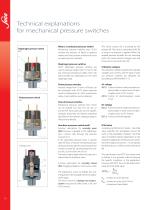
Technical explanations for mechanical pressure switches Diaphragm pressure switch NO Piston pressure switch NC What is a mechanical pressure switch? Mechanical pressure switches from SUCO monitor the pressure of liquid or gaseous media, and close or open an electrical circuit on reaching a set threshold. Diaphragm pressure switches SUCO diaphragm pressure switches are used in pressure ranges from 0.1 bar to 100 bar, meaning overpressure safety of 35, 100, 300 and 600 bar, depending on the used diaphragm type. Piston pressure switches Pressure ranges from 10 bar to 400 bar can be monitored with...
Open the catalog to page 7
Classification of electrical switch functions Contact form DIN EN60947-5-1 SPST single pole, single throw SPST single pole, single throw Changeover contacts CO, change over (snap action) SPDT single pole, double throw The switching point (for rising pressure) and hysteresis increase, whilst the switch-back point (for falling pressure) sinks. Also, the effect of the maximum (system) pressure on the switchback point (for falling pressure ramp) must be factored in for tolerance-critical applications. The higher the (system) pressure, the lower the resulting switch-back value. Potential-free – galvanically...
Open the catalog to page 8
Technical explanations for mechanical pressure switches Hysteresis can be set at SUCO in range from approx. 10 % (at end of adjustment range) to 30 % or higher (at start of adjustment range), related to the respective switching point for hex 27 and 30 A/F pressure switches with adjustable hysteresis. The specifications in the catalogue only represent typical average values. Please ask about the possible setting ranges you may require. Our electronic pressure switches are excellently suited to extremely low or high hysteresis. The lowest possible hysteresis is set if nothing is specified in the...
Open the catalog to page 9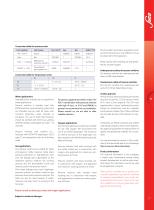
Conversion table for pressure units Water applications Standard piston switches are not suitable for water applications. Pressure switches in stainless steel with EPDM seal have a special sealing system and can therefore also be used for water with corrosion protection, water mixtures or emulsions. The use of other fluid mixtures should be clarified with SUCO (e.g. swelling of EPDM sealing could happen by water - oil mixture). Pressure switches with stainless ste^ housings with EPDM-TW diaphragm, SUCO type „5" are designed for the use of drinking water. Gas applications Our pressure switches...
Open the catalog to page 10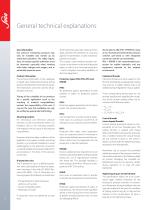
General technical explanations User information Our pressure monitoring products may only be installed and started up by authorised specialists. The safety regulations of country-specific authorities must be observed, especially when working with mains voltages and oxygen, and in potentially explosive areas. Product information The technical information in this catalogue is based upon fundamental testing during product development and empirical values. The information cannot be used for all application scenarios. Testing of the suitability of our products for a specific application (such as the checking...
Open the catalog to page 11
RoHSII compliant Values 30% lower than in the table above must be used for brass housings. Gaseous applications In particular using additional sealant to attain the required leak tightness may be necessary for gas applications. Vacuum The values given in the technical details for the vacuum range are specified in millibars (mbar) below atmospheric pressure. Pressure change rate (~rise / ~fall) The pressure change rate denotes the pressure over time for the rising/falling pressure. The pressure change rate is specified in bar/s or bar/ms. The maximum pressure change rate for SUCO mechanical pressure...
Open the catalog to page 12All SUCO Robert Scheuffele GmbH & Co. KG catalogs and technical brochures
 T3 Robust pressure transmitters
11 Pages
 T2 Robust pressure transmitters
11 Pages
 Pressure Monitoring 2019
170 Pages
 Transmission Technology
40 Pages
 M.6 Pressure switches "PLUS"
15 Pages
 M.7 Hex 30, changeover
12 Pages
 M.9 Vacuum
11 Pages
 M.10 Accessories
13 Pages
 E.7 Accessories
12 Pages
 M.5 Hex 24/27, ready-wired
11 Pages
 M.3 Hex 24
19 Pages
 M.1 Hex 24, integrated
17 Pages
 Product Overview 2018
6 Pages
 T.3
T.313 Pages
 E5
E513 Pages
 M.4
M.411 Pages
 M2
M216 Pages


