
- Catalogs
- SUCO Robert Scheuffele GmbH & Co. KG
- T2 Robust pressure transmitters


T2 Robust pressure transmitters

T2 Robust pressure transmitters
- Constructed with stainless steel housing and wetted parts for excellent media compatibility.
- Features a piezo-resistive sensor filled with oil for high accuracy and stability.
- Output signals include 0.5 - 4.5 V ratiometric, 0 - 10 V (3-wire), and 4 - 20 mA (2-wire).
- Pressure ranges from -1 to 100 bar, with overpressure protection up to 200 bar and burst pressure up to 250 bar.
- Mechanical life expectancy of 10 million pulsations at rise rates up to 1,000 bar/s.
- Accuracy of ±0.5% full scale at room temperature, with long-term stability of < ±0.2% FS per year.
- Temperature ranges vary based on seal material (NBR, EPDM, FKM).
- Installation and startup should be performed by authorized specialists, especially in explosive areas.
- Mounting position does not affect accuracy but may be influenced by application conditions.
- IP protection classes (IP65, IP67, IP6K9K) are specified for dust and water protection.
- For oxygen applications, components must be oil and grease-free, with plasma cleaning available.
- Electrical connections include DIN EN 175301-803-A, M12x1, Bayonet ISO 15170-A1-4.1, and cable connections.
- Sealing materials and pressure connections are specified for various applications.
- Overpressure protection values are based on static pressure, with dynamic values recommended to be 30-50% lower.
- Complies with RoHSII and CE directives, ensuring restriction of hazardous substances and adherence to European standards.
- EMC Directive 2014/30/EC applies to electronic products, while mechanical pressure switches are exempt.
- Silicone-on-Sapphire (SoS) Technology: Offers excellent mechanical and temperature stability.
- Oil-filled Stainless Steel Measuring Cell: Provides mechanical stress relief and suitability for oxygen applications.
- Ceramic Measuring Cell: Allows for precise pressure range adjustments.
- Accuracy: Defined as ±0.5% or ±1% of the full scale.
- Non-linearity: Deviation from the ideal output curve.
- Temperature Compensation: Minimize errors over specific temperature ranges.
- Response Time: Typically between 2 to 4 milliseconds.
- Resolution: Defines the smallest detectable change in pressure.
- Pressure Units: Conversion formulas for pressure units.
- Temperature Units: Conversion formulas for temperature units.
Catalog excerpts

Robust pressure transmitters Stainless steel housing (1.4305 / AISI 303, hex 22) stainless steel 1.4305 / AISI 303 Pressure transmitters especially for low pressures, including vacuum applications High overpressure protection (up to 3 x) Long life time even under high pressure change rates Housing and wetted parts are made of stainless steel providing excellent media compatibility Suitable for hydrogen and oxygen applications1) The highly-sensitive piezo-resistive sensor in the measuring cell filled with oil guarantees high level of accuracy, repeatability and long-term stability The availability of different sealing materials enables deployment in a broad temperature range with a diverse array of media For oxygen applications, the EPDM diaphragm can only be used up to 10 bar and a media temperature of
Open the catalog to page 1
Robust pressure transmitters Technical details Output signal: Permissible load / apparent ohmic resistance: Idle power consumption: 0645 / 0650 / 0660 Standard pressure ranges pnom: Mechanical life expectancy: 10,000,000 pulsations at rise rates to 1,000 bar/s at pnom Permitted pressure change rate: ±0.5 % full scale (FS) at room temperature, ±0.25 % BFSL Long term stability: < ±0.2 % of full scale (FS) per year Temperature error : ±0.02 % of full scale (FS) / °C; -1 … 1 bar ±0.03 % of full scale (FS) / °C Compensated temperature range: Temperature range ambient: with NBR seal: with EPDM seal:...
Open the catalog to page 2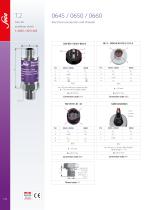
Electrical connectors and threads x ~ 60 mm without coupler socket x ~ 76 mm with coupler socket Cable connection x ~ 44 mm (+ 20 mm bend relief ) Cable length ~ 2 m Sealing ring G1/4 DIN EN ISO 1179-2 (DIN 3852-11) form E
Open the catalog to page 3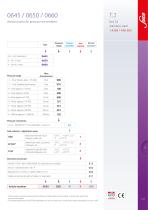
Article matrix for pressure transmitters hex 22 stainless steel 1.4305 / AISI 303 Electrical connection Seal material Pressure Pressure range connection Pressure range -1 – 0 bar (Vacuum, approx. -29.6 inHg) -1 – 1 bar (Compound pressure range) Pressure connection G1/4 – DIN EN ISO 1179-2 (DIN 3852-11), form E Seal material – Application areas Hydraulic/machine oil, air, nitrogen, water, etc. Brake fluid, water, acetylene, hydrogen, etc. Hydraulic fluids (HFA, HFB, HFD), petrol/gasoline, etc. Electrical connection DIN EN 175301-803-A (DIN 43650-A); socket device included Cable connection (length...
Open the catalog to page 4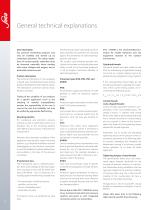
General technical explanations User information Our pressure monitoring products may only be installed and started up by authorised specialists. The safety regulations of country-specific authorities must be observed, especially when working with mains voltages and oxygen, and in potentially explosive areas. Product information The technical information in this catalogue is based upon fundamental testing during product development and empirical values. The information cannot be used for all application scenarios. Testing of the suitability of our products for a specific application (such as the...
Open the catalog to page 5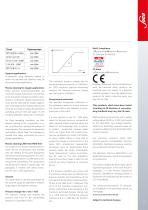
Tightening torgue RoHS-Compliance = Restriction of Hazardous Substances (EC Directive 2011/65/EU) Gaseous applications In particular using additional sealant to attain the required leak tightness may be necessary for gas applications. Plasma cleaning for oxygen applications When pressure switches/transmitters are used with oxygen, the surfaces must be free of oil and grease residues to prevent spontaneous combustion. Special requirements must also be observed for oxygen applications with regard to the material selection of housings and seals as well as the permitted operating pressure (see also...
Open the catalog to page 6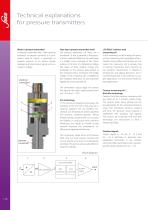
Technical explanations for pressure transmitters What is a pressure transmitter? A pressure transmitter (also called pressure transducer or pressure converter) is a component used to convert a pneumatic or hydraulic pressure to an electric (usually analogue and linear) output signal, such as a current or voltage. electrical connection How does a pressure transmitter work? The pressure measuring cell fitted has a membrane (1) that is exposed to the pressure to be measured. Affixed on this membrane is a bridge circuit consisting of four ohmic resistors in the form of a Wheatstone bridge. The values...
Open the catalog to page 7
Voltage output 0 - 10 V Transmitters with an output signal of 0 to 10 V are a commonly used variant due to their simple initial operation and straightforward scaling of the signal (0 V for 0 bar). The output load must be selected as highly resistive (with typical minimum value 4.7 kΩ). SUCO transmitters with voltage output have a 3-wire design. Conversion formula for pressure and voltage: Conversion formula for pressure and voltage: Uout = pressure applied x 10 V pressure range Voltage output 0.5 – 4.5 V ratiometric SUCO transmitters with ratiometric output are operated with a 5 V supply voltage...
Open the catalog to page 8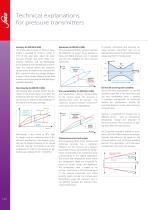
Technical explanations for pressure transmitters Accuracy (to DIN EN 61298) The (measuring) accuracy of pressure transmitters is specified by SUCO as ±0.5% or ±1% of the span (also called full scale). Accuracy includes zero point offset, nonlinearity, hysteresis and non-repeatability, and is defined at room temperature and new state. This method defines the maximum deviation from the ideal line (in contrast to the BFSL method in which the average deviation is given). Other factors influencing the total accuracy, such as temperature and ageing, are specified separately. Hysteresis (to DIN EN 61298)...
Open the catalog to page 9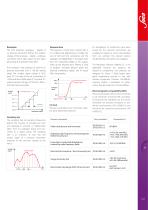
Resolution The A/D resolution (analogue - digital) of an pressure transmitter defines the smallest change of the analogue – digital – analogue conversion which takes places by the signal processing of an pressure transmitter. If for example 13-bit resolution is used for an pressure transmitter with a 100 bar setting range, the smallest signal change is 8192 steps (213). As state of the art a resolution of 12 bits and hence 4096 steps (212) is typical. Therefore pressure changes of 100 bar / 4096 = 0.024 bar can be recorded. Response time The response or circuit time is shorter than 2 to 4 milliseconds...
Open the catalog to page 10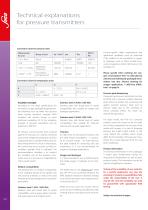
Technical explanations for pressure transmitters Conversion chart for pressure units Abbreviation for unit Pound-force per square inch Conversion chart for temperature units K Insulation strength According to the latest specifications for immunity to surges and lightning protection, the following must be taken into account when testing insulation strength: With insulation test devices having an inner resistance exceeding 42 Ω, the insulation strength of pressure transmitters can be tested up to 500 VDC. Stainless steel (1.4305 / AISI 303) Stainless steel with broad level of media compatibility....
Open the catalog to page 11All SUCO Robert Scheuffele GmbH & Co. KG catalogs and technical brochures
 T3 Robust pressure transmitters
11 Pages
 Pressure Monitoring 2019
170 Pages
 Transmission Technology
40 Pages
 M.6 Pressure switches "PLUS"
15 Pages
 M.7 Hex 30, changeover
12 Pages
 M.8 ATEX
12 Pages
 M.9 Vacuum
11 Pages
 M.10 Accessories
13 Pages
 E.7 Accessories
12 Pages
 M.5 Hex 24/27, ready-wired
11 Pages
 M.3 Hex 24
19 Pages
 M.1 Hex 24, integrated
17 Pages
 Product Overview 2018
6 Pages
 T.3
T.313 Pages
 E5
E513 Pages
 M.4
M.411 Pages
 M2
M216 Pages


