


T.3

T.3
Catalog excerpts

Pressure Transmitters srettimsnarT erusserP
Open the catalog to page 1
Robust pressure transmitters Stainless steel housing 1.4404 / AISI 316L, hex 22 P ressure transmitters specially for low pressures, including vacuum applications L ong life time even under high pressure change rates H ousing and wetted parts are made of stainless steel 1.4404 providing excellent media compatibility when used in seawater, chemical and process technology applications T he highly-sensitive piezo-resistive sensor in the measuring cell filled with oil guarantees high level of accuracy, repeatability and long-term stability T he availability of different sealing materials enables deployment...
Open the catalog to page 2
11 Static pressure. Dynamic value is 30 to 50% lower. Values refer to the hydraulic/pneumatic part of the pressure transmitter. 2) Within the compensated temperature range.
Open the catalog to page 3
0675/0680/0690 Electrical connectors and threads Cable connection
Open the catalog to page 4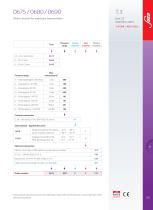
Order matrix for pressure transmitters 1) Static pressure, dynamic pressure 30 to 50% lower. Values refer to the hydraulic or pneumatic part of the pressure transmitter.
Open the catalog to page 5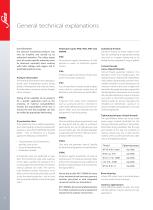
General technical explanations Thread User information Our pressure monitoring products may only be installed and started up by authorised specialists. The safety regulations of country-specific authorities must be observed, especially when working with mains voltages and oxygen, and in potentially explosive areas. Product information The technical information in this catalogue is based upon fundamental testing during product development and empirical values. The information cannot be used for all application scenarios. Testing of the suitability of our products for a specific application (such...
Open the catalog to page 6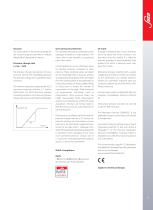
Vacuum The values given in the technical details for the vacuum range are specified in millibars (mbar) below atmospheric pressure. Pressure change rate (~rise / ~fall) The pressure change rate denotes the pressure over time for the rising/falling pressure. The pressure change rate is specified in bar/s or bar/ms. The maximum pressure change rate for SUCO mechanical pressure switches is 1 bar/ms (1,000 bar/s). For SUCO electronic pressure monitoring products the maximum pressure change rate can be up to 5 bar/ms (5,000 bar/s). Over pressure protection The specified over pressure protection in...
Open the catalog to page 7
Technical explanations for pressure transmitters What is a pressure transmitter? A pressure transmitter (also called pressure transducer or pressure converter) is a component used to convert a pneumatic or hydraulic pressure to an electric (usually analogue and linear) output signal, such as a current or voltage. electrical connection How does a pressure transmitter work? The pressure measuring cell fitted has a membrane (1) that is exposed to the pressure to be measured. Affixed on this membrane is a bridge circuit consisting of four ohmic resistors in the form of a Wheatstone bridge. The values...
Open the catalog to page 8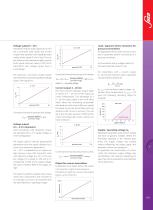
Conversion formula for pressure and voltage: Uout = pressure applied × 10 V pressure range Voltage output 0.5 – 4.5 V ratiometric SUCO transmitters with ratiometric output are operated with a 5 V supply voltage as 3-wire configuration. The output signal is directly proportional/ dependent to/on the supply voltage; this is known as a ratiometric dependency. 0.5 – 4.5 V is established as an output voltage because many A/D converters work with reference voltage Uv+ of 5 V. The output voltage 0.5 V equals to 10% and 4.5 V corresponds to 90% of the supply voltage. The span is therefore 80% of the...
Open the catalog to page 9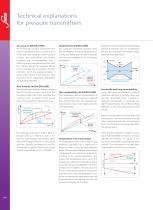
Technical explanations for pressure transmitters Accuracy (to DIN EN 61298) The (measuring) accuracy of pressure transmitters is specified by SUCO as ±0.5% or ±1% of the span (also called full scale). Accuracy includes zero point offset, non-linearity, hysteresis and non-repeatability, and is defined at room temperature and new state. This method defines the maximum deviation from the ideal line (in contrast to the BSFL method in which the average deviation is given). Other factors influencing the total accuracy, such as temperature and ageing, are specified separately. Hysteresis (to DIN EN...
Open the catalog to page 10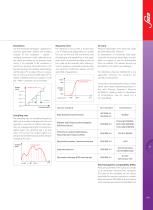
Resolution The A/D resolution (analogue - digital) of an pressure transmitter defines the smallest change of the analogue - digital -analogue conversion which takes places by the signal processing of an pressure transmitter. If for example 13-bit resolution is used for an pressure transmitter with a 100 bar setting range, the smallest signal change is 8192 steps (213). As state of the art a resolution of 12 bits and hence 4096 steps (212) is typical. Therefore pressure changes of 100 bar / 4096 = 0.024 bar can be recorded. Sampling rate The sampling rate (or sampling frequency) defines the number...
Open the catalog to page 11
Technical explanations for pressure transmitters Conversion chart for pressure units Insulation strength According to the latest specifications for immunity to surges and lightning protection, the following must be taken into account when testing insulation strength: With insulation test devices having an inner resistance exceeding 42 Ohm, the insulation strength of pressure transmitters can be tested up to 500 VDC. All contacts must be tested short-circuited against the housing. For a specific threshold value of test voltage, the protective circuit for surge protection is activated without any...
Open the catalog to page 12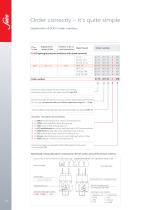
Order correctly - it's quite simpleExplanation of SUCO order numbers 0170 Diaphragm pressure switches with spade terminal Order number The first four digits indicate the type number: Our example: Diaphragm pressure switch with spade terminals, type 0170 By these three digits, the type of construction and the setting range are determined Our example: overpressure safe up to 100 bar, adjustment range 0.3 - 1.5 bar. These two digits provide information about the desired thread. Our example: NPT 1/8. Important - the code for the seal material: 1 for NBR (Buna-N): hydraulic fluid, machine oil, heating...
Open the catalog to page 13All SUCO Robert Scheuffele GmbH & Co. KG catalogs and technical brochures
 T3 Robust pressure transmitters
11 Pages
 T2 Robust pressure transmitters
11 Pages
 Pressure Monitoring 2019
170 Pages
 Transmission Technology
40 Pages
 M.6 Pressure switches "PLUS"
15 Pages
 M.7 Hex 30, changeover
12 Pages
 M.8 ATEX
12 Pages
 M.9 Vacuum
11 Pages
 M.10 Accessories
13 Pages
 E.7 Accessories
12 Pages
 M.5 Hex 24/27, ready-wired
11 Pages
 M.3 Hex 24
19 Pages
 M.1 Hex 24, integrated
17 Pages
 Product Overview 2018
6 Pages
 E5
E513 Pages
 M.4
M.411 Pages
 M2
M216 Pages


