video corpo

SHELTA

SHELTA
1 / 96 PagesView full catalog

SHELTA

Product catalog summary
Overview: Sweden & Martina is a prominent player in the Italian dental implant market, recognized for its innovative implant systems that enhance clinical functionality and aesthetic outcomes. Their products focus on optimizing titanium surface roughness to accelerate bone healing, complemented by comprehensive training and support services.
Implant System: The Shelta implant system comprises two variants: the standard Shelta and the Shelta SL (Wide Spire). The Shelta SL is tailored for low-density bone and post-extraction scenarios, offering enhanced stability. Both versions share a common connection geometry, simplifying prosthesis management.
Design and Features: Shelta implants feature a triangular thread profile with consistent pitch and depth, while the Shelta SL has variable depth for increased stability. Both types have a hemispherical apex suitable for sinus lift procedures. The ZirTi surface treatment improves osseointegration by increasing the bone-implant contact surface.
Prosthetic Components: The implants utilize a single connection hexagon with a perimeter collar, enabling the Switching Platform technique to reduce bone reabsorption risks. The system supports a wide range of prosthetic components for customization to individual patient needs.
Surgical Instruments and Procedures: Easy Insert drivers ensure safe and precise implant insertion without deformation. The mountless surgical procedure enhances visibility and ease of use.
Packaging and Sterilization: Implants are packaged in PMMA vials with titanium baskets to prevent contamination. Sterilization is achieved using beta rays, ensuring a 5-year sterility guarantee. Packaging includes color-coded labels for easy identification and traceability.
Decontamination Process: Implants undergo cold plasma surface decontamination using argon gas, enhancing the titanium surface's purity and osseointegration potential.
Implant Codes and Identification: The Shelta system uses mnemonic codes for easy identification, with a color code system for intraosseous diameter identification during the surgical phase.
Specifications: The document details various Shelta and Shelta SL implants, specifying diameters (ø 3.80 mm, ø 4.25 mm, ø 5.00 mm) and lengths (8.50 mm to 15.00 mm). Each implant is sold with a surgical cover screw, which can also be purchased separately. The screws must be tightened to 10 Ncm.
Procedures: The Shelta surgical kit is designed for ease of use, with stainless steel instruments marked for easy identification. The kit includes templates for implant measurements and a ratchet for checking torque. The Screw Kit contains drivers for various prosthetic solutions and is compact for easy management post-surgery.
Norms and Recommendations: It is recommended to follow the cleansing and sterilization procedures outlined in the surgical manual to ensure the longevity of the instruments. The use of bone taps is advised for certain bone types to avoid complications during implant insertion.
Surgical Instruments: The document describes various surgical instruments, including precision drills, intermediate drills, pilot drills, and final conical drills, all made of stainless steel. The instruments are designed for high precision and minimal bone stress. Bone taps and parallelism pins are also available for better control and preparation.
Additional Instruments: Additional instruments include steel drivers for implant removal and bone profilers for leveling irregular bone crests. The document also lists various drivers for connecting screws and abutments, emphasizing their ergonomic design and ease of use.
Key Data from Tables: The tables provide detailed measurements for each type of implant and instrument, including diameters, lengths, and specific codes for ordering. The document emphasizes the importance of precise measurements for successful surgical outcomes.
Surgical Instruments: The document outlines various surgical instruments and their extensions, fittings, and adapters. Key components include extensions for bone taps, mounters, drivers, and manual drivers with hexagonal connectors, mechanical adapters, and hand knobs. The PAD-CAR carrier is used for transferring angled abutments into the oral cavity and is sterilisable and reusable.
X-ray Templates: X-ray templates are available for Shelta and Shelta SL implants, with options for real dimensions and dimensions increased by 20% and 30%. These templates assist in accurate implant placement.
Prosthetic Components: The document details transgingival healing screws made from Gr. 5 titanium, which are laser-marked for easy identification. These screws are available in various heights and diameters, with specific recommendations for torque settings. The prosthetic components are compatible with different implant sizes, allowing for prosthetic switching platforms.
Impression and Model Phase: Components for impressions and model creation are produced with high precision. Open and closed tray transfers are made of Gr.5 titanium, while pull-up transfers are made of radiopaque PEEK. These components ensure accurate reproduction of the clinical situation.
Temporary Posts: The SIMPLE prosthetic protocol provides solutions for creating temporary posts, which can be used after the bone healing period or immediately after surgical insertion. PEEK is highlighted as a durable and biodegradable polymer suitable for these applications.
Prosthetic Components Overview: The document provides detailed specifications and guidelines for various types of prosthetic components used in dental implantology. It covers temporary posts, pre-made posts, millable posts, and castable posts, highlighting their features, compatibility, and recommended usage.
Specifications: The document outlines different prosthetic components with diameters of ø 3.30 mm and ø 3.80 mm. It specifies the materials used, such as PEEK with a Titanium base, Titanium, and alloy bases like gold, cobalt chrome, and titanium. Each component type is described with its emergence profile, repositionability, and included connecting screws.
Procedures and Recommendations: The document emphasizes the importance of using test screws during laboratory phases and reserving new screws for final fastening. It provides recommended torque values for connecting screws, typically between 20-25 Ncm. Specific warnings are given regarding the use of prosthetic components with different implant sizes, particularly for single crowns and multiple prostheses.
Norms and Standards: All measurements are provided in millimeters, and the document stresses the importance of adhering to specified torque values and using appropriate components for specific implant sizes to ensure compatibility and stability.
Key Features and Innovations: The document highlights the SIMPLE Technique for mucosa conditioning and the Interceptive Technique for precise repositioning. It also describes the use of millable posts for custom-built prostheses and the benefits of castable posts with biocompatible bases.
Warnings and Limitations: The document includes several warnings about the compatibility of prosthetic components with different implant sizes and the necessity of using test screws. It advises against using certain components for premolars and emphasizes the importance of maintaining new screws for final use.
Prosthetic Components Overview: The document provides detailed specifications and guidelines for various prosthetic components used in dental implantology. It includes information on repositionable and non-repositionable castable posts, abutments, and the P.A.D. (Disparallel Screwed Prosthesis) system.
Specifications: Prosthetic components are available in diameters of ø 3.30 mm and ø 3.80 mm. Repositionable and non-repositionable posts are available with straight and anatomical emergence profiles. Connecting screws are included with most components and can be ordered separately. Recommended torque for connecting screws is 20-25 Ncm.
Warnings and Recommendations: ø 3.30 mm components are recommended for single crowns in front sectors and as support for multiple prostheses in distal sectors. ø 3.80 mm components are compatible with ø 3.80 mm, ø 4.25 mm, and ø 5.00 mm implants but do not allow prosthetic Switching Platform on ø 3.80 mm implants. Test screws should be used during laboratory phases, and new screws should be reserved for final fastening.
Intermediate Abutments: These abutments have a straight emergence profile and are supplied with castable sleeves and passing screws. Impressions are typically taken directly on the implants using transfers.
P.A.D. System: Designed for multiple screwed prostheses with divergent implants. Includes straight and angled abutments with various transgingival heights and angles. Allows management of disparallelism up to 45° on each side.
Prosthetic Components for P.A.D.: Includes rotating and non-rotating caps, open tray transfers, and castable sleeves. Recommended tightening torque for securing prosthetic screws is 20-25 Ncm.
D.P.F. Technique: The Direct Prosthetic Framework technique allows for the creation of temporary posts for full-arch implant rehabilitations. Involves intra-oral cementing of a metal truss, reducing insertion time to 8 hours post-surgery.
PLAIN Abutments: Feature a flat geometry for maximized centring and repositioning of structures. Includes transfers and analogs for direct impression taking.
Specifications: The document details various prosthetic components and their specifications, including diameters, transgingival heights, and compatible implant sizes. It specifies the use of different materials such as titanium, zirconium, and cobalt chrome for individual posts and screw-retained structures. The document also provides recommended torque values for connecting screws, abutments, and transfer screws.
Procedures: Instructions are provided for the use of open tray transfers, healing caps, and castable sleeves. The document emphasizes the importance of using test screws during laboratory phases and reserving new screws for final fastening in the mouth. It also outlines the use of standard screwdrivers for transferring PLAIN abutments into the oral cavity.
Norms and Recommendations: The document includes warnings about the compatibility of prosthetic components with different implant sizes and the limitations of prosthetic switching platforms. It recommends using specific posts for single crowns in front sectors and as support for multiple prostheses in distal sectors.
Recommendations: For individualized prostheses, the document suggests using ECHO individual posts and Direct Bridges for maximum aesthetics and design flexibility. It highlights the advantages of zirconium oxide posts, including translucence, biocompatibility, and resistance to occlusal loads.
Accessories and Additional Components: The document lists various accessories for overdentures on Locator abutments, including kits with titanium caps, spacer rings, and nylon retainers with different retention capacities. It also provides details on the Locator Core Tool and other tools for screwing and unscrewing abutments.
Warnings: Several warnings are included regarding the use of prosthetic components, such as the recommendation to use test screws during laboratory phases and the compatibility of components with specific implant sizes.
See more

Catalog excerpts

SHELTA-2

IMPLANTOLOGY TABLE OF CONTENTS Implant system Material composition Bibliography on Sweden & Martina implants Sweden & Martina develops and manufactures implant systems that offer both excellent clinical functionality and perfect aesthetic results. The surfaces have been designed to obtain the best relationships between the surface roughness of the titanium and speed of bone healing. The surgical instruments are functional, easy to use and ergonomic. Training courses, continuous refresher courses and extensive assistance distinguish the service and reliability that have made Sweden & Martina a...

 Open the catalog to page 2
SHELTA-4

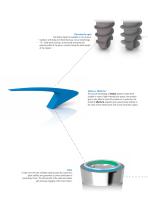
Choosing the spire The Shelta implant is available in two versions: -- standard, with body and thread having a conical morphology -- “SL” (wide spire), having a conical body and cylindrical external profile of the spires, constant along the whole length of the implant. Shelta or Shelta SL? The conical morphology of Shelta implants makes them suitable in cases of tight interradicular spaces; the rounded apex is also ideal for sinus lift procedures. In particular, the thread of Shelta SL implants gives great primary stability in the cases of low-density bone and in post-extraction surgery. Collar...

 Open the catalog to page 4
SHELTA-5

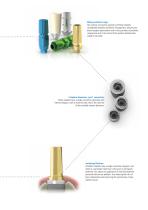
Wide prosthetic range The common connection geometry of Shelta implants considerably simplifies prosthesis management, allowing the dental surgeon optimisation both in the purchase of prosthetic components and in the choice of the implant diameter best suited to his needs. 3 implant diameters, just 1 connection Shelta implants have a single connection geometry with internal hexagon, with an external collar that is the same for all the available implant diameters. Switching Platform All Shelta implants have a single connection hexagon, over which is a perimeter collar that is the same on all implant...

 Open the catalog to page 5
SHELTA-6

IMPLANT SYSTEM Shelta implants Shelta implants have a collar 0.35 mm high with the function of supporting the masticatory loads for prosthetic components; they also have a smooth neck 1.00 mm high. The thread of Shelta implants is characterised by a triangular profile, a pitch of 1.50 mm and a depth of 0.40 mm The thread of Shelta implants develops with the same geometry along the whole body of the implant. The apex of Shelta implants has two incisions that increase its penetration capacity and non-rotational property. The hemispherical apex makes Shelta implants ideal in sinus lift procedures....

 Open the catalog to page 6
SHELTA-7

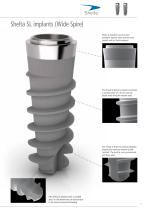
Shelta SL implants (Wide Spire) Shelta SL implants have the same prosthetic support collar and the same smooth neck as Shelta implants. The thread of Shelta SL implants maintains a constant pitch of 1.50 mm, but the depth varies along the implant body. The thread of Shelta SL implants develops keeping the maximum external profile constant. The result is a very pronounced and sharp apex. Also Shelta SL implants have a rounded apex, but the dimensions are reduced due to the more pronounced threading.

 Open the catalog to page 7
SHELTA-8

IMPLANT SYSTEM Choosing the spire Shelta and Shelta SL implants differ in the morphology of the apical part. These differences allow the ideal morphology always to be available for achieving optimum primary stability depending on the surgical practice and on the clinical conditions of the individual case. Shelta SL implants have a core with a conical geometric shape, though they maintain a constant cylindrical external diameter along the whole length of the implant. This characteristics means that the threading at the apex is much more accentuated. The resulting morphology is indicated in post-extraction...

 Open the catalog to page 8
SHELTA-9

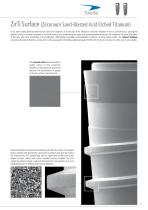
ZirTi Surface (Zirconium Sand-Blasted Acid Etched Titanium) It has been widely demonstrated that the closer the roughness is to the size of the fibroblasts, the more influence it has on cell behaviour, causing the platelet activity to increase compared to a smooth surface, thus accelerating the repair and osseointegration processes: the roughness can guide the layout of the cells, alter their metabolism and proliferation, differentiate osteoblasts and modulate production of extra-cellular matrix. For clinical findings concerning Sweden & Martina surfaces refer to the paragraph in the bibliography...

 Open the catalog to page 9
SHELTA-10

IMPLANT SYSTEM Connection Shelta and Shelta SL implants have a common prosthetic connection geometry, thus facilitating the task of the prosthodontist, irrespective of the implant platform diameter. This connection is the same as that of the ø 3.80 mm implants in the Premium Kohno (and Premium Kohno SP) family by Sweden & Martina, with which the Shelta family of implants shares the prosthetic line with the same diameter. COLLAR A collar on top of the neck gives great stability to the connection and aids the correct distribution of the masticatory forces, which are unloaded along the entire implant...

 Open the catalog to page 10
SHELTA-11

Switching Platform The Switching Platform is a prosthetic rehabilitation technique that aims to distance the prosthetic connection platform from the cervical bone. In fact, the abutment-implant junction is today indicated as one of the factors responsible for peri-implant bone reabsorption because it can trigger inflammatory reactions. All Shelta implants have a single connection hexagon, over which is a collar that is the same on all platforms: this considerably simplifies prosthesis management. The posts are available in two diameters, 3.30 mm and 3.80 mm. ø 3.80 mm posts can be used with the...

 Open the catalog to page 11
SHELTA-12

IMPLANT SYSTEM Mountless surgical procedure The surgical procedure of insertion is extremely simple. The implant does not require a mounter for inserting into the implant site because it is engaged directly inside the connection by practical Easy Insert drivers designed to guarantee a safe grip, to prevent deformations to the corners of the connections and at the same time to allow easy removal from the implant wells. A single instrument that allows the insertion of all Shelta implant diameters. The Easy Insert drivers aid visibility of the operating field, do not occupy much space, and allow...

 Open the catalog to page 12

All Sweden & Martina catalogs and technical brochures

  1. D-IMP CSR

    20  Pages

  2. zygma

    12  Pages

  3. P-SLIM

    12  Pages

  4. PRAMA W

    12  Pages

  5. Premium One

    16  Pages

  6. PRAMA

    16  Pages

  7. SYRA

    20  Pages

  8. PREMIUM

    12  Pages

  9. PREMIUM KOHNO

    12  Pages

Archived catalogs

  1. CSR

    12  Pages

*Prices are pre-tax. They exclude delivery charges and customs duties and do not include additional charges for installation or activation options. Prices are indicative only and may vary by country, with changes to the cost of raw materials and exchange rates.