

Benefits of Pencil Beam Technology

Benefits of Pencil Beam Technology
Dual energy x-ray absorptiometry (DXA) is a technology used to measure bone density and body composition. The two primary types of DXA technologies are pencil beam and fan beam, both of which utilize the differential absorption of high and low energy photons to assess bone and soft tissue components.
Pencil beam densitometers were the first generation of DXA systems and are considered the gold standard for accuracy. Initially, whole body scans with pencil beam systems took up to 30 minutes. However, advancements such as Norland's Quikscan technology have reduced scan times to as little as five minutes, matching or exceeding the speed of fan beam systems. Pencil beam systems are noted for their high accuracy in bone edge detection and minimal magnification or distortion issues.
Fan beam DXA systems were developed to reduce scan times, achieving whole body scans in as little as three minutes. However, this speed increase comes with a significant rise in radiation exposure, sometimes up to 60 times more than pencil beam systems. Fan beam systems also face challenges with magnification and distortion, leading to variations in bone mineral content (BMC) assessments.
The document provides a comparison of different DXA systems, highlighting key parameters such as the number of detectors, beam geometry, accuracy, bone edge detection, magnification/distortion, image reconstruction, radiation dose, and scan times. Pencil beam systems like the Norland XR800 are noted for their low radiation dose and high accuracy, while fan beam systems like the Hologic Discovery and Lunar Prodigy offer faster scan times but with higher radiation doses and potential distortion issues.
While fan beam DXA systems offer faster scan times, pencil beam systems remain the gold standard for accuracy and lower radiation exposure. Norland's advancements in pencil beam technology have significantly reduced scan times, making them competitive with fan beam systems without compromising on safety and accuracy.
Catalog excerpts

Pencil Beam & Fan Beam DXA Technology The two most commonly applied bone densitometer technologies (dual energy x-ray absorptiometry, DXA) are pencil beam and fan beam. Both methods rely on the differential absorption of two distinct photon energies - a high and low energy photon. The attenuation of these two photon energies is used to determine bone and soft tissue (fat and lean) components of the body. Pencil Beam densitometers were the first generation of DXA systems to market and are considered the Gold Standard for accuracy1. Initially, whole body scans done using a pencil beam DXA system took up to 30 minutes to complete. As a result of this long scan time fan beam DXA systems were developed to speed-up the testing process and a whole body scan time was reduced to as quick as three minutes. A significant downside to the increased scan speed of fan beam DXA systems was the need to increase the amount of radiation required to complete a scan (in some cases 60 times more). Further, fan beam systems suffer from issues related to magnification and/or distortion of the scans. These magnification issues result in a variation of up to 37% in BMC assessments2,3. 1. Ruetsche, AG, Lippuner, K, Jaeger, P and Casez, JP: Differences between dual x-ray absorptiometry using pencil beam and fan beam modes and their determinants in vivo and in vitro. Journal of Clinical Densitometry. 3:157-166, 2000. 2. Cole, JH, Dowthawaite, JN, Scerpella, TA and van der Meulen, MCH: Correcting fan-beam magnification in clinical densitometry scans of growing subjects. Journal of Clinical Densitometry. 12:322-329, 2009. 3. Cole, JH, Scerpella, TA, van der Meulen, MCH: Fan-beam densitometry of the growing skeleton. Journal of Clinical Densitometry. 8:57-64, 2005. ©Copyright 2015 Norland at Swissray Form No. 600P182 Rev A 5/15 Printed in USA Certified ISO 13485
Open the catalog to page 1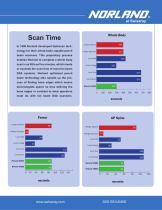
Whole Body Scan Time In 1999 Norland developed Quikscan technology for their whole-body capable pencil Hologic Explorer Hologic Discovery beam scanners. This proprietary process enables Norland to complete a whole body scan in as little as five minutes, which meets Lunar IDXA Lunar Prodigy or exceeds the scan time of most fan beam DXA systems. Norland optimized pencil beam technology also speeds up the pro- Lunar Bravo cess of finding bone edges which means technologists spend no time defining the bone edges in contrast to what operators must do with fan beam DXA scanners. Hologic Explorer Hologic...
Open the catalog to page 2All Swissray catalogs and technical brochures
 Norland
8 Pages
 ELITE
ELITE2 Pages
 ddRAura™ S
4 Pages

- Ultrasound system
- B/W ultrasound system
- Color doppler ultrasound system
- Portable ultrasound system
- Multipurpose ultrasound imaging system
- Convex-array ultrasound system
- Linear-array ultrasound system
- Hand-held ultrasound system
- Wireless probe ultrasound system
- Microconvex-array ultrasound system
- DEXA bone densitometer
- Pencil beam bone densitometer