

Norland

Norland
Norland Densitometry is renowned for its excellence in bone density measurement and body composition analysis using DXA technology. This document outlines the specifications, procedures, and technological advancements of Norland DXA systems, emphasizing their role in diagnosing osteoporosis and assessing body composition.
Osteoporosis affects approximately 54 million Americans, increasing fracture risk, particularly in postmenopausal women and the elderly. Norland's DXA systems, such as the XR600/XR800, provide noninvasive, rapid, and accurate measurements of bone density at central sites like the lumbar spine and hip. Early diagnosis through DXA can prevent complications associated with osteoporosis.
Obesity is a global epidemic, contributing to various health issues. Norland DXA assesses fat mass, lean mass, and bone mineral content, offering precise body composition analysis. This allows for monitoring changes over time, aiding in the evaluation of treatment effects on obesity and related conditions.
Norland employs advanced technology, including automatic x-ray flux adjustment and automatic analysis routines, ensuring precision and accuracy. The system's calibration is tied to chemical standards, providing absolute accuracy in measurements. Norland's dynamic filter system minimizes radiation exposure, making it one of the safest options available.
Norland's pencil-beam design and dynamic filter system result in the lowest patient radiation doses in the market. Studies confirm that Norland equipment consistently delivers lower radiation doses compared to other systems, benefiting both patients and operators.
Norland DXA offers a direct three-compartment assessment of body composition, providing accurate measurements of bone, lean, and fat content. This accuracy is validated by studies showing a strong correlation between DXA results and total body weight.
Initial and follow-up assessments provide detailed reports on bone density and body composition, including patient background, images, reference graphs, and absolute values. These reports help clinicians evaluate treatment progress and plan appropriate clinical programs.
Norland has been a pioneer in densitometry since 1968, introducing several technological advancements, including the first commercial densitometer and dual energy systems. The company continues to lead in technology with innovations like dynamic filtration systems and FDA-cleared assessments for fracture risk and body fat classification.
Catalog excerpts

Norland Densitometry
Open the catalog to page 1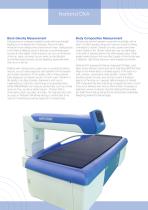
Bone Density Measurement Osteoporosis is a disease marked by reduced bone strength leading to an increased risk of fractures. About 54 million Americans have osteoporosis and low bone mass. Osteoporosis is the major underlying cause of fractures in postmenopausal women and the elderly. These fractures can occur in the bones of the hip, spine, and wrist, but any bone can be affected. Sometimes these fractures can be disabling, especially when they occur in the hip. Patients with osteoporosis usually have no symptoms before fracture, as such early diagnosis and treatment of the disease are of great...
Open the catalog to page 2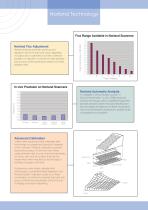
Norland Technology Norland Flux Adjustment Norland employs automatic point-by-point adjusted x-ray flux so that every study, regardless of subject size, is optimized to be free of detector saturation or starvation to achieve the best precision and accuracy while exposing the patients to lowest radiation dose. Filters Available In vivo Precision on Norland Scanners Norland Automatic Analysis As validated in clinical studies (Journal of Clinical Densitometry. 11:455, 2008) advanced Norland technology, unlike competitive equipment, provides analysis routines that automatically place all bone edges...
Open the catalog to page 3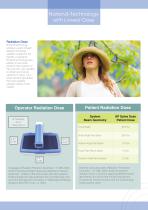
Radiation Dose Norland technology employs a pencil-beam design minimizing radiation scatter for the benefit of operators. Norland technology also applies its exclusive dynamic filter system so that only the x-ray needed to obtain good study statistics is used. As a result Norland generates the lowest patient radiation doses in the market. System Beam Geometry Investigators (Radiation Protection Dosimetry, 117:288, 2005) confirm the lowest operator doses are obtained on Norland equipment. Indeed, unlike what is seen with other systems, Norland equipment rates well below the Controlled Area Limit...
Open the catalog to page 4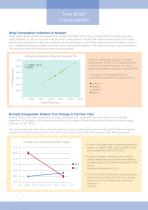
True Body Composition Body Composition Validation of Norland Being a direct three compartment assessment of body composition, DXA has the unique potential to provide advanced “gold standard” accuracy in bone, lean and fat content measurements. Norland DXA is especially well suited to accurately provide these measurements because it operates with the advantages of pencil beam geometry, dynamic filtration control of flux, a sophisticated regional analysis routine and chemically indexed calibration. This superior accuracy is demonstrated by the consistency with which the results match total body...
Open the catalog to page 5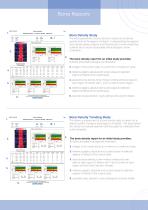
Bone Reports Bone Density Study The initial assessment of bone density is carried out to directly quantify bone in the regions of interest. Understanding the regional bone density allows subjects and the physician to know where they currently are so that an appropriate clinical program can be undertaken. 1. facility and patient background information, 2. images of the current study on a minimum to maximum scale, 3. reference graphs, absolute and scored values for selected regions of interest of the current study, 4. absolute bone density, bone mineral content and bone area for each region of...
Open the catalog to page 6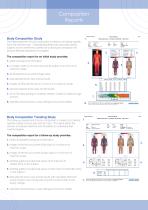
Composition Reports Body Composition Study The initial assessment of body composition is carried out to directly quantify bone, lean and fat mass. Understanding their body composition allows subjects to know where they currently are so that future comparison will produce effective evaluations of a program. The composition report for an initial study provides: 1. patient background information, 2. an image made up of bone, lean and fat scaled on a minimum to maximum range, 3. fat assessments as a percentage value, 4. total absolute bone, lean and fat results, 5. mages of %Fat and %Lean on a minimum...
Open the catalog to page 7
1968 Norland produces the first commercial densitometer in the world. 1978 Norland applies microprocessor controlled technology in the densitometer, 1983 With Gd-153 commercially available Norland releases one of first dual energy systems—the Norland 2600—a spine and hip scanner, 1988 Norland produces the XR-26, the only x-ray based densitometer in the world that is fitted with step-wedge calibration and tied to chemical standards for bone, lean and fat assessment, 1993 Norland produces the dynamic filtration systems allowing the scanner to produce swift studies to regulate x-ray flux for every...
Open the catalog to page 8All Swissray catalogs and technical brochures
 ELITE
ELITE2 Pages
 ddRAura™ S
4 Pages


- Ultrasound system
- B/W ultrasound system
- Color doppler ultrasound system
- Portable ultrasound system
- Multipurpose ultrasound imaging system
- Convex-array ultrasound system
- Linear-array ultrasound system
- Hand-held ultrasound system
- Wireless probe ultrasound system
- Microconvex-array ultrasound system
- Bone densitometer
- DEXA bone densitometer
- Pencil beam bone densitometer