

OPFA

OPFA
The document discusses a non-invasive diagnostic procedure for measuring and recording pulsatile ocular perfusion, aiding in the early detection of glaucoma and other circulatory irregularities. The device used is the Ocular Pressure Blood Flow Analyzer (OPFA), developed by tpm taberna pro medicum GmbH.
Fields of Application
- Early detection and management of primary open angle glaucoma (POAG) due to impaired autoregulation.
- Diagnosis and management of normal-tension glaucoma (NTG) from reduced perfusion reserve.
- Identification of reduced autoregulatory capacity indicating transition from ocular hypertension to POAG.
- Determination of ocular perfusion pressures and ocular pulse blood volumes for glaucoma diagnosis and treatment control.
- Examination of ocular perfusion in retinal arterial and venous blockages, and choroidal vascular abnormalities.
- Diagnosis and therapy control of arteriitis temporalis (Mb. Horton).
- Assessment of ocular perfusion in supra-aortic arterial occlusion processes, pre- and post-operative.
- Monitoring of ocular perfusion in hereditary and degenerative retinal and choroidal diseases.
- Ocular perfusion in age-related macula degeneration and macular dystrophies.
- Monitoring of ocular perfusion in diabetes and diabetic retinopathies.
- Management of ocular perfusion for patients with hypertony, hypotony, and vascular disregulation.
Device Capabilities
- Analyzes ocular perfusion and hemodynamics.
- Determines real systolic and diastolic ocular perfusion and arterial blood pressures.
- Monitors ocular autoregulatory capacity to assess ocular perfusion reserve.
- Records ocular pulsatile blood volumes.
Examination Procedure
The procedure lasts about one minute for both eyes using special scleral suction cups after local anesthesia. Pupil dilation is not required. It produces an ocular perfusion pressure pulse blood volume graph for both eyes, indicating healthy or diseased ocular circulation characteristics.
Catalog excerpts
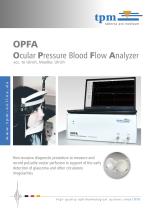
OPFA Ocular Pressure Blood Flow Analyzer www.tpm-online.de acc. to Ulrich, Moeller, Ulrich Non-invasive diagnostic procedure to measure and record pulsatile ocular perfusion in support of the early detection of glaucoma and other circulatory irregularities
Open the catalog to page 1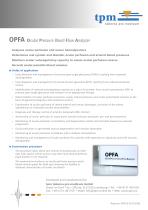
Ocular Pressure Blood Flow Analyzer Analyzes ocular perfusion and ocular hemodynamics Determines real systolic and diastolic ocular perfusion and arterial blood pressures Monitors ocular autoregulatory capacity to assess ocular perfusion reserve Records ocular pulsatile blood volumes < Fields of application Ÿ Early detection and management of primary open angle glaucoma (POAG) resulting from impaired autoregulation Early diagnosis and management of normal-tension glaucoma (NTG) resulting from reduced perfusion reserve Identification of reduced autoregulatory capacity as a sign of transition from...
Open the catalog to page 2All Taberna pro medicum catalogs and technical brochures
 DUB brochure
12 Pages
 Dermatology
2 Pages
 Aesthetics
2 Pages
 DUB Brochure
12 Pages