
- Catalogs
- Taiwan Main Orthopaedic Biotechnology
- Asclepius AI Table

- Company
- Products
- Catalogs
- News & Trends
- Exhibitions
Asclepius AI Table
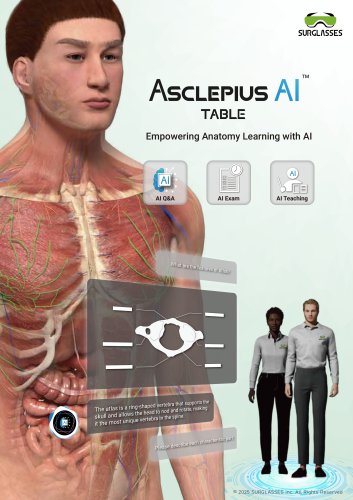
Asclepius AI Table
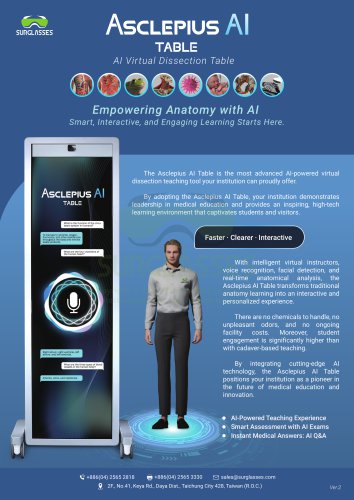
The document introduces the Asclepius AI Table by SURGLASSES Inc., a cutting-edge tool for anatomy education that combines high-resolution 3D human models with advanced AI technology to enhance the learning experience through interactive and intelligent educational tools.
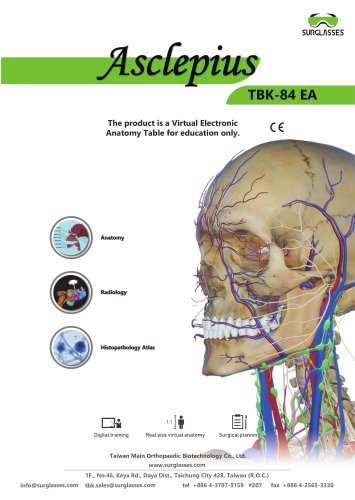
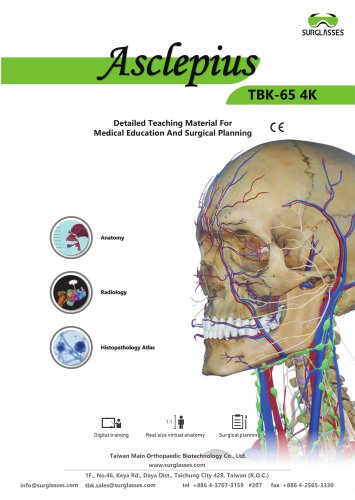
The Asclepius AI Table is available in two models: an 84-inch ultra-wide full HD display for larger groups and a 65-inch 4K UHD display for smaller groups. Both models feature electronically adjustable viewing angles and high-resolution displays for detailed anatomical presentations.
The AI system includes several applications:
- AI Q&A: Users can ask medical questions and receive detailed answers with relevant anatomical models.
- AI Exam: Conducts quizzes using past medical exam questions and provides performance reports.
- AI Teaching: Offers pre-designed courses with real-time explanations and interactive guidance.
The platform enhances learning outcomes by providing real-time feedback, intelligent guidance, and adaptive learning processes, supporting faster knowledge retention and improved exam performance.
The virtual platform replaces traditional cadavers, eliminating the need for chemicals and complex lab setups, providing a safe and eco-friendly learning environment.
The system allows for virtual dissections, detailed annotations, and customizable views of anatomical structures, including tools for measuring and highlighting specific parts.
The platform covers embryology with a comprehensive 42-week fetal development model and animal anatomy with models of approximately 40 species, supporting veterinary and comparative anatomy studies.
Features include custom hiding and color customization, measurement tools, annotation capabilities, and a 3-axis display mode for detailed exploration.
Supports image and video formats, includes image adjustment tools, and provides high-resolution images for detailed observation.
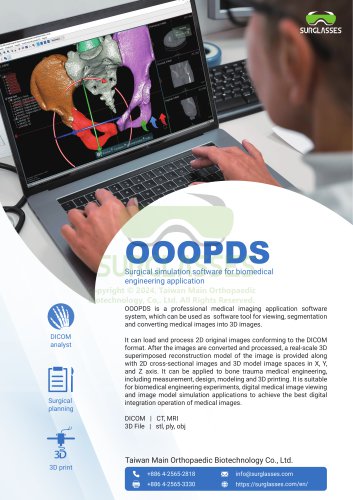
Converts DICOM data into 3D models, offers real-time rendering, and integrates CT images with 3D models for better spatial understanding.
Includes surgical simulation features like bone screw simulation and fracture reduction, with 3D printing support.
Provides detailed explanations and visual representations of muscle functions, with motion control for animations.
Converts CT data into ultrasound images and synchronizes display for enhanced diagnostic accuracy.
Includes screen projection and sharing, screenshot and recording capabilities, and multi-window switching for application comparison.
Supports voice commands for model switching and information access, with high-capacity storage for data availability.
Catalog excerpts
Empowering Anatomy Learning with AI © 2025 SURGLASSES Inc. All Rights Reserved
Open the catalog to page 1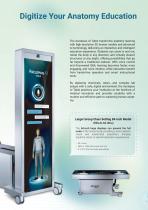
Digitize Your Anatomy Education The Asclepius AI Table transforms anatomy learning with high-resolution 3D human models and advanced AI technology, delivering an interactive and intelligent education experience. Students can zoom in and out, rotate the body in any direction, and virtually dissect structures at any depth, offering possibilities that go far beyond a traditional cadaver. With voice control and AI-powered Q&A, learning becomes faster, more engaging, and more intuitive, while educators benefit from hands-free operation and smart instructional tools. By replacing chemicals, odors,...
Open the catalog to page 2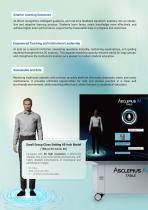
Smarter Learning Outcomes AI-driven recognition, intelligent guidance, and real-time feedback transform anatomy into an interactive and adaptive learning process. Students learn faster, retain knowledge more effectively, and achieve higher exam performance, supported by measurable data on progress and outcomes. Empowered Teaching and Institutional Leadership AI acts as a second instructor, answering questions instantly, reinforcing explanations, and guiding students through precise 3D anatomy. This expands teaching capacity, ensures clarity for large groups, and strengthens the institution’s...
Open the catalog to page 3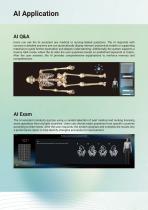
Users can ask the Al assistant any medical or nursing-related questions. The Al responds with concise or detailed answers and can automatically display relevant anatomical models or supporting materials to guide further exploration and deepen understanding. Additionally, the system supports a reverse Q&A mode, where the Al asks the user questions based on predefined keywords or topics. After the user answers, the Al provides comprehensive explanations to reinforce memory and comprehension. Al Exam The Al assistant conducts quizzes using a curated selection of past medical and nursing licensing...
Open the catalog to page 4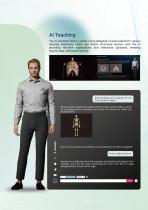
AI Teaching The AI assistant offers a series of pre-designed courses tailored to various learning objectives. Users can follow structured lessons with the AI providing real-time explanations and interactive guidance, enabling step-by-step, self-paced learning. Provide shape and support for the body, protect organs Bones provide shape and support for the body, protect organs, serve as a storage site for minerals, and house the marrow for blood cell development. How do human bones contribute to the protection of internal organs? Form a rigid structure Bones form a rigid structure that encases and...
Open the catalog to page 5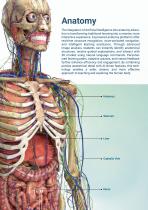
Anatomy The integration of Artificial Intelligence into anatomy education is transforming traditional learning into a smarter, more interactive experience. AI-powered anatomy platforms offer real-time structure recognition, voice-activated navigation, and intelligent learning assistance. Through advanced image analysis, students can instantly identify anatomical structures, receive guided explanations, and interact with 3D models using natural language commands. Personalized learning paths, adaptive quizzes, and instant feedback further enhance efficiency and engagement. By combining precise...
Open the catalog to page 6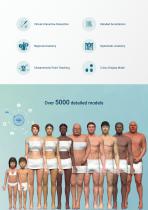
Virtual Interactive Dissection Detailed Annotations Regional Anatomy Systematic Anatomy Characteristic Point Teaching 3 Axis Display Mode Over 5000 detailed models
Open the catalog to page 7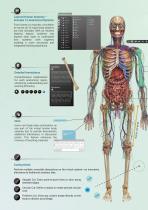
Layered Human Anatomy – Includes 13 Anatomical Systems From bones to muscles, circulation to nerves, all 13 major body systems are fully included. With an intuitive layering feature, students can explore each layer to understand how systems work together, enabling a more structured and integrated learning experience. Skeletal Arterial Skeletal System Auditory Ossicles Lower Arm Lower Leg Pelvic Venous Nervous Rib Cage Spine Teeth Lymphatics Respiratory Endocrine Urinary Reproductive Detailed Annotations Comprehensive explanations for each anatomical region, enhancing understanding and learning...
Open the catalog to page 8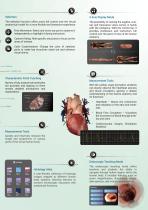
3 Axis Display Mode The selection function offers users full control over the virtual anatomical model for a more flexible and interactive experience. The possibility of viewing the sagittal, coronal, and transverse views comes in handy with the Asclepius. With the control bar, it provides professors and instructors full control over the point of view of the human anatomy. Free Movement: Select and move any part to observe it independently or highlight it during instruction. Custom Hiding: Hide specific structures to focus on the areas of interest. Color Customization: Change the color of selected...
Open the catalog to page 9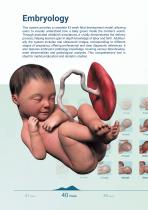
Embryology This system provides a complete 42-week fetal development model, allowing users to visually understand how a baby grows inside the mother’s womb. Through animated childbirth simulations, it vividly demonstrates the delivery process, helping learners gain in-depth knowledge of labor and birth. Additionally, the system includes real ultrasound images, corresponding to different stages of pregnancy, offering professional and clear diagnostic references. It also features embryonic pathology knowledge, covering various fetal development abnormalities and pathological analyses. This comprehensive...
Open the catalog to page 10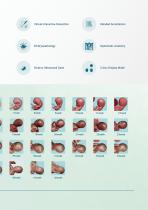
Virtual Interactive Dissection Detailed Annotations Systematic Anatomy Embryo Ultrasound Case 3 Axis Display Mode
Open the catalog to page 11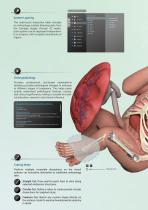
The multi-touch dissection table includes an embryology module featuring data from the Carnegie stages through 42 weeks. Each system can be displayed independently or in layers, with complete annotations of organs. O • j|||| Skeletal 0 Head Foot Bone Circulatory Legs Talus(Right) • Nervous • Pelvic I • ^ Respiratory I ® |j| Digestive I ® 4ft Endocrine I • ^ Urogenital Provides professional, text-based explanations detailing possible pathological changes in embryos at different stages of pregnancy. This helps users quickly understand pathological features, causes, and clinical significance, making...
Open the catalog to page 12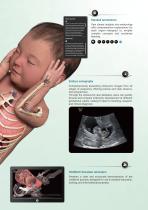
Detailed Annotations Gain clearer insights into embryology with comprehensive explanations for each region-designed to simplify complex concepts and accelerate learning. Comprehensively presenting embryonic images from all stages of pregnancy, offering precise and clear observation perspectives. Through the ultrasound case database, users can quickly browse and compare embryonic development at different gestational weeks, making it ideal for teaching, research, and clinical diagnosis. Presents a clear and structured demonstration of the childbirth process, designed for use in medical education,...
Open the catalog to page 13All Taiwan Main Orthopaedic Biotechnology catalogs and technical brochures
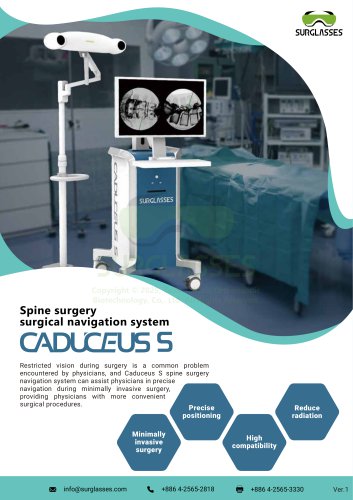 Caduceus Navigation System
2 Pages
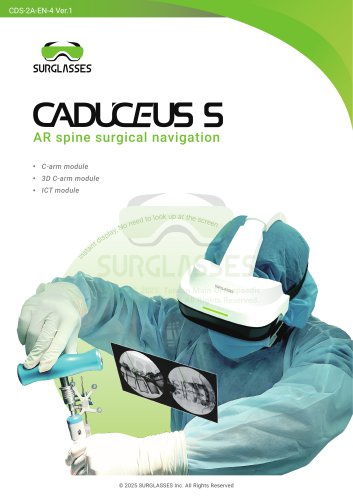 Caduceus AR Surgical Glasses
12 Pages
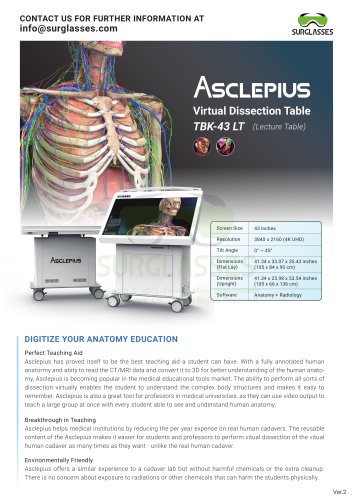
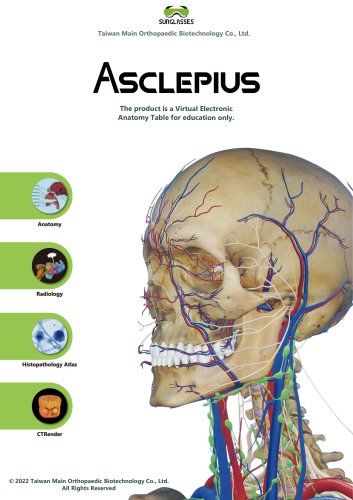
 Asclepius AI (8 software)
2 Pages
 OOOPDS
2 Pages
 Foresee X
2 Pages
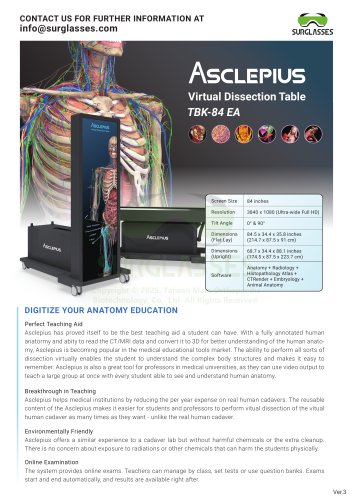
 TBK 84 EA
6 Pages
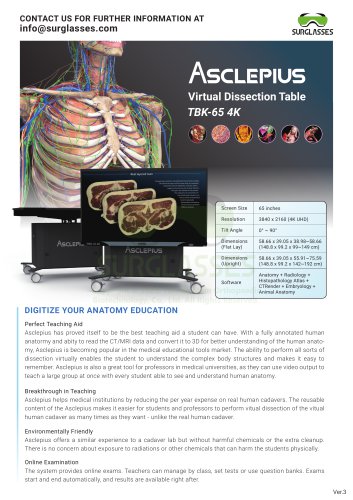
 TBK-65 4K
6 Pages
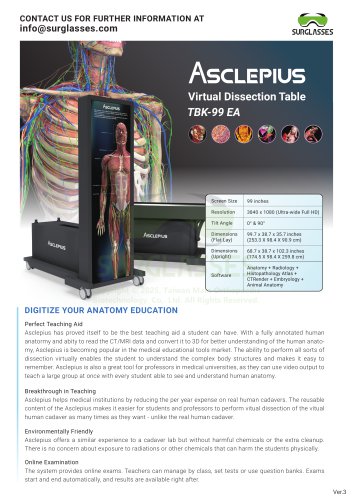
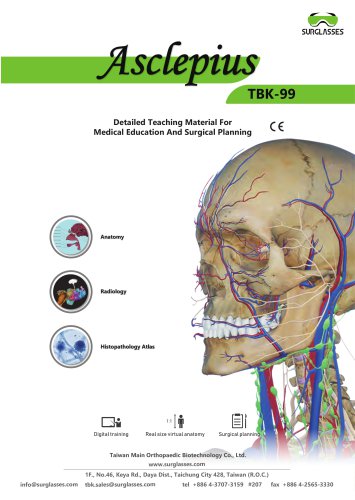 TBK 99 EA
6 Pages

Archived catalogs
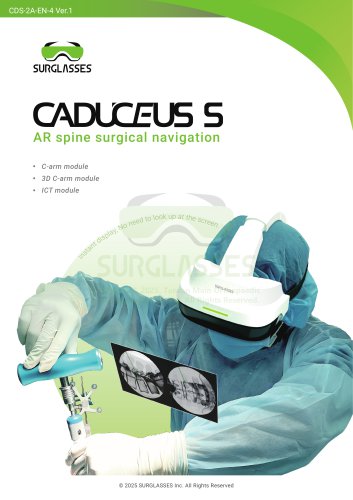 Caduceus S AR Surgical Glasses
12 Pages
 Foresee-X 2020
2 Pages
- Radiology software
- Visualization software
- Planning software
- Laboratory workstation
- Surgery software
- Simulation software
- Printing software
- 3D printing software
- Radiation therapy software
- Surgical navigation system
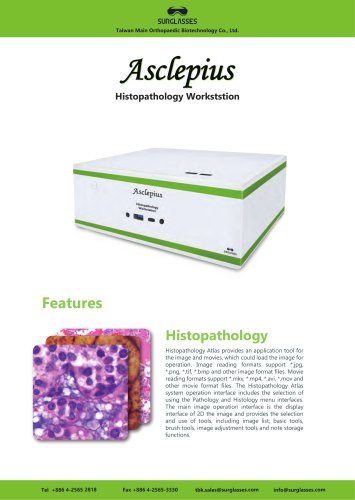
- Histopathology laboratory workstation
- Optical surgical navigation system
- Surglasses anatomy table
- Preoperative planning software
- Surglasses dissection anatomy table
- Surglasses training anatomy table
- Rectangular anatomy table
- Orthopedic surgery navigation system
- Neurosurgery surgical navigation system
- Preoperative software