
- Catalogs
- Tecnimoem Care S.L
- POWERLIFT 175 HOIST


POWERLIFT 175 HOIST

POWERLIFT 175 HOIST
The Powerlift cranes are designed for medical use, specifically for lifting and transferring patients. They come with a 2-year warranty, except for batteries which have a 12-month warranty. Unauthorized repairs or neglecting maintenance voids the warranty. The cranes comply with Spanish regulations and CE marking, adhering to UNE-EN ISO 10535 standards.
Users must thoroughly read and understand all instructions. The crane should be used on smooth, horizontal surfaces, and the combined weight of the patient and harness must not exceed the crane's maximum load. Avoid using the crane on inclines over 5 degrees and keep it away from water and corrosive environments.
Assembly requires no tools, but assistance is recommended due to the weight of components. Ensure all parts are securely attached and functioning correctly.
The crane's legs can be adjusted for wheelchair access. Lifting and lowering are controlled manually, with an emergency stop and manual descent option available. The crane should be braked when not in use.
Use only the supplied harness or a CE-marked alternative. Avoid using worn harnesses and follow all usage instructions.
Regular maintenance is essential for safety and functionality. Follow the manufacturer's guidelines for cleaning and servicing.
Specifications include load capacity and dimensions for each model. Compliance with these specifications is crucial to avoid misuse and hazards.
This document is a user manual for the POWERLIFT 150/135 Mini/175 hoist, detailing safety precautions, assembly, operation, and sling usage.
The product complies with Royal Decree 1591/2009 for medical devices and UNE-EN ISO 10535 standards. Specifications may change due to continuous improvement policies.
Users must understand all safety instructions, including using the supplied sling and ensuring the weight does not exceed the hoist's maximum load. Electrical safety compliance with IEC standards is required.
Assembly is tool-free but requires assistance. Detailed steps for connecting structures and electrical components are provided.
Instructions cover leg adjustment for wheelchair access, patient lifting and lowering, emergency procedures, and battery recharging. Avoid overloading and improper use.
Instructions for sling insertion in various settings are provided, with methods for using leg straps to ensure safety and comfort.
Emphasizes identifying risk patients, adhering to safety standards, and following procedures to prevent injury and equipment damage.
Attach shoulder and head loops before leg loops. Adjust positions using different straps for vertical or reclined lifts. End loops are safety attachments and should not be used.
Made of hypoallergenic polyester, the sling must fit correctly for safety. Inspect for damage before use. Maximum load is 200kg.
Designed for safe patient transfer, suitable for patients with head mobility, and can be used sitting or recumbent.
Features include ultra-absorbent, breathable, quick-drying material with high tensile strength. Adjustable at three heights with safety attachment.
Wash at 30º with neutral soap. Do not bleach, dry-clean, or iron. Dry flat, away from direct sunlight or heat sources.
Clean and disinfect the hoist carefully. Use diluted detergent or disinfectant, avoiding high-pressure water and temperatures above 60ºC. Regular checks on controls, hinges, cables, and sling condition are advised.
Common issues include actuator failure, battery charging problems, and noisy hinges. Solutions involve checking connections, replacing batteries, and applying lubricant.
Details for POWERLIFT 150, 175, and 135 Mini models include dimensions, maximum load, sound pressure, weight, duty cycle, and expected operating lifetime.
Catalog excerpts

Grúa Powerlift 150 Grúa Powerlift 135 Mini Grúa Powerlift 175
Open the catalog to page 1
Manual usuario grúa POWERLIFT 150/135 Mini/175 Prestaciones, garantía, servicio técnico y marcado CE ... pág. 3
Open the catalog to page 2
Manual usuario grúa POWERLIFT 150/135 Mini/175 1.- PRESTACIONES, GARANTÍA, SERVICIO TÉCNICO Y MARCADO CE El producto está destinado por el fabricante a ser utilizado en seres humanos con fines de tratamiento o alivio de una enfermedad, así como al tratamiento, alivio o compensación de una lesión o una deficiencia, según la reglamentación española de productos sanitarios vigente. Nuestros productos están garantizados por un periodo de 2 años contra todo defecto de fabricación (en el caso de las baterías 12 meses). El producto sólo puede ser utilizado para elevación, descenso y traslado de pacientes....
Open the catalog to page 3
Manual usuario grúa POWERLIFT 150/135 Mini/175 2.- ADVERTENCIAS PARA LA SEGURIDAD Toda persona que utilice/monte estos artículos, debe leer y comprender primero las instrucciones de montaje, manejo y lavado. Leer atentamente las partes relacionadas con la seguridad e identificadas con el símbolo en los distintos capítulos del manual. El incumplimiento de estas instrucciones puede causar daños materiales o lesiones. 2.1.- Recomendaciones Familiarizarse con los mandos y dispositivos de seguridad antes de utilizarlo con pacientes. Tecnimoem recomienda el uso del arnés suministrado con la grúa, que...
Open the catalog to page 4
Manual usuario grúa POWERLIFT 150/135 Mini/175 ANTES DE TRASLADAR AL PACIENTE Evaluar los riesgos individuales incluyendo: • Advertencia de peligro de aplastamiento. • Posibles caídas. • Los pacientes perturbados. • Los pacientes con dificultades de aprendizaje. • Los niños pequeños o las mujeres embarazadas. • Las personas sin capacidad mental para reconocer acciones inseguras. • Las personas no autorizadas. Todas las personas autorizadas a utilizar la grúa deben ser capaces de hacerlo de manera segura y controlada. Con el continuo y suave funcionamiento de elevación de las partes móviles existe...
Open the catalog to page 5
Manual usuario grúa POWERLIFT 150/135 Mini/175 Entre las medidas probadas y aprobadas, figura el establecimiento de un protocolo con los puntos siguientes: 1. Cuándo y con qué finalidad se puede utilizar la grúa, con qué tipo de arnés y con qué medios de inmovilización u otras medidas particulares. 2. Cuándo y con qué finalidad hay que inmovilizar al paciente o cuándo se requieren otros medios para reducir el riesgo de caídas (por ejemplo disponer de espuma sobre el suelo). 3. En el caso de utilizar medios especiales para inmovilizar a un paciente, seguir atentamente las instrucciones y consejos...
Open the catalog to page 6
Manual usuario grúa POWERLIFT 150/135 Mini/175 3.- MONTAJE Aunque no es necesario el uso de herramientas para el montaje, algunas piezas son de peso considerable. Es recomendable la ayuda de otra persona para manejarlas. Ponga especial cuidado para evitar posibles atrapamientos o golpes. 3.1.- Componentes Retire cuidadosamente el embalaje y coloque en una zona espaciosa los dos conjuntos premontados que se suministran (foto 1). CONJUNTO SOPORTE 1.- Zócalo central /armazón 2.- Pedales 3.- Ruedas traseras (con freno) 4.- Patas 5.- Ruedas delanteras (sin freno) CONJUNTO MÁSTIL-BRAZO 6.- Mástil 7.-...
Open the catalog to page 7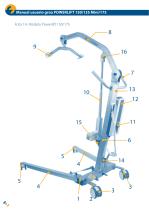
Manual usuario grúa POWERLIFT 150/135 Mini/175 Foto 1A: Modelo Powerlift 150/175
Open the catalog to page 8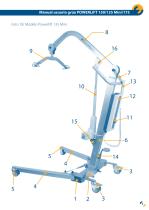
Manual usuario grúa POWERLIFT 150/135 Mini/175 Foto 1B: Modelo Powerlift 135 Mini
Open the catalog to page 9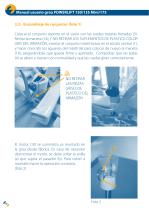
Manual usuario grúa POWERLIFT 150/135 Mini/175 3.2.- Ensamblaje de conjuntos (foto 1) Colocar el conjunto soporte en el suelo con las ruedas traseras frenadas (3). Retirar la maneta (14), Y SIN RETIRAR LOS SUPLEMENTOS DE PLÁSTICO COLOR GRIS DEL ARMAZÓN, insertar el conjunto mástil-brazo en el zócalo central (1), y hacer coincidir los agujeros del mástil (6) para colocar de nuevo la maneta (14), asegurándose que queda firme y apretado. Comprobar que las patas (4) se abren y cierran con normalidad y que las ruedas giran correctamente. El motor (10) se suministra ya montado en la grúa desde fábrica....
Open the catalog to page 10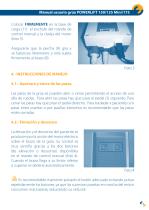
Manual usuario grúa POWERLIFT 150/135 Mini/175 Colocar FIRMEMENTE en la base de carga (11) el enchufe del mando de control manual y la clavija del motor (foto 3). Asegurarse que la percha (9) gira y se balancea libremente y está sujeta firmemente al brazo (8). 4.- INSTRUCCIONES DE MANEJO 4.1.- Apertura y cierre de las patas. Las patas de la grúa se pueden abrir o cerrar permitiendo el acceso de una silla de ruedas. Para abrir las patas hay que pisar el pedal (2) izquierdo. Para cerrar las patas hay que pisar el pedal derecho. Para trasladar a pacientes y/o pasar entre puertas o por pasillos estrechos...
Open the catalog to page 11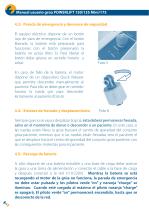
Manual usuario grúa POWERLIFT 150/135 Mini/175 4.3.- Parada de emergencia y descenso de seguridad El equipo eléctrico dispone de un botón rojo de paro de emergencia. Con el botón liberado la batería está preparada para funcionar; con el botón presionado la batería no actúa (foto 5). Para liberar el botón debe girarse en sentido horario y soltar. En caso de fallo de la batería, el motor dispone de un dispositivo Quick Release que permite descender manualmente al paciente. Para ello se debe girar en sentido horario la rueda gris para descender lentamente al paciente (foto 6). 4.4.- Sistema de frenado...
Open the catalog to page 12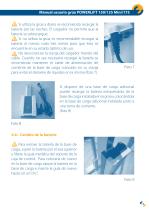
Manual usuario grúa POWERLIFT 150/135 Mini/175 Si utiliza la grúa a diario se recomienda recargar la batería por las noches. El cargador no permite que la batería se sobrecargue. Si no utiliza la grúa es recomendable recargar la batería al menos cada tres meses para que ésta se encuentre en su estado óptimo de uso. No desconectar la clavija del cargador tirando del cable. Cuando no sea necesario recargar la batería se recomienda mantener el cable de alimentación de corriente de la base de carga colocado en su clavija para evitar el derrame de líquidos en la misma (foto 7). Si dispone de una base...
Open the catalog to page 13All Tecnimoem Care S.L catalogs and technical brochures
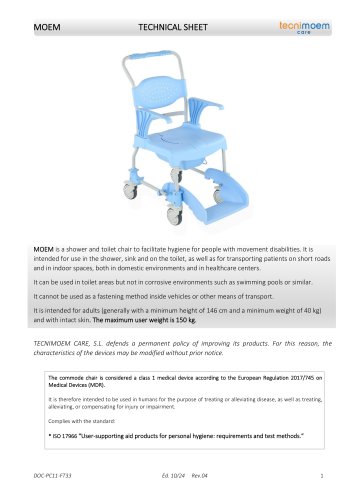 MOEM
MOEM6 Pages
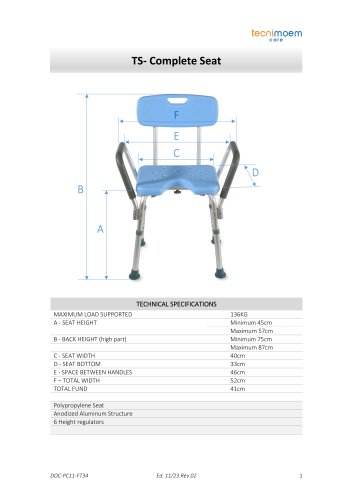 TS- Complete Seat
1 Page
Archived catalogs
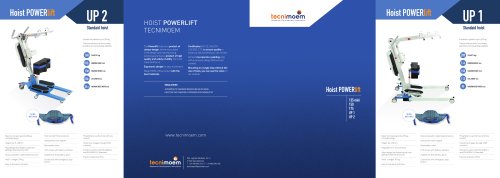 HOISTS
2 Pages
 SHOWERING LINE
2 Pages

- Tecnimoem care hospital bed
- Tecnimoem care tilting bed
- Trendelenburg bed
- Infusion stand
- Hospital bed mattress
- Reverse Trendelenburg bed
- Tecnimoem care medical bed
- Foam mattress
- Patient lifter
- Electric patient lift
- Shower chair
- Bedside table with compartments
- Healthcare facility armchair
- Bedside locker with drawers
- Fixed-height bed
- Patient lift sling
- Shower chair with armrests
- Shower chair with backrest
- Patient lift on casters
- Overbed table on castors