
- Catalogs
- Teledyne DALSA
- Xineos Scanning Family


Xineos Scanning Family
Xineos Scanning Family
- Exceptional low-dose sensitivity and signal-to-noise ratio.
- Over 1,000 fps in ROI binning mode.
- Frame-based imaging enhances depth-of-field for reconstructed 2D images.
- Digital TDI mode allows retrofitting to legacy CCD-TDI systems.
- Gigabit Ethernet data interface, with LVDS option available.
- Dental Panoramic
- Dental Cephalometric
- Bone Densitometry
- Pathology
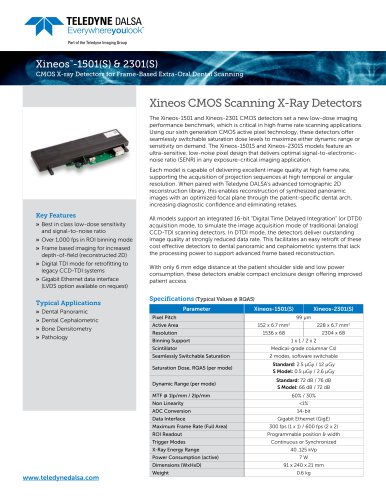
The Xineos-1501 and Xineos-2301 CMOS detectors are designed for high frame rate scanning applications, offering low-dose imaging performance. They utilize sixth-generation CMOS active pixel technology, providing switchable saturation dose levels to optimize dynamic range or sensitivity. These detectors deliver high-quality images at high frame rates, supporting projection sequences with high temporal or angular resolution.
When used with Teledyne DALSA’s tomographic 2D reconstruction library, they enable the creation of synthesized panoramic images with optimized focal planes, enhancing diagnostic confidence and reducing retakes.
In DTDI mode, the detectors simulate traditional CCD-TDI scanning detectors, offering excellent image quality at reduced data rates. This mode is beneficial for retrofitting cost-effective detectors to systems lacking advanced processing power.
- Pixel Pitch: 99 μm
- Active Area: 152 x 6.7 mm2 (1501), 228 x 6.7 mm2 (2301)
- Resolution: 1536 x 68 (1501), 2304 x 68 (2301)
- Binning Support: 1 x 1 / 2 x 2
- Scintillator: Medical-grade columnar CsI
- Saturation Dose: Standard: 2.5 μGy / 12 μGy, S Model: 0.5 μGy / 2.6 μGy
- Dynamic Range: Standard: 72 dB / 76 dB, S Model: 66 dB / 72 dB
- MTF @ 1lp/mm / 2lp/mm: 60% / 30%
- Non-Linearity: <1%
- ADC Conversion: 14-bit
- Data Interface: Gigabit Ethernet (GigE)
- Maximum Frame Rate: 300 fps (1 x 1), 600 fps (2 x 2)
- Power Consumption: 7 W
- Dimensions: 91 x 240 x 21 mm
- Weight: 0.6 kg
The Standard models focus on dynamic range to handle large differences in tissue absorption, while the S-models prioritize sensitivity for exposure-critical applications.
Teledyne DALSA has offices in Waterloo, Canada; Eindhoven, The Netherlands; Tokyo, Japan; and Shanghai, China. Contact details are provided for each region.
Catalog excerpts

CMOS X-ray Detectors for Frame-Based Extra-Oral Dental Scanning Xineos CMOS Scanning X-Ray Detectors The Xineos-1501 and Xineos-2301 CMOS detectors set a new low-dose imaging performance benchmark, which is critical in high frame rate scanning applications. Using our sixth generation CMOS active pixel technology, these detectors offer seamlessly switchable saturation dose levels to maximize either dynamic range or sensitivity on demand. The Xineos-1501S and Xineos-2301S models feature an ultra-sensitive, low-noise pixel design that delivers optimal signal-to-electronicnoise ratio (SENR) in any exposure-critical imaging application. Each model is capable of delivering excellent image quality at high frame rate, supporting the acquisition of projection sequences at high temporal or angular resolution. When paired with Teledyne DALSA’s advanced tomographic 2D reconstruction library, this enables reconstruction of synthesized panoramic images with an optimized focal plane through the patient-specific dental arch, increasing diagnostic confidence and eliminating retakes. Key Features » Best in class low-dose sensitivity and signal-to-noise ratio » Over 1,000 fps in ROI binning mode » Frame based imaging for increased depth-of-field (reconstructed 2D) » Digital TDI mode for retrofitting to legacy CCD-TDI systems » Gigabit Ethernet data interface (LVDS option available on request) Typical Applications » Dental Panoramic » Dental Cephalometric » Bone Densitometry » Pathology All models support an integrated 16-bit “Digital Time Delayed Integration” (or DTDI) acquisition mode, to simulate the image acquisition mode of traditional (analog) CCD-TDI scanning detectors. In DTDI mode, the detectors deliver outstanding image quality at strongly reduced data rate. This facilitates an easy retrofit of these cost effective detectors to dental panoramic and cephalometric systems that lack the processing power to support advanced frame based reconstruction. With only 6 mm edge distance at the patient shoulder side and low power consumption, these detectors enable compact enclosure design offering improved patient access. Specifications (Typical Values @ RQA5) Parameter Pixel Pitch Active Area Binning Support Seamlessly Switchable Saturation 2 modes, software switchable Saturation Dose, RQA5 (per mode) Dynamic Range (per mode) MTF @ 1lp/mm / 2lp/mm Non Linearity ADC Conversion Data Interface Maximum Frame Rate (Full Area) ROI Readout Trigger Modes X-Ray Energy Range Power Consumption (active) Dimensions (WxHxD) Standard: 72 dB / 76 dB S Model: 66 dB / 72 dB 60% / 30% <1% 14-bit Gigabit Ethernet (GigE) 300 fps (1 x 1) / 600 fps (2 x 2) Programmable position & width Continuous or Synchronized 40..125 kVp 7W 91 x
Open the catalog to page 1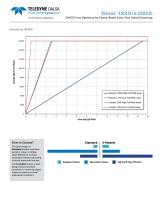
CMOS X-ray Detectors for Frame-Based Extra-Oral Dental Scanning How to Choose? The pixel design of Standard models prioritizes dynamic range, to bridge large differences in tissue absorption without saturating clinically important features. The S-models feature a pixel design which prioritizes sensitivity, to maximize signal output in exposure critical application conditions. Readout Noise Saturation Dose Signal/X-Ray Photon
Open the catalog to page 2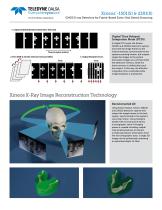
CMOS X-ray Detectors for Frame-Based Extra-Oral Dental Scanning Digital Time Delayed Integration Mode (DTDI) In Digital TDI mode, the Xineos1501(S) and 2301(S) detectors capture and write full image frames to the internal memory, synchronized to the systems scanning motion, but outputs single line images to the system. Successive images are summed inside the detectors memory, while the frame memory is shifted after each line output. In this way, the effective integration time is extended while image sharpness is maintained. Xineos X-Ray Image Reconstruction Technology Reconstructed 2D Using frame...
Open the catalog to page 3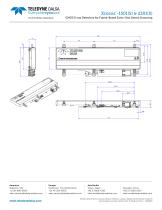
CMOS X-ray Detectors for Frame-Based Extra-Oral Dental Scanning Americas Waterloo, ON +1 519-886-6000 [email protected] Europe Eindhoven, The Netherlands +31 40-259-9000 [email protected] Asia Pacific Tokyo, Japan +81 3-5960-6353 [email protected] Shanghai, China +86 21-3368-0027 [email protected] Teledyne DALSA has its corporate offices in Waterloo, Canada. Teledyne DALSA reserves the right to make changes at any time without notice. © Teledyne DALSA. | 20200825
Open the catalog to page 4All Teledyne DALSA catalogs and technical brochures
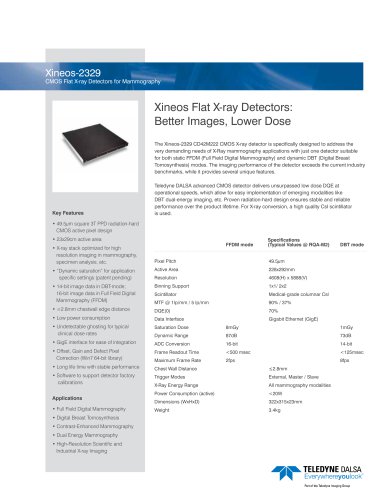 Xineos-2329
2 Pages
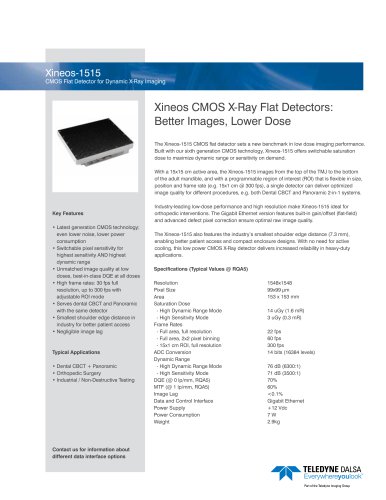 Xineos-1515 Gige
2 Pages
- Flat panel detector
- CMOS camera
- Multipurpose radiography flat panel detector
- Medical camera
- LED camera
- Inspection camera
- Fluoroscopy flat panel detector
- Mobile camera
- Camera for life sciences applications
- Infrared camera
- Mammography flat panel detector
- Panoramic radiography flat panel detector
- Cephalometric radiography flat panel detector