


- Company
- Products
- Catalogs
- News & Trends
- Exhibitions
What ski to use on my sitski
What ski to use on my sitski
This document provides guidance on selecting skis and bindings for sitski equipment, specifically Uniski and Dualski, and offers recommendations for ski edge sharpening.
Specifications for Ski Selection
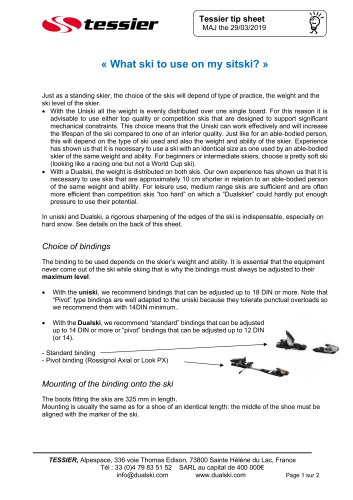
- Uniski: The weight is distributed over a single ski, requiring high-quality or competition skis to withstand mechanical stress. The ski size should match that of an able-bodied skier of similar weight and ability. Beginners should opt for softer skis.
- Dualski: Weight is distributed over two skis, and skis should be approximately 10 cm shorter than those used by able-bodied skiers of similar weight and ability. Medium-range skis are recommended for leisure use.
Binding Recommendations
- Uniski: Bindings should be adjustable up to 18 DIN or more, with "Pivot" type bindings recommended for their ability to handle overloads.
- Dualski: Standard bindings adjustable up to 14 DIN or "Pivot" bindings adjustable up to 12 or 14 DIN are recommended.
Mounting of Bindings
The boots used are 325 mm in length, and the mounting should align the middle of the shoe with the ski marker.
Sharpening the Edges of the Ski
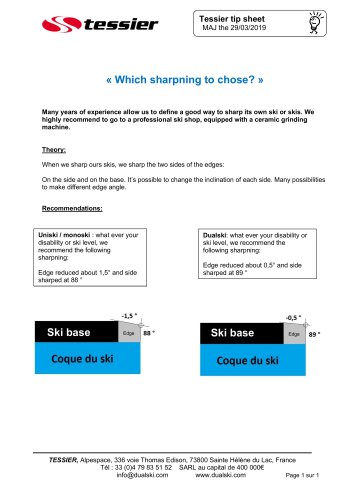
Both sides of the ski edge should be sharpened. Recommended angles are:
- Dualski: 89° on the side and 0.5° on the base side.
- Uniski: 88° on the side and between 0.5° and 2° on the base side.
- For skiers with high levels of injury, a base side angle of 1.5° or 2° and an external side angle of 88° are advised to facilitate edging.
Catalog excerpts
« What ski to use on my sitski? » Just as a standing skier, the choice of the skis will depend of type of practice, the weight and the ski level of the skier. • With the Uniski all the weight is evenly distributed over one single board. For this reason it is advisable to use either top quality or competition skis that are designed to support significant mechanical constraints. This choice means that the Uniski can work effectively and will increase the lifespan of the ski compared to one of an inferior quality. Just like for an able-bodied person, this will depend on the type of ski used and also the weight and ability of the skier. Experience has shown us that it is necessary to use a ski with an identical size as one used by an able-bodied skier of the same weight and ability. For beginners or intermediate skiers, choose a pretty soft ski (looking like a racing one but not a World Cup ski). • With a Dualski, the weight is distributed on both skis. Our own experience has shown us that it is necessary to use skis that are approximately 10 cm shorter in relation to an able-bodied person of the same weight and ability. For leisure use, medium range skis are sufficient and are often more efficient than competition skis “too hard” on which a “Dualskier” could hardly put enough pressure to use their potential. In uniski and Dualski, a rigorous sharpening of the edges of the ski is indispensable, especially on hard snow. See details on the back of this sheet. Choice of bindings The binding to be used depends on the skier’s weight and ability. It is essential that the equipment never come out of the ski while skiing that is why the bindings must always be adjusted to their maximum level. • With the uniski, we recommend bindings that can be adjusted up to 18 DIN or more. Note that “Pivot” type bindings are well adapted to the uniski because they tolerate punctual overloads so we recommend them with 14DIN minimum.. With the Dualski, we recommend “standard” bindings that can be adjusted up to 14 DIN or more or “pivot” bindings that can be adjusted up to 12 DIN (or 14). - Standard binding - Pivot binding (Rossignol Axial or Look PX) Mounting of the binding onto the ski The boots fitting the skis are 325 mm in length. Mounting is usually the same as for a shoe of an identical length: the middle of the shoe must be aligned with the marker of the ski. TESSIER, Alpespace, 336 voie Thomas Edison, 73800 Sainte Hélène du Lac, France Tél : 33 (0)4 79 83 51 52 SARL au capital de 400 000€ info@dualsk
Open the catalog to page 1
Sharpening the edges of the ski It’s important to have both side of the edge sharped. Base side and external side. It’s possible to make different angle of each side. For our equipment we advise to sharp like this: For Dualski: 89° on the side and 0.5°on base side For Uniski: 88° on the side and between 0,5°and 2°on base side For skier with high level of injury, we advise to sharp the base side at 1,5° or 2° to facilitate the edging and to sharp the external side at 88°. TESSIER, Alpespace, 336 voie Thomas Edison, 73800 Sainte Hélène du Lac, France Tél : 33 (0)4 79 83 51 52 SARL au capital de...
Open the catalog to page 2All TESSIER catalogs and technical brochures
 Tessier catalogue 2026
40 Pages
 Which sharpning to chose
1 Page
Archived catalogs
 Adaptive Outdoor Sport Equipment
32 Pages