
- Catalogs
- Thermo Scientific
- Acclaim Bonded Silica-Based Columns for HPLC


Acclaim Bonded Silica-Based Columns for HPLC

Acclaim Bonded Silica-Based Columns for HPLC
Orders in the U.S. can be placed via credit card, blanket orders, or emergency orders. A minimum of $50 is required for credit card orders. Outside the U.S., customers should contact their local Dionex representative. Orders for consumables are typically shipped within two working days, with shipping FOB Sunnyvale, CA.
Dionex Acclaim columns are silica-based and designed for high-efficiency separations. They include conventional C8 and C18 phases, polar embedded phases, and specialty phases for specific applications, all manufactured to tight specifications for consistent performance.
- Acclaim 120: For small molecule separations, compatible with high organic mobile phases.
- Acclaim 300: For macromolecule applications, ideal for proteins and peptides.
- Acclaim PA: Polar-embedded columns for a wide range of analytes, compatible with 100% aqueous mobile phases.
- Acclaim PA2: Enhanced hydrolytic stability, suitable for both polar and nonpolar analytes.
- Acclaim OA: For fast organic acid analysis.
- Acclaim Surfactant: For separation of surfactants in various matrices.
- Acclaim Explosives: Designed for EPA Method 8330, providing baseline resolution of explosives.
Consider the goals of the separation, silica characteristics, column format, and stationary phase chemistry. Selectivity depends on the nature of the desired separation.
- Stationary Phases: C8 and C18 phases for hydrophobic properties and low ion-exchange activity.
- Hydrophobicity: Acclaim C18 and C8 columns provide almost pure reversed-phase behavior.
- Ion-exchange Activity: Low ion-exchange activity ensures reliable separations.
- Molecular Shape and Secondary Interactions: Influence separation efficiency.
- Particle Size: Smaller particles offer higher efficiency and resolution but result in higher backpressure.
- Pore Size and Surface Area: Pore size should match the molecular weight of analytes.
- Column Format: Select column length and diameter based on analysis requirements.
Use high-quality water, solvents, and buffers to extend column life. Avoid extreme pH conditions.
Acclaim columns are rigorously tested for quality and reliability.
The document provides guidance on selecting and using Acclaim columns for chromatography, emphasizing the importance of understanding interactions and characteristics of different phases.
- Acclaim 120 C8 Columns: Optimized for HPLC, available in various dimensions and particle sizes.
- Acclaim 300 C18 Columns: For high-resolution peptide mapping and protein separations.
- Acclaim PolarAdvantage (PA) Columns: Polar-enhanced stationary phase suitable for a wide range of conditions.
Acclaim 300 C18 columns provide high efficiency and retention time stability. Acclaim PA columns offer high selectivity and resistance to dewetting.
Columns are available in various dimensions and particle sizes, with guard cartridges recommended for protection.
Suitable for LC/MS applications, with optimal performance under specific conditions.
Silica-based, reversed-phase columns with enhanced hydrolytic stability.
Optimized for the separation of organic acids at low pH, ideal for food and beverage analysis.
Detailed methodologies for the chromatographic analysis of pharmaceutical compounds and environmental contaminants using different types of Acclaim columns.
Emphasizes the importance of column specifications, mobile phase composition, and detection techniques for optimal analysis.
Technical index and product overview from Dionex Corporation, detailing various chemical compounds and chromatography systems.
- Analyte Index: List of chemical compounds and their respective page numbers.
- Appendix: Contact information for Dionex Corporation's offices.
- Product Information: Describes Dionex's chromatography systems.
- Awards and Recognition: Awards won by Dionex products.
Catalog excerpts
Bonded Silica-Based Columns for HPLC Thermo Scientific brand
Open the catalog to page 1
Ordering and Warranty Information In the U.S. Acclaim 120 Acclaim 300 Acclaim PA/PA2 Acclaim OA All Orders Including: • Credit Card Orders (VISA, American Express, MasterCard) • Blanket Orders • Emergency Orders Call 1-800-Dionex-0 (1-800-346-6390) or Acclaim 120 Acclaim PA Acclaim Explosives FAX 1-408-736-4476 Ordering by Credit Card Dionex accepts payment by MasterCard, VISA, and American Express cards with minimum orders of $50.00. Call 1-800-DIONEX-0 (1-800-346-6390) for more information. Blanket Orders Acclaim OA Acclaim PA/PA2 Acclaim 120 Dionex will arrange for blanket orders with a specified...
Open the catalog to page 2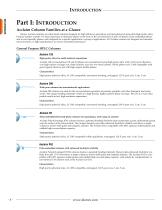
Introduction INTRODUCTION Par I: Introduction t Acclaim Column Families at a Glance Dionex Acclaim columns are silica-based columns designed for high efficiency separations and manufactured using ultra-high purity silica. Product families consists of a broad spectrum of stationary phases in the form of the conventional C8 and C18 phases. polar embedded phases. and several specialty phases, each designed for a specific application or group of applications. All Acclaim columns are designed and manufactured at Dionex, to tight specifications, to ensure consistent performance. General Purpose HPLC...
Open the catalog to page 4
Dionex phase Bonded phase Ultrapure silica Ultrapure silica Ultrapure silica Ultrapure silica Ultrapure silica Particle shape Particle size Average pore diameter Total carbon content Acclaim General Purpose Column Specifications Acclaim Specialty Column Specifications Specialty HPLC Columns Dionex phase Acclaim Surfactant Bonded phase na na Specialty column for fast organic acid analysis Yes Yes Endcapped Substrate Particle shape Particle size The Acclaim OA column features a patented polar-embedded stationary phase optimized and use tested for hydrophilic Ultrapure silica Ultrapure OA Ultrapure...
Open the catalog to page 5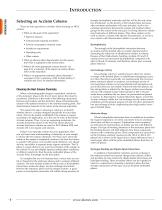
Introduction INTRODUCTION Selecting an Acclaim Column There are four questions to consider when choosing an HPLC column: 1. What are the goals of the separation? • Speed of analysis • Critical peaks requiring resolution strongly hydrophobic molecules and this will be the only retention mechanism. As the density of the bonded phase decreases, other retention mechanisms will come into play, such as ion exchange interactions between the sample and residual silanol groups on the surface of the silica gel, or sieving effects for similar sized molecules of different shapes. Thus, these studies can...
Open the catalog to page 6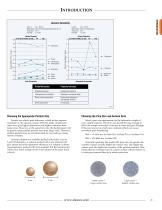
Introduction INTRODUCTION Acclaim Selectivity Column: Mobile Phase: Temperature: Flow Rate: 4.6 × 150 mm 49/51 w/w methanol/phosphate buffer, pH 7.0 40 °C 1 mL/min Column: Mobile Phase: Temperature: Flow Rate: Ethyl benzoate Dimethylaniline 0.4 Phenol Aniline Pyridine Retention Time Relative to Toluene Relative Retention Time vs Toluene o-Terphenyl 2 Ethylbenzene Toluene Hydrophobic Compounds Probe Molecules Property Indicator Hydrophobic interaction Selectivity for molecular shape Phenol, aniline and pyridine Dipole-dipole interactions and hydrogen bonding Choosing the Appropriate Particle Size...
Open the catalog to page 7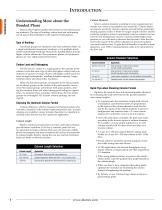
Introduction INTRODUCTION Understanding More about the Bonded Phase Column Diameter Dionex offers highest quality silica-based reversed phase packing materials. The type of bonding, carbon load and endcapping are all factors that contribute to the superior bonded phase. Type of Bonding Functional groups are attached to the silica substrate either via a single attachment (monomeric bonding), or via multiple attachments (multidentate bonding). Monomeric bonded phases provide higher column efficiencies, than polymeric phases, but polymeric phases are very stable under pH extremes. Select a column...
Open the catalog to page 8
The effect of mobile phase composition on column lifetime should be part of the consideration for designing a method. Use the highest practical quality of water, solvent, and buffer components; HPLC-grade material has low UV absorbance and is submicron-filtered by the manufacturer. To prevent fouling of your Acclaim column, use mobile phases that have been filtered through a 0.5-µm or smaller filter. Both alkaline conditions and strong acid conditions will degrade silica-based columns over time. The silica substrate resists acids, but is soluble in alkali. The upper pH limit is determined by...
Open the catalog to page 9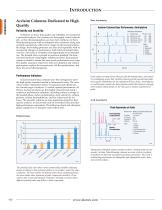
Introduction INTRODUCTION Acclaim Columns Dedicated to High Quality Base Asymmetry Acclaim Columns Base Performance: Amitriptyline Reliability and Durability At Dionex we know that quality and reliability are essential to a successful analysis. Our columns are thoroughly tested individually, so that chromatographers can have full confidence in them. Manufacturing starts with an ultrapure silica substrate, using only carefully selected lots with narrow ranges of physical parameters. By design, the bonding processes are clean and repeatable with no unexpected changes in performance. Each batch...
Open the catalog to page 10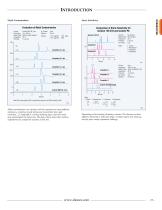
Introduction Steric Selectivity Evaluation of Metal Contamination Column: Dimensions: Mobile Phase: Temperature: Flow Rate: Comparison of Steric Selectivity for Acclaim 120 C18 and Acclaim PA Acclaim 300 C18, 3 µm 4.6 × 150 mm 50/50 v/v water/methanol 30 °C 1.0 mL/min Columns: Mobile Phase: Temperature: Flow Rate: Inj. Volume: 1. Toluene 2. Phenanthrene 3. o-Terphenyl 4. Triphenylene Column: Dimensions: Mobile Phase: Temperature: Flow Rate: Inj. Volume: Detection: As indicated 90% methanol 30 °C 1 mL/min 5 µL Metal Contamination Peaks: 1. Toluene 2. Phenanthrene 3. o–Terphenyl 4. Triphenylene...
Open the catalog to page 11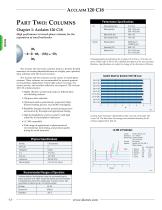
Performance Specifications Polar selectivity ratio Base asymmetry High performance reversed-phase columns for the separation of small molecules Metal activity ratio Steric selectivity ratio Retention time Chromatographic specifications for Acclaim 120 C18 4.6 × 150 mm columns. Please refer to Part 4 for a detailed description of the tests and specifications. Specifications are subject to change at the discretion of Dionex. The Acclaim 120 C18 series columns feature a densely bonded monolayer of octadecyldimethylsiloxane on a highly pure, spherical, silica substrate with 120 Å pore structure....
Open the catalog to page 12All Thermo Scientific catalogs and technical brochures
 Nunc Cell Factory systems
12 Pages
 CryoStar NX50
2 Pages
 MSC-Advantage BSC
54 Pages
 Multifuge
58 Pages
 Thermo Scientific Pico 17 / 21
52 Pages
 CO2 Incubator HERAcell 150 i / 240 i
196 Pages
 Revco® Blood Bank Refrigerators
37 Pages
 Multidrop Combi nL
4 Pages
 Forma Environmental Chambers
25 Pages
 MaxQ 6000
40 Pages
 Multi Tube Rotator
13 Pages
 picoSpin Spectrometer
6 Pages
 1300 Series A2
76 Pages
 CO2 Incubator Family
28 Pages
 CO2 incubators
7 Pages
 MaxQ Mini 4450 Shaker
40 Pages
 E1-ClipTip Electronic Pipette
108 Pages
 Varioskan™ LUX
54 Pages
 ISQ Series Mass Spectrometers
412 Pages
 Q Exactive™ BioPharma
16 Pages
 Q Exactive Plus
4 Pages
 LTQ XL™
4 Pages
 Platinum DNA polymerases
6 Pages
 -80°C Benchtop Freezer
2 Pages
 Nicolet iS10 FT-IR Spectrometer
12 Pages
 Ion S5 and Ion S5 XL Systems
2 Pages
 SureTect Range
4 Pages
 QuantStudio™ 3
8 Pages
 Furnaces
2 Pages
 Nunc Serological Pipettes
3 Pages
![Vanquish Duo UHPLC System [ZH]](https://img.medicalexpo.com/pdf/repository_me/78678/vanquish-duo-uhplc-system-zh-191145_1mg.jpg) Vanquish Duo UHPLC System [ZH]
Vanquish Duo UHPLC System [ZH]12 Pages
 native MS
16 Pages
 Compound Discoverer Software
12 Pages
 Vanquish Horizon UHPLC System
16 Pages
 Thermo Scientific TSQ Duo
9 Pages
 Thermo Scientific TSQ 8000 Evo
16 Pages
 Heraeus Labofuge 300
2 Pages
 Heraeus Cryofuge 5500i
8 Pages
 Heraeus Clinifuge Centrifuge
2 Pages
 Vials and Closures Catalog 2014-2015
128 Pages
 RM 200 EG
4 Pages
 Darwin LIMS
2 Pages
 Immunohistory Solutions
292 Pages
 Process Water Products Catalog
68 Pages
 Technical Training Catalog
15 Pages
 FBS Alternatives
8 Pages
 Pierce Magnetic Beads
16 Pages
 interactive catalog today
222 Pages
 HERAGUARD HPH clean benches
2 Pages
 MBC 240 Bench Top Analyzer
4 Pages
 Konelab 20
2 Pages
 Indiko
6 Pages


![ISQ 7000 Single Quadrupole GC-MS System VPI [ZH]](https://img.medicalexpo.com/pdf/repository_me/78678/isq-7000-single-quadrupole-gc-ms-system-vpi-zh-191148_1mg.jpg)
![ISQ 7000 Single Quadrupole GC-MS System [ZH]](https://img.medicalexpo.com/pdf/repository_me/78678/isq-7000-single-quadrupole-gc-ms-system-zh-191147_1mg.jpg)


![Thermo Scientific Herasafe KS and KSP Class II Biological Safety Cabinets [EN]](https://img.medicalexpo.com/pdf/repository_me/78678/thermo-scientific-herasafe-ks-ksp-class-ii-biological-safety-cabinets-en-85081_1mg.jpg)


Archived catalogs
 Nunc Cell Factory systems
8 Pages
- Vertical refrigerator
- Laboratory refrigerator
- 1-door refrigerator
- Automatic defrost refrigerator
- Electric refrigerator
- Laboratory incubator
- Refrigerator with glass door
- Laboratory centrifuge
- Benchtop centrifuge
- Laboratory agitator
- Sample tube
- Stainless steel refrigerator
- Blood centrifuge
- Sample preparation system
- Laboratory test tube
- Automatic sample processor
- Clinical chemistry analyzer
- Temperature-control laboratory incubator
- Heating oven
- Laboratory oven