
- Catalogs
- Thermo Scientific
- Improved Electron Transfer Dissociation (ETD) Duty Cycle and Spectral Signal to Noise Ratio in a Dual Cell Linear Ion Trap


Improved Electron Transfer Dissociation (ETD) Duty Cycle and Spectral Signal to Noise Ratio in a Dual Cell Linear Ion Trap

Improved Electron Transfer Dissociation (ETD) Duty Cycle and Spectral Signal to Noise Ratio in a Dual Cell Linear Ion Trap
The document focuses on enhancing the Electron Transfer Dissociation (ETD) Signal to Noise (S/N) ratio and scan duty cycle using the Thermo Scientific™ Orbitrap Fusion™ Tribrid™ mass spectrometer with the EASY-ETD™ ion source. The proposed methodology involves multiple fills of ETD products into a storage cell followed by a single m/z analysis, which improves spectral S/N ratio and acquisition speed.
Introduction
ETD is crucial for analyzing polypeptides, especially those with labile post-translational modifications (PTMs) and large proteins. However, it traditionally reduces scan duty cycle and total MS2 ion signal. This research addresses these limitations by implementing multiple ETD reactions per m/z analysis in a dual cell linear ion trap.
Methods
The multi-fill per m/z analysis scan mode utilizes the high pressure trap (HPT) for reactions and the low pressure trap (LPT) for accumulation and m/z analysis. This involves multiple ETD reactions, transfers, and storage cycles, followed by a single m/z analysis. Experiments were conducted on an Orbitrap Fusion Tribrid MS.
Results
The ETD reaction in the HPT requires cation precursor sequestration to allow reagent anion injection. The space charge capacity limits the number of cation precursor charges per ETD reaction. The study discusses the balance of space charge forces and RF focusing forces, leading to a plateau in ETD product yield. Figures illustrate aspects such as ETD product ion yield, the ETD multiple fills approach, and scan acquisition time comparisons.
Conclusions
- Single fill ETD is limited by space charge capacity.
- Sequestration conditions during ETD must minimize collision-induced dissociation.
- The multiple fills methodology enhances S/N ratio and acquisition speed.
- Parallel operation of analyzers in the Orbitrap Fusion Tribrid MS allows faster high S/N ratio spectra acquisition.
References
The document references foundational research in mass spectrometry and ETD methodologies, including works by Tolmachev et al., Sannes-Lowery et al., Rose et al., and Earley et al.
Catalog excerpts

Improved Electron Transfer Dissociation (ETD) Duty Cycle and Spectral Signal to Noise Ratio in a Dual Cell Linear Ion Trap Christopher Mullen,1 Lee Earley,1 Jean-Jacques Dunyach,1 John E.P. Syka,1 Jeffrey Shabanowitz, 2 A. Michelle English, 2 Donald F. Hunt2 1 Thermo Fisher Scientific, San Jose, CA; 2 Department of Chemistry, University of Virginia, Charlottesville, VA
Open the catalog to page 1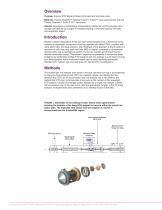
Methods: Thermo Scientific™ Orbitrap Fusion™ Tribrid™ mass spectrometer with the Thermo Scientific™ EASY-ETD™ ion source. Performing the ETD reaction in cation precursor population to the reagent anion species can independent trapping (CSIT) a number of cation precursor ch function of the space charge c Figure 2 shows the potentials injection events and the relativ Purpose: Improve ETD Signal to Noise (S/N) ratio and scan duty cycle. Results: Developed a methodology incorporating multiple fills of ETD products into a storage cell followed by a single m/z analysis leading to improved spectral...
Open the catalog to page 2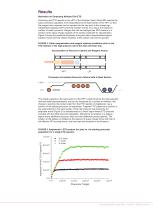
Motivation for Employing Multiple Fills ETD ated to be a useful tool for the with labile PTM’s, peptides with he approach is that it leads to a al, compared to conventional action and the fact that the possibility to circumvent these z analysis in a 2D linear ion trap ss resolving quadrupole, OT-LT) architecture. linear ion trap is accomplished sel, and utilizing the low is cell. In this fashion, the e number of fills requested) a single m/z analysis in either priate transfer, in the OT mass p Fusion Tribrid MS. FIGURE 2. Cation sequestration and reagent injection conditions prior to the ETD...
Open the catalog to page 3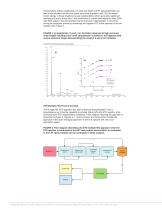
jection conditions prior to the ual cell linear trap FIGURE 4. a) Angiotensin I b and y ion formation observed at high precursor initial targets resulting from harsh sequestration conditions. b) Fragment yield versus precursor target demonstrating the onset of b and y ion formation. AngioVsTarget_ETD_50msec #548 RT: 2.58 AV: 1 NL: 6.18E5 T: FTMS + p ESI Full ms2 [email protected] [150.0000-1500.0000] Relative Abundance ations Held In Back Section T is determined by the axial potential ured by a number of methods. We reaction of Angiotensin I as a ragment TIC plotted as a function of ressure trap...
Open the catalog to page 4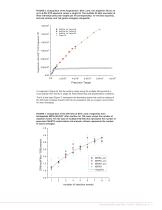
FIGURE 6. Comparison of the Angiotensin I ETD c and z ion fragment TIC for an up to 8-fills ETD approach versus a single fill. The multiple fill data was taken at three individual precursor targets per fill corresponding to 1e4 (blue squares), 5e4 (red circles), and 1e5 (green triangles) charges/fill. erved at high precursor ditions. b) Fragment yield and y ion formation. ea vs. Precursor Target . Rxn Time = 70 msec rsor = Angio3+ zer = Orbitrap It is apparent (Figure 6) that the working range using the multiple fills approach is much greater than that for a single fill, while preserving soft...
Open the catalog to page 5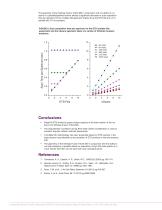
nd z ion fragment TIC for an multiple fill data was taken at ding to 1e4 (blue squares), fill. The geometry of the Orbitrap Fusion Tribrid MS in conjunction with it’s ability to run scans in a parallel/pipelined fashion affords a significant decrease in scan acquisition time per spectrum for the multiple fills approach (Figure 8) as the ETD fills are run in parallel with OT m/z analysis. FIGURE 8. Scan acquisition time per spectrum for the ETD multiple fills experiment and the uScans approach taken at a variety of Orbitrap transient durations. Scan Time per Spectrum (sec) e multiple fills approach...
Open the catalog to page 6
www.thermoscientific.com ©2014 Thermo Fisher Scientific Inc. All rights reserved. ISO is a trademark of the International Standards Organization. All other trademarks are the property of Thermo Fisher Scientific and its subsidiaries. This information is presented as an example of the capabilities of Thermo Fisher Scientific products. It is not intended to encourage use of these products in any manners that might infringe the intellectual property rights of others. Specifications, terms and pricing are subject to change. Not all products are available in all countries. Please consult your local...
Open the catalog to page 7All Thermo Scientific catalogs and technical brochures
 Nunc Cell Factory systems
12 Pages
 CryoStar NX50
2 Pages
 MSC-Advantage BSC
54 Pages
 Multifuge
58 Pages
 Thermo Scientific Pico 17 / 21
52 Pages
 CO2 Incubator HERAcell 150 i / 240 i
196 Pages
 Revco® Blood Bank Refrigerators
37 Pages
 Multidrop Combi nL
4 Pages
 Forma Environmental Chambers
25 Pages
 MaxQ 6000
40 Pages
 Multi Tube Rotator
13 Pages
 picoSpin Spectrometer
6 Pages
 1300 Series A2
76 Pages
 CO2 Incubator Family
28 Pages
 CO2 incubators
7 Pages
 MaxQ Mini 4450 Shaker
40 Pages
 E1-ClipTip Electronic Pipette
108 Pages
 Varioskan™ LUX
54 Pages
 ISQ Series Mass Spectrometers
412 Pages
 Q Exactive™ BioPharma
16 Pages
 Q Exactive Plus
4 Pages
 LTQ XL™
4 Pages
 Platinum DNA polymerases
6 Pages
 -80°C Benchtop Freezer
2 Pages
 Nicolet iS10 FT-IR Spectrometer
12 Pages
 Ion S5 and Ion S5 XL Systems
2 Pages
 SureTect Range
4 Pages
 QuantStudio™ 3
8 Pages
 Furnaces
2 Pages
 Nunc Serological Pipettes
3 Pages
![Vanquish Duo UHPLC System [ZH]](https://img.medicalexpo.com/pdf/repository_me/78678/vanquish-duo-uhplc-system-zh-191145_1mg.jpg) Vanquish Duo UHPLC System [ZH]
Vanquish Duo UHPLC System [ZH]12 Pages
 native MS
16 Pages
 Compound Discoverer Software
12 Pages
 Vanquish Horizon UHPLC System
16 Pages
 Thermo Scientific TSQ Duo
9 Pages
 Thermo Scientific TSQ 8000 Evo
16 Pages
 Heraeus Labofuge 300
2 Pages
 Heraeus Cryofuge 5500i
8 Pages
 Heraeus Clinifuge Centrifuge
2 Pages
 Vials and Closures Catalog 2014-2015
128 Pages
 RM 200 EG
4 Pages
 Darwin LIMS
2 Pages
 Immunohistory Solutions
292 Pages
 Process Water Products Catalog
68 Pages
 Technical Training Catalog
15 Pages
 FBS Alternatives
8 Pages
 Pierce Magnetic Beads
16 Pages
 interactive catalog today
222 Pages
 HERAGUARD HPH clean benches
2 Pages
 MBC 240 Bench Top Analyzer
4 Pages
 Konelab 20
2 Pages
 Indiko
6 Pages




![ISQ 7000 Single Quadrupole GC-MS System VPI [ZH]](https://img.medicalexpo.com/pdf/repository_me/78678/isq-7000-single-quadrupole-gc-ms-system-vpi-zh-191148_1mg.jpg)
![ISQ 7000 Single Quadrupole GC-MS System [ZH]](https://img.medicalexpo.com/pdf/repository_me/78678/isq-7000-single-quadrupole-gc-ms-system-zh-191147_1mg.jpg)


![Thermo Scientific Herasafe KS and KSP Class II Biological Safety Cabinets [EN]](https://img.medicalexpo.com/pdf/repository_me/78678/thermo-scientific-herasafe-ks-ksp-class-ii-biological-safety-cabinets-en-85081_1mg.jpg)


Archived catalogs
 Nunc Cell Factory systems
8 Pages
- Vertical refrigerator
- Laboratory refrigerator
- 1-door refrigerator
- Automatic defrost refrigerator
- Electric refrigerator
- Refrigerator with glass door
- Laboratory incubator
- Laboratory centrifuge
- Benchtop centrifuge
- Laboratory agitator
- Sample tube
- Stainless steel refrigerator
- Blood centrifuge
- Sample preparation system
- Laboratory test tube
- Automatic sample processor
- Clinical chemistry analyzer
- Temperature-control laboratory incubator
- Heating oven
- Laboratory oven